archive / post / October 23, 2026
How to Read Anthropic's IPO Filing: Ignore the $80.7B Loss, Watch These 6 Numbers
Anthropic's public filing is due any day. Everyone will quote the same loss. These are the six numbers that will actually tell you whether the fastest-growing company in AI gets to keep its money.
Last updated 22 October 2026. Figures come from Reuters, WSJ and Bloomberg reporting on the draft filing and investor meetings. The public S-1 is expected as early as 23 October; this page will be updated when it lands.
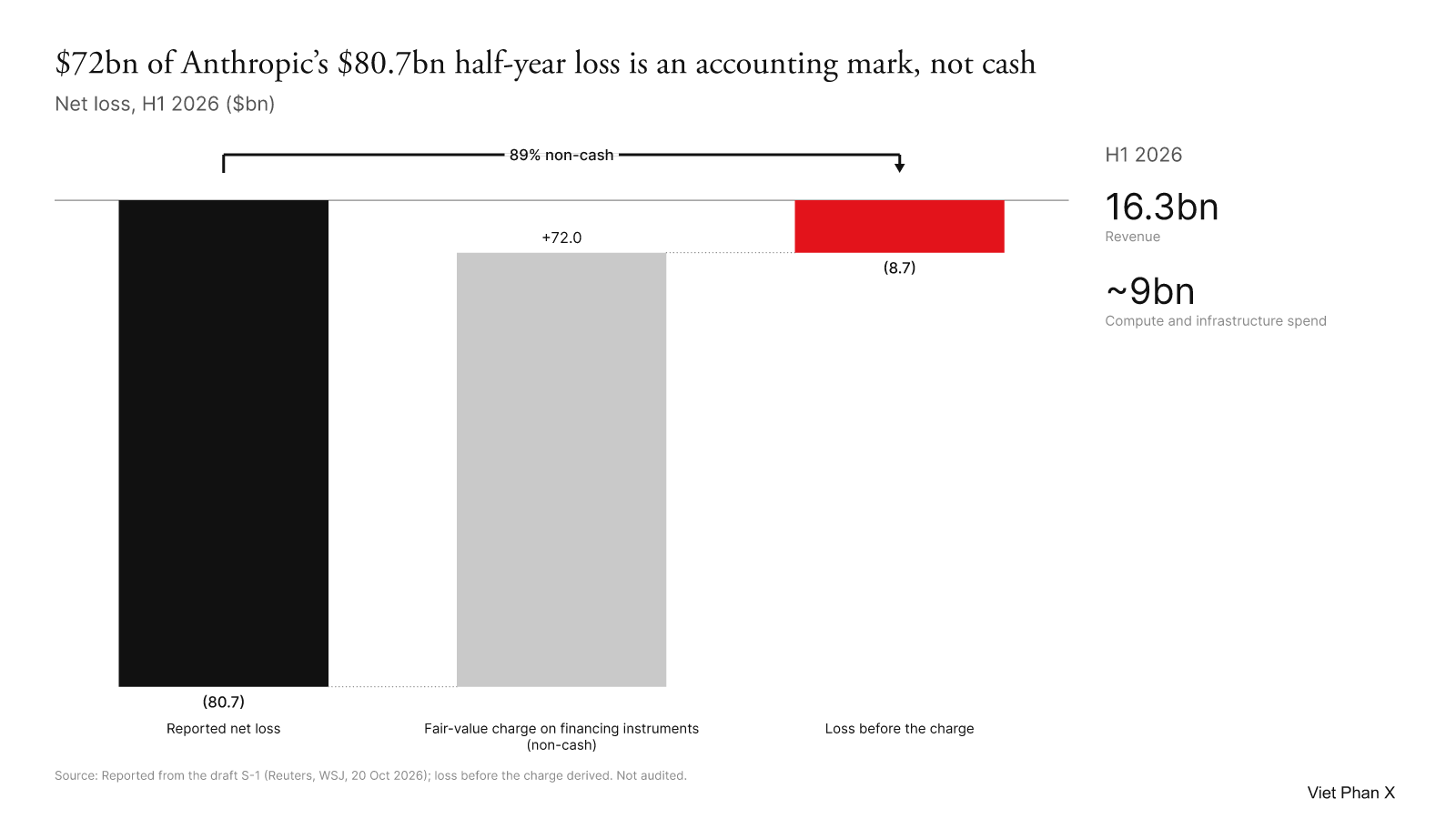
Anthropic lost $80.7 billion in the first six months of 2026.
That number has been all over my feed this week.
And under every post sits the same reply: relax, $72 billion of that is an accounting charge. No cash left the building.
Both sides are right. And both are looking at the wrong number.
If you've seen the headline, you've probably thought something like this:
"Growing fast is easy when you lose money on every sale, right?"
Fair question. But the loss isn't what will decide this IPO. This is:
Anthropic built one of the most wanted products in tech. Can it keep the money that product makes?
When the public filing lands, six numbers answer that.
Quick disclosure: I pay for Claude every month and use it every day. So I'd like this company to work. That's exactly why I want to read its numbers properly.
And the $72 billion? Hold that thought. It comes back in number six.
1. Revenue in Dollars, Not Percentages
Here's the growth, quarter by quarter in 2026, as shared with prospective investors:
- Q1: $4.7B
- Q2: $11.6B
- Q3: $16.8B
Anthropic made more in the last three months than in all of 2025. More than three and a half times more.
But look what happened to the headline. Q2 grew 147%. Q3 grew 45%.
On a chart of percentages, that looks like a crash.
It isn't. Percentages always shrink as the base gets bigger. The honest measure is dollars added per quarter: +$6.9B in Q2, then +$5.2B in Q3.
That is a slowdown. Just a much smaller one than the percentages scream.
It also explains a chart that went viral this month, claiming growth had "flatlined since June" and that SEC financials proved it. The numbers came from a third-party estimate site, not the SEC. Actual Q3 sales rose 45%.
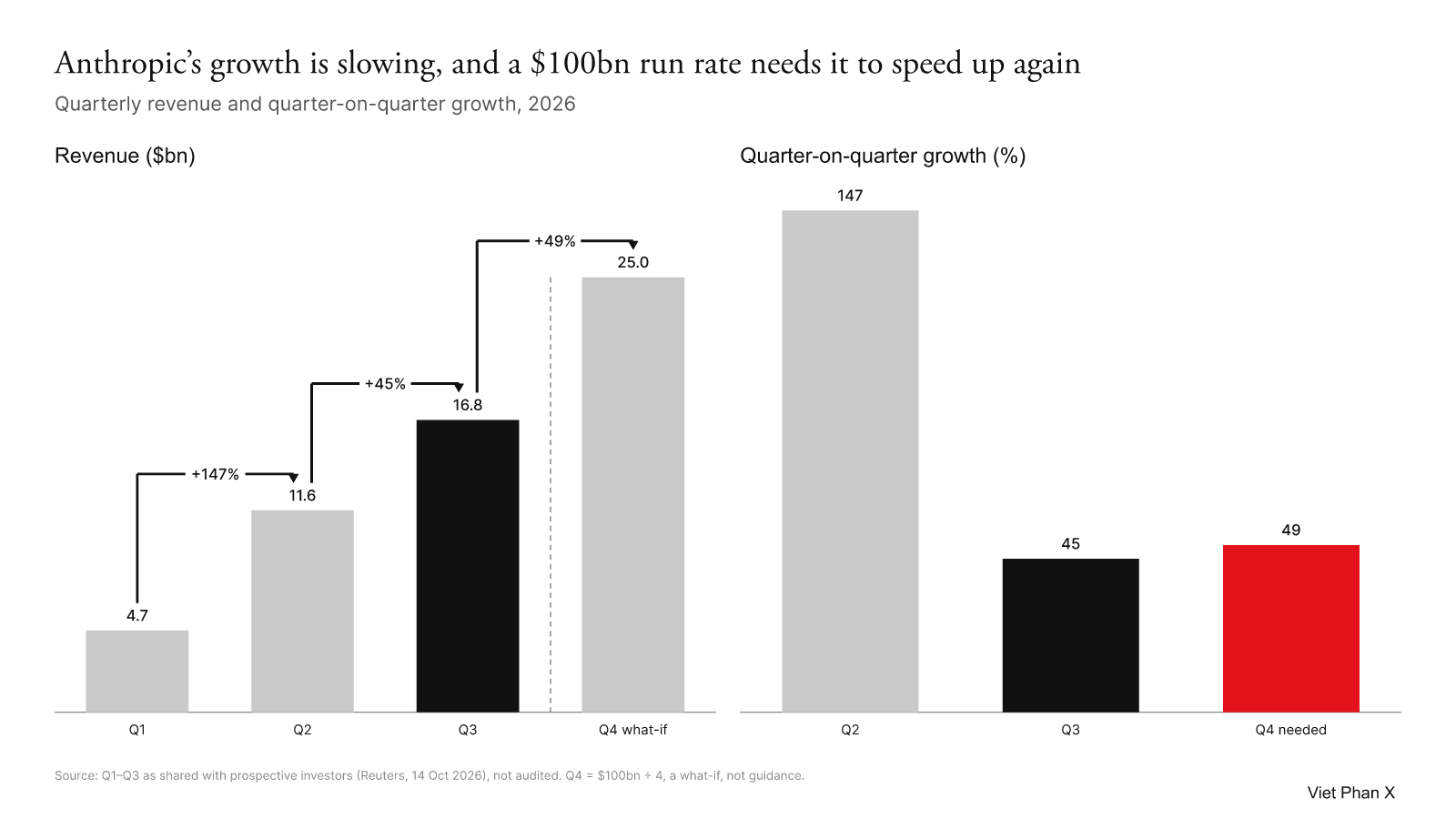
What we know now (22 October): Q1–Q3 revenue, as shared with prospective investors. Estimates for the end-of-year run rate range from $74B to $110B.
What to check in the filing: Q4.
A $100B run rate needs about $25B in Q4. That's $8.2B more than Q3, a bigger jump than any quarter so far. If Q4 adds less than Q3's $5.2B, the deceleration is real.
2. Who the "Two Customers" Really Are
Read the coverage and you might come away thinking:
"Wait, they only have two real customers?"
Not quite. The real number: Anthropic's two largest direct customers made up about 20% of revenue in the first half of 2026. Big, but not "two customers."
The more interesting part is who they might be.
About half of Anthropic's 2025 sales went through cloud partners, according to Reuters. Amazon, Google and Microsoft resell Claude to their own enterprise customers, and one invoice can hide thousands of companies.
The reporting doesn't name the two accounts. But if they are resellers, the risk isn't a customer leaving. It's a middleman with leverage.
Because those same companies sit on every side of the table:
- Supplier: Anthropic has committed $111B to Google Cloud and $110B to AWS for compute.
- Salesman: they distribute Claude to their customers.
- Rival: both build their own AI models.
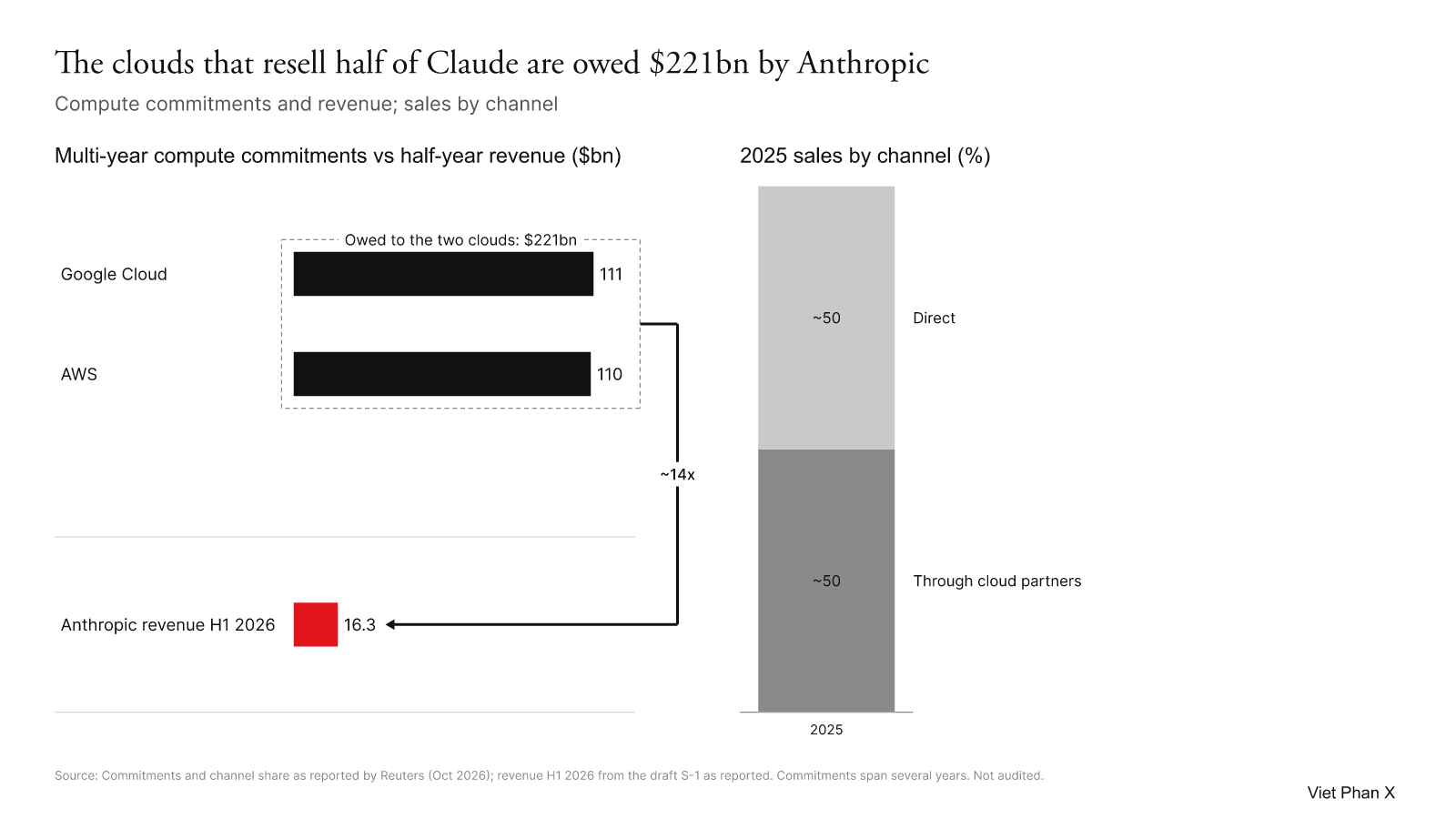
A reseller doesn't need to "churn" to hurt you. It can quietly route its customers' requests to its own model.
What we know now: the two accounts are unnamed; the 50% channel share is a 2025 figure.
What to check in the filing: revenue by channel (direct API, cloud resellers, subscriptions, Claude Code), and whether the top accounts are resellers.
3. How Revenue Gets Counted
You'll see headlines comparing Anthropic's revenue with OpenAI's. Be careful: they may not be counting the same way.
Here's the difference.
When a company buys Claude through Amazon's or Google's cloud, the cloud keeps a cut. Historically, about 16 cents of every dollar.
Anthropic counts the whole dollar as its revenue, and the 16 cents as a cost.
OpenAI, according to Reuters, doesn't count its partner sales that way.
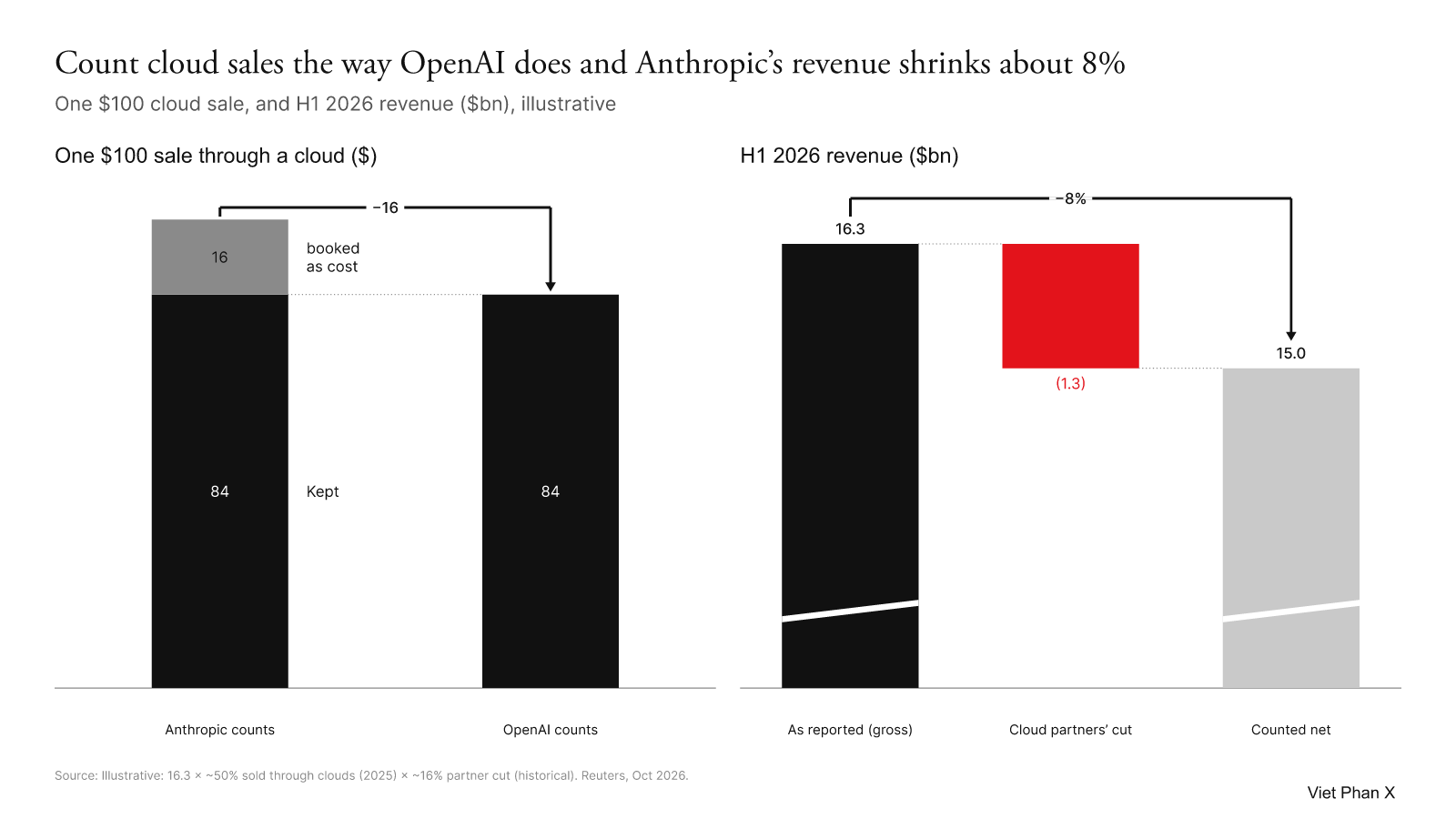
Neither method is wrong. But they produce different headlines from the same sale.
About half of Anthropic's 2025 sales went through clouds. Count those sales net of the cloud's cut, and Anthropic's revenue would be roughly 8% smaller.
So when you read "Anthropic catches up with OpenAI," part of the gap may be how they count, not how much they sell.
What to check in the filing: how much revenue still comes through clouds, and how big their cut is today. The 16% is a historical figure.
4. What's Inside the 85% Margin
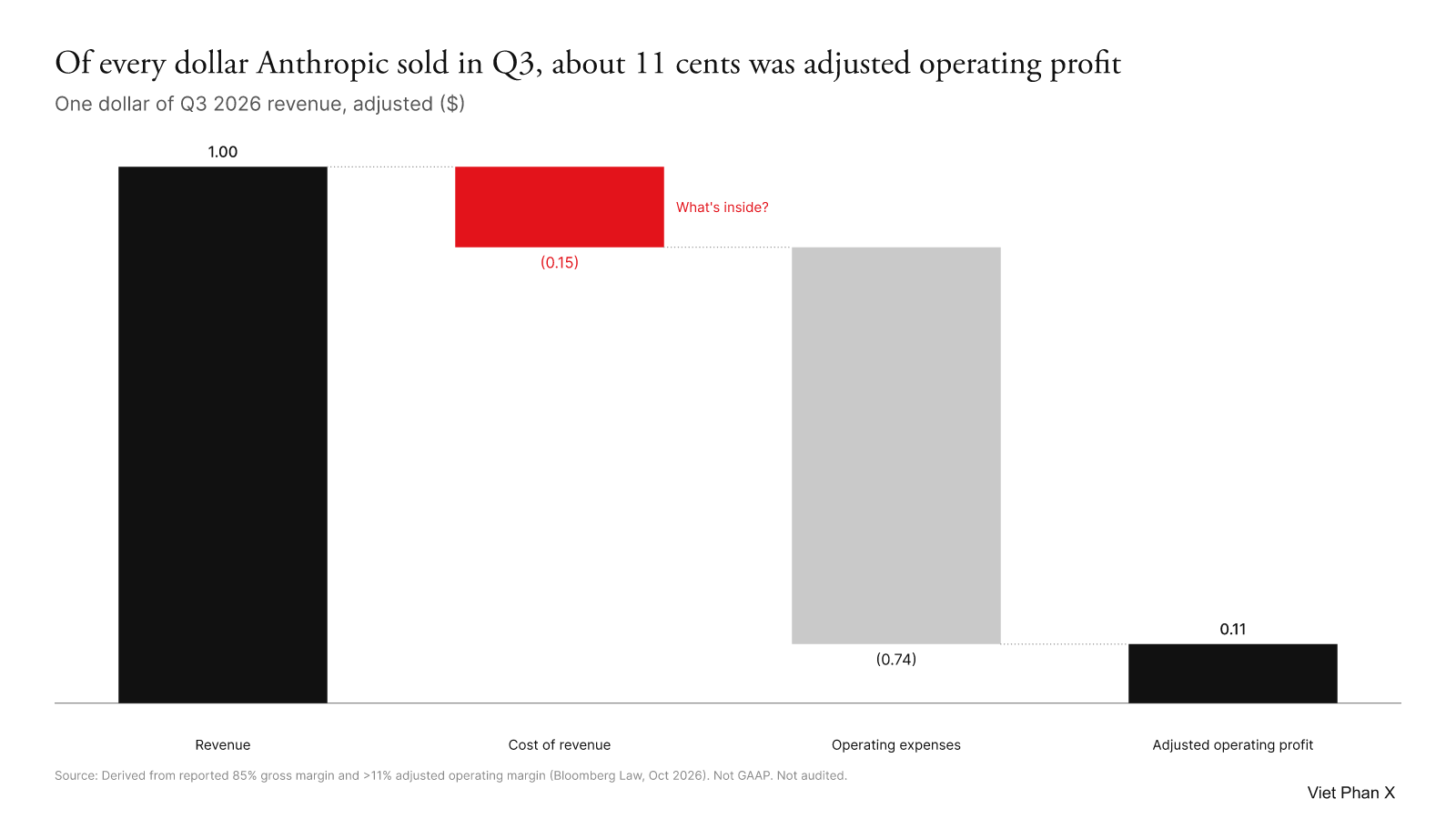
Then came the good news. In Q3, Anthropic reportedly showed investors:
- an 85% gross margin,
- an adjusted operating margin above 11%,
- and positive free cash flow.
Compare that with 2025, when Anthropic spent $2.76 for every $1 of sales.
That's a huge swing in less than a year. Which is exactly why the definition matters.
A gross margin is only as honest as the costs it leaves out. Where does training a new model go? The depreciation on chips? The cut the clouds take?
You might try to work it out yourself:
"They spent about $9B on compute and made $16.3B. So the margin is really about 45%?"
Not necessarily. Compute spend isn't the same thing as the cost line under gross margin.
Right now, everyone is guessing. The filing ends the guessing.
What we know now: the 85% comes from reporting on an investor meeting, sometimes labelled "adjusted."
What to check in the filing: the reconciliation from adjusted to GAAP margins, and where training costs are booked.
5. When the $518B Is Due, Not How Big It Is
This is the number that sounds scariest.
Anthropic has signed at least $518 billion in multi-year deals for cloud, chips and infrastructure. About 80% has to be paid whether Anthropic uses the capacity or not. Later reporting put commitments above $600B, with another ~$150B under negotiation.
So the natural question is:
"Where does a company find $518 billion?"
One popular back-of-the-envelope answer: raise $100B in the IPO, subtract it from $400B of commitments, and you're left with a $300B hole.
That's not how these contracts work. They're not one bill. They're a decade of bills:
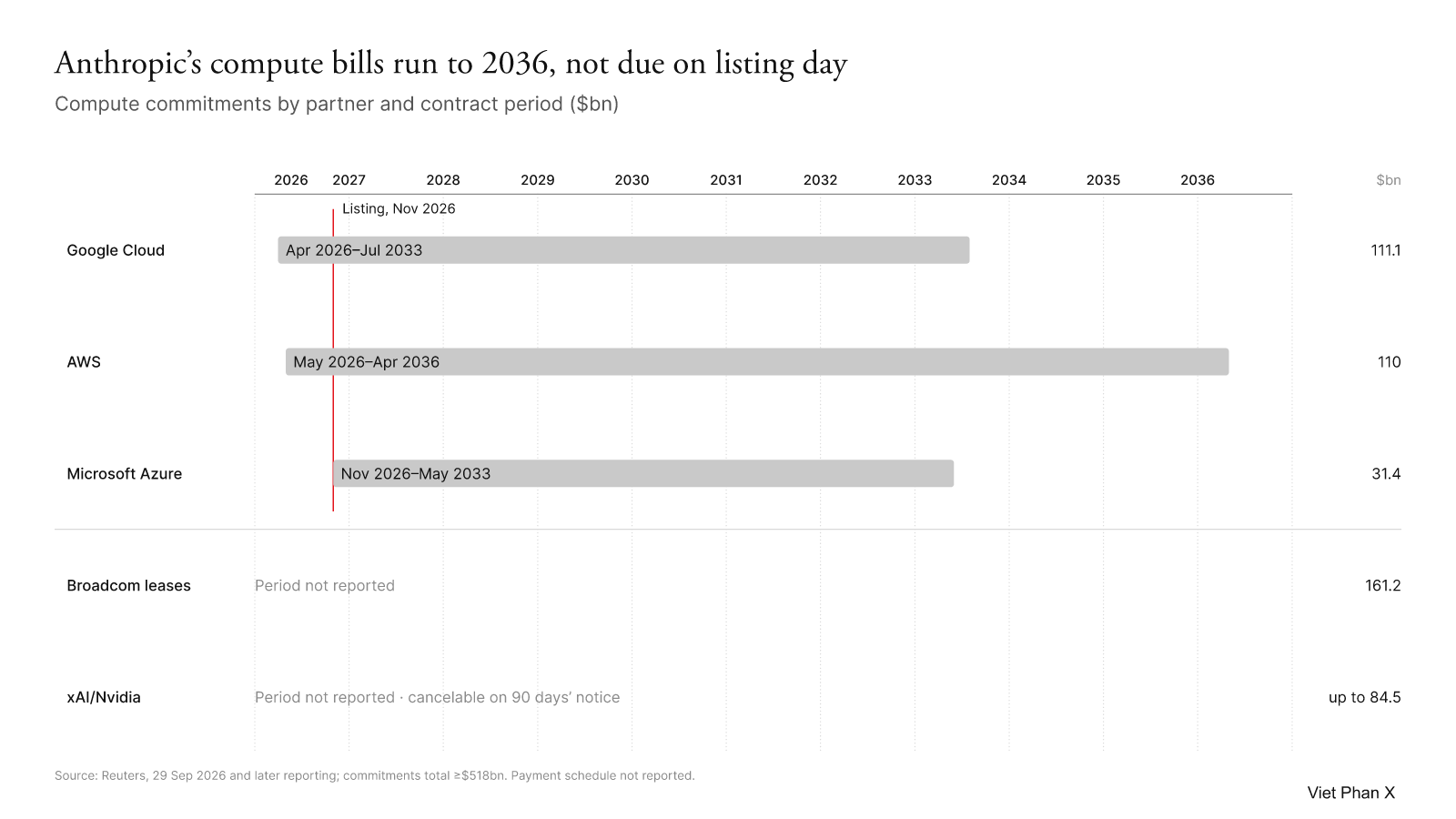
- Google Cloud: $111.1B, April 2026 to July 2033
- AWS: $110B, May 2026 to April 2036
- Microsoft Azure: $31.4B, November 2026 to May 2033
- Broadcom equipment leases: $161.2B, mostly noncancelable
- xAI / Nvidia compute: up to $84.5B, largely cancelable on 90 days' notice
So no, nobody has to find $518B on listing day.
But there is a real risk hiding in here, and it's sneakier than bankruptcy.
These contracts lock in today's prices for seven to ten years. Meanwhile, one AI price index cited by Reuters has fallen more than 40% since June.
If AI compute keeps getting cheaper, Anthropic keeps paying 2026 prices while competitors buy at 2029 prices.
What we know now: the partner totals and contract periods above. Not the payment schedule.
What to check in the filing: the minimum payment due each year. If that table shows big payments landing before revenue gets there, that's the real stress point.
6. The Fully Diluted Share Count
Back to the $72 billion.
Here's what it actually is. Anthropic raised money through instruments that turn into shares later. As the company's value shot up, those future shares became worth a lot more, and accounting rules record that increase as a loss.
No cash left. The "it's just paper" replies are right about that.
But those instruments are claims on future shares. When they convert, the company gets cut into more slices.
Paper for the company. Real for the shareholder.
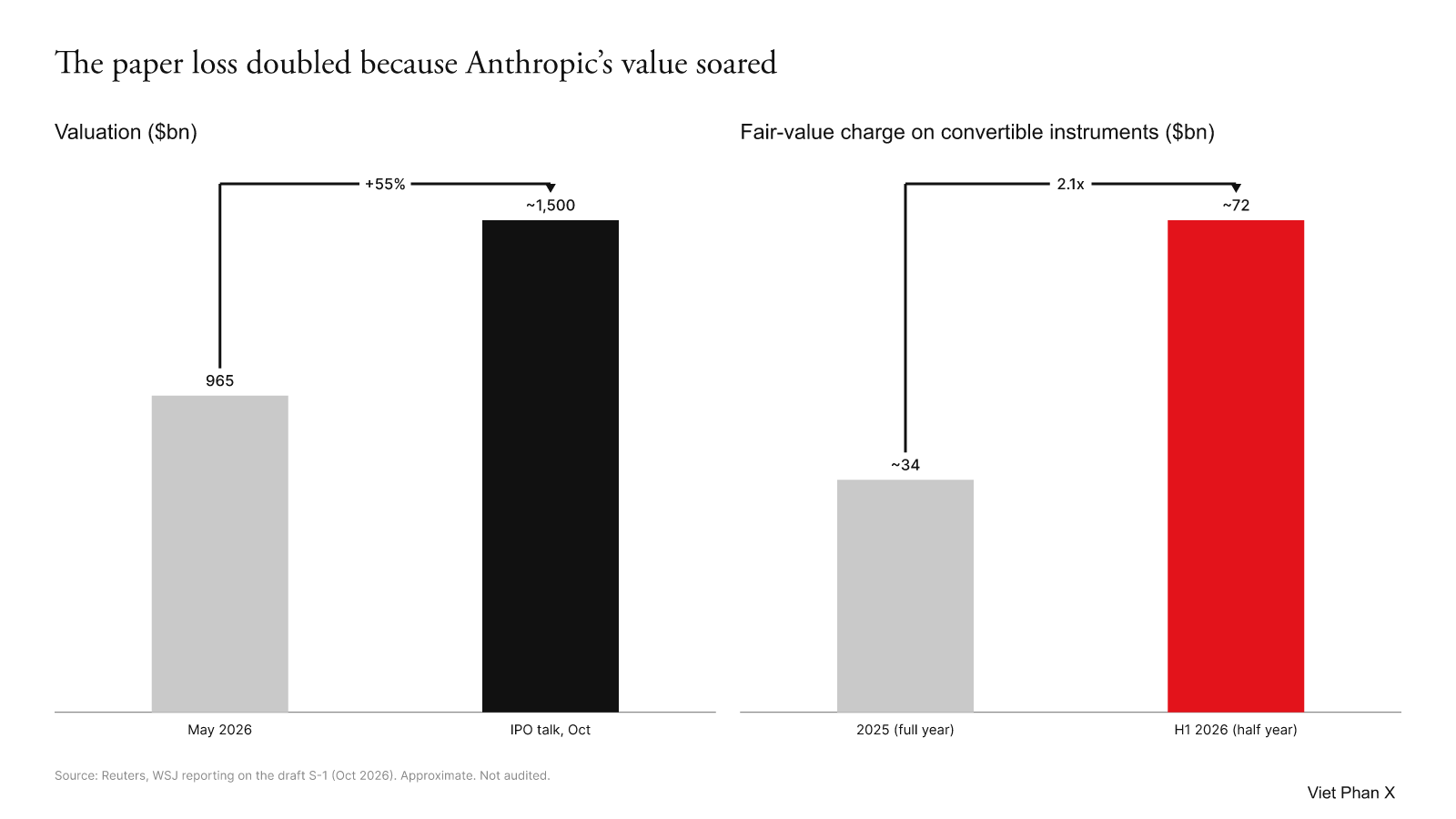
That's why the most useful number in the filing isn't the loss. It's the fully diluted share count: every share that exists, plus every share that could exist once these instruments convert.
What we know now: the charge comes mainly from convertible instruments. The share count, conversion terms and how many shares go to the public aren't in the reporting yet.
What to check in the filing: all convertibles and warrants, lockups, and how many shares go to the public.
The One Question Behind All Six
Put the six together and they ask one thing.
Revenue grew about 15× year over year in the first half. The product works. People like me pay for it every month.
But money can leak out at every step:
- to the clouds that resell it (numbers 2 and 3),
- to costs the margin may not show yet (number 4),
- to contracts signed at today's prices (number 5),
- and to early investors whose claims convert into shares (number 6).
And customers have options. Ask yourself:
"If a cheaper model did 90% of my tasks well enough, would I keep paying for the best one?"
For a lot of companies, switching the model behind their AI tools is a one-line change. Rebuilding the tools around it is what takes months.
That's the tension. The model is the brilliant part. Keeping the money is the hard part.
The valuation talk has already moved from $2 trillion to about $1.5 trillion, still well above May's $965B. Whether that's cheap or expensive is a different article.
What I'm confident about: the S-1 will answer more than any hot take did this week.
And when OpenAI eventually files, it will be the same six numbers.
This is how I'm reading the filing, not investment advice. I'll update this page when the public S-1 lands.
Artifact postscript
Publication details +-
- License
- All Rights Reserved
- Quote policy
- short_quotes_ok
- AI search indexing
- allowed
- AI training
- unspecified
- Citation
- How to Read Anthropic's IPO Filing: Ignore the $80.7B Loss, Watch These 6 Numbers. published Oct 23, 2026. /archive/anthropic-ipo-six-numbers. License: All Rights Reserved