Google's Czech Rival Built Its AI on a Google Model. The Textbook Fine-Tune Broke It.
And 6 other takeaways from a meetup at Seznam, the Czech search unicorn that competes with Google.
By Viet Phan6 November 20266 min read
Prague, 3 November 2026. Written from my notes and memory, so the numbers are what I heard on stage.
Most companies in Czechia buy their AI.
Seznam, the Czech search engine, built its own.
On Tuesday it invited people to a university campus in Prague to explain how. There were four talks and a Q&A.
The first talk was the best one, because it was about their big fuck-up.

The 70B model that was too slow
Seznam's own model is called SeLLMa. The big version, SeLLMa 2 large, is a fine-tuned Llama 70B. For a while it ran next to GPT.
It worked, until traffic grew from a few hundred queries to hundreds of thousands.
Then latency became the problem.
A search assistant doesn't answer in one step. It calls tools and chains services together: maps, weather, search. Every step waits for the model, and a 70B model makes every step slow.
So Seznam switched to Gemma 4, Google's open mixture-of-experts model. It was the best open model at a reasonable speed.
Yes, Google's. Seznam's answer to Google runs on a model Google gives away.
There was one catch. Its Czech was bad. It mixed in Slovak and made grammar mistakes.
So they had to train it in Czech.
The advice that broke it
Everyone says the same thing about fine-tuning.
Start from the base model. The instruction model has already been trained once to follow instructions, so training it again should make it worse.
Seznam followed that advice.
The model came out broken. It didn't work at all.
So they did the opposite. They took the instruction model, trained it with reinforcement learning, and in every phase they mixed in examples from the original model, so it didn't forget how to follow instructions.
That one worked. It writes proper Czech.
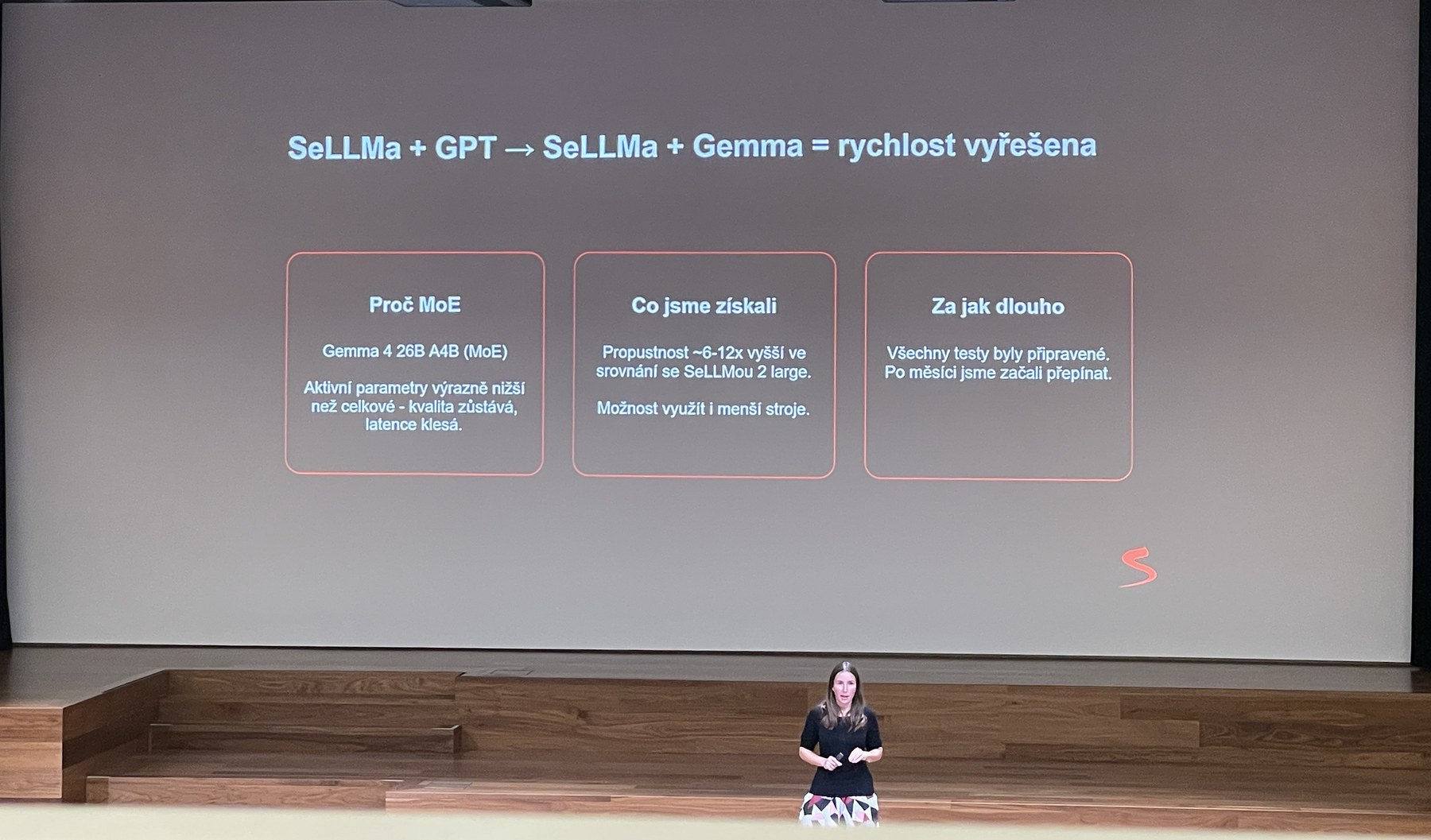
The slide put the switch in one line: "SeLLMa + GPT → SeLLMa + Gemma = speed solved."
Some details from the talk:
- The training data was scraped news, not user emails. Someone in the audience asked. Every model is checked by people for Czech grammar and for knowledge, including history.
- Throughput went up about 6 to 12 times compared with SeLLMa 2 large.
- It runs on smaller machines. Only a fraction of the model's parameters are active for each word, so quality stays and latency falls.
- About a month after the tests were ready, they started switching.
Today that model answers Seznam's searches, runs its conversations and picks its recommendations.
In Czech, on Google's model, trained the way the textbook says not to.
1. Agent payments: lots of standards, very little money
The second talk was about payments made by AI agents.
The speaker's first slide was a list of protocols for agent payments. I counted 14 since 2020, from Coinbase, Stripe, Visa, Mastercard, Google, OpenAI, Shopify, Alipay, UnionPay and OKX. Ten of them launched in the last 14 months.
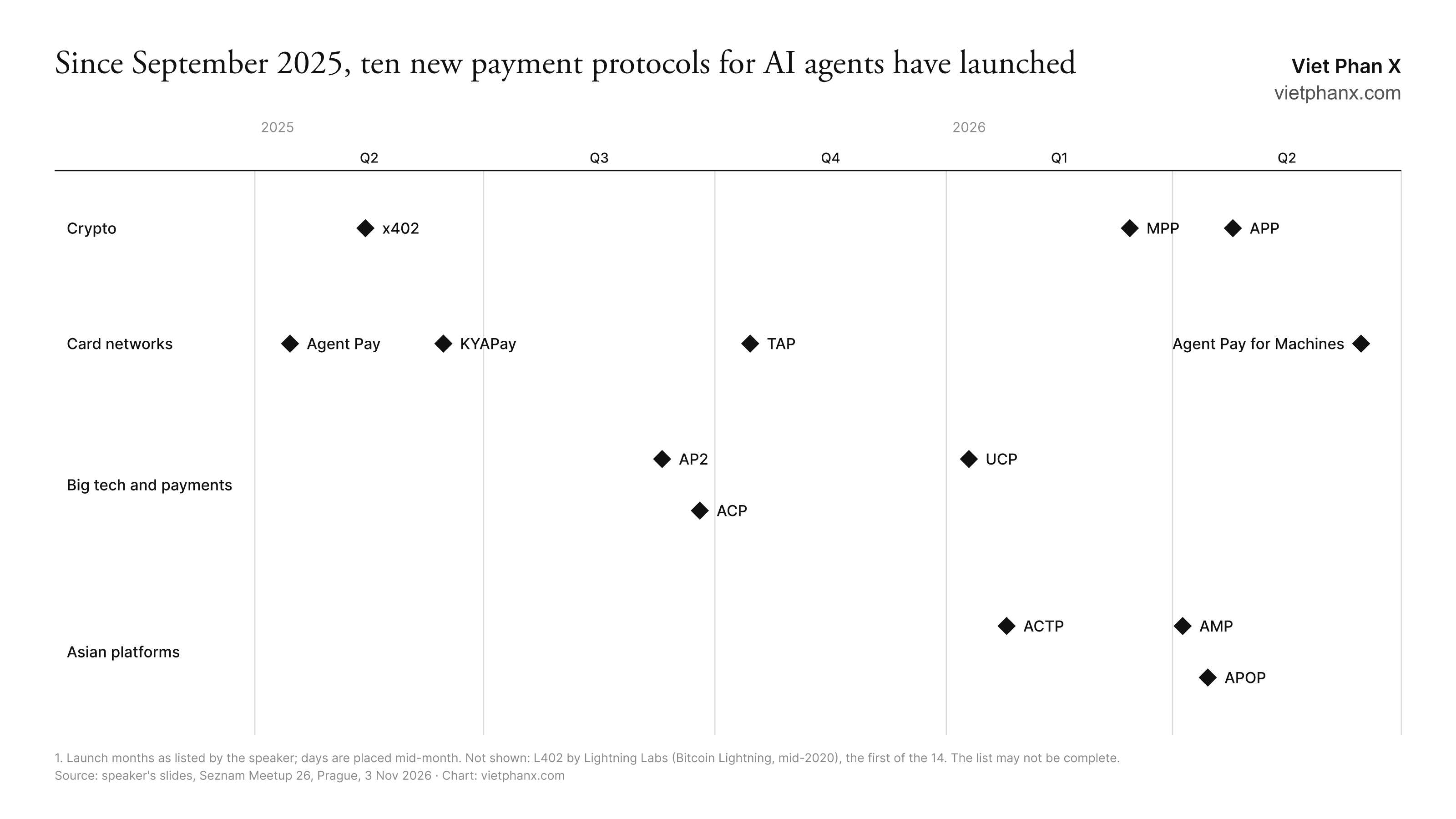
Everyone wants to be the standard.
Then he showed how much money actually moves through them.
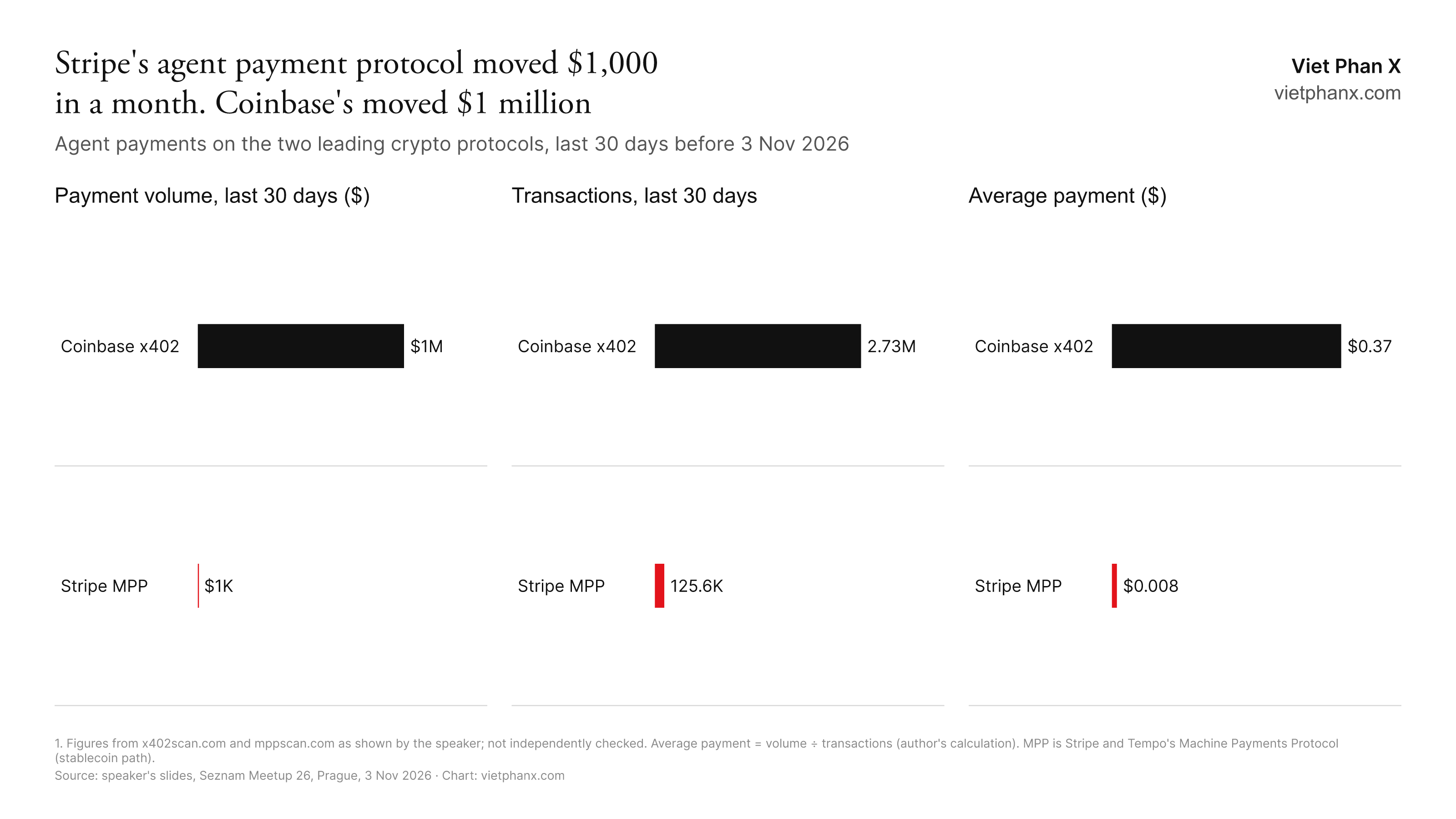
x402, Coinbase's protocol: $1 million in the last 30 days. MPP, from Stripe and Tempo: $1,000.
One thousand dollars. I read that twice.
Divide by the number of payments: MPP's average payment was under one cent. These are agents paying for tiny things, and not many of them yet.
His explanation was distribution. There's no real use case yet, for businesses or for people. People don't have a reason to give an agent their money, and when they do, they don't trust it.
Even the leading standards, like x402, don't solve basic problems such as being charged twice.
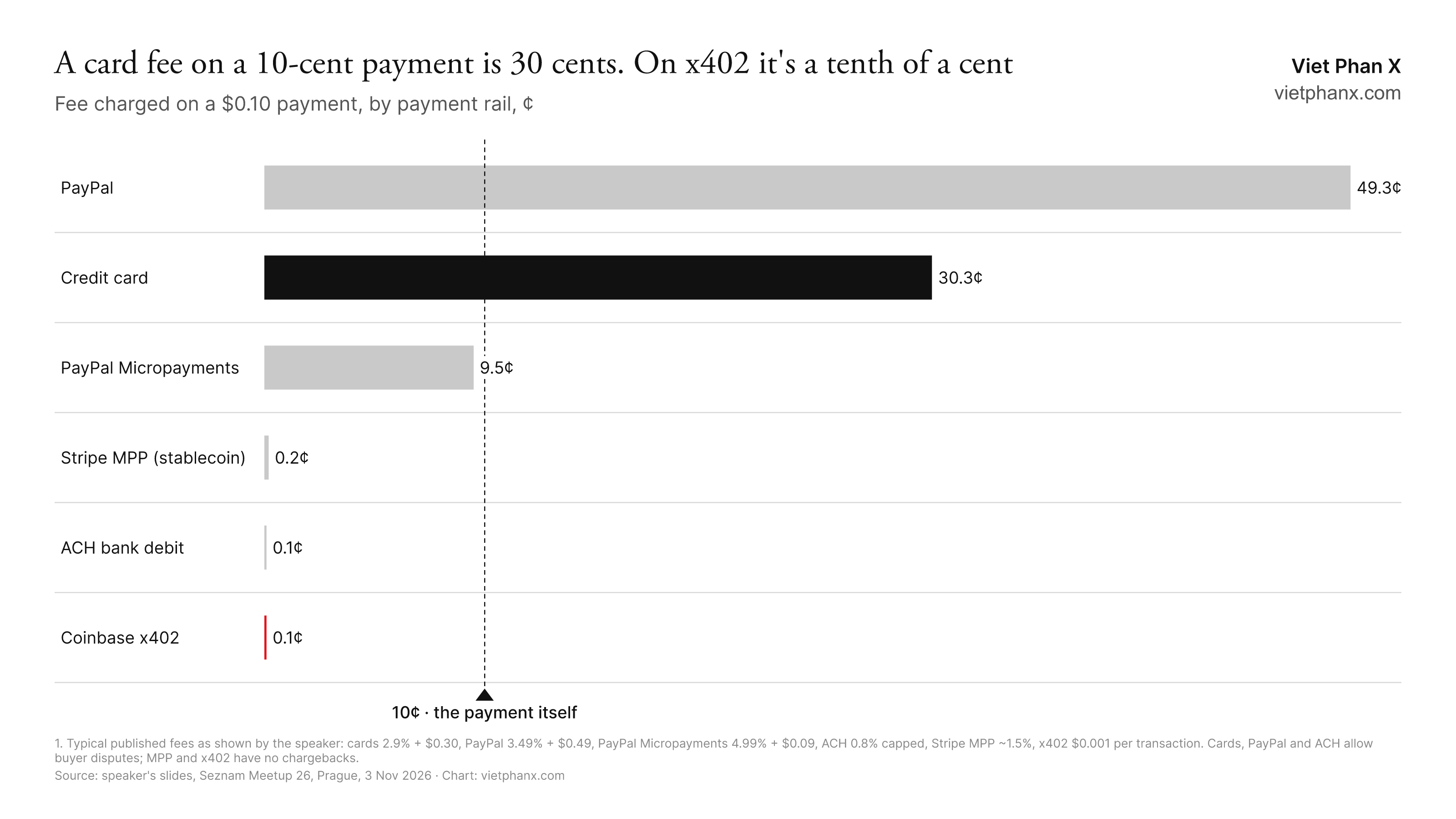
So why crypto rails at all? Because of fees. He showed a table: a 10-cent card payment costs about 30 cents in fees. On PayPal it's 49 cents. On x402 it's a tenth of a cent. An agent paying a few cents per request can't use a card at all.
2. Tokens won't stay cheap, and that's the case for agent payments
So why would anyone build this now? He gave two reasons.
First, tokens are subsidized. Venture money pays for a lot of today's AI usage. When that stops and people pay the real price, running your own agents gets expensive.
Paying a few cents for a finished, reliable tool starts to make sense. That's what micropayments are for.
Second, the big labs. Once OpenAI lets people shop through ChatGPT, he said, it's a matter of time before it spreads.
3. Agent payments won't pump crypto
In the Q&A, someone asked if agent payments would push crypto prices up.
The answer was no.
Agents will pay in stablecoins, coins pegged to the dollar. Money moves through them, but no value flows to Bitcoin or the other big coins.
It sounds wrong at first. It isn't.
4. Don't download a model you can't trace
The security talk was given by a Cambridge graduate who works at a startup of about fifty people that Cohere acquired.
Her first point was the simplest one.
Don't trust Hugging Face models from unknown publishers. Only from big organizations. Downloading is the first unsafe step.
5. You can't test a model's safety from the outside
The usual way to check something is to test it.
That doesn't work here. To see if a model does something harmful, you need the input that triggers it. And you don't know that input. A classifier can't find it for you.
What works better, she said, is looking inside. She pointed to Anthropic's work on seeing what a model is thinking. If it's thinking about the wrong things, that's the warning sign.
6. One benchmark can make a small team worth buying
Her startup doesn't train its own models. It uses the top ones.
But it got to the top of a public benchmark, and that was a big part of why it got acquired.
Fifty people. No model of their own. Best in the world at one measurable thing.
That's a path a small team can actually take.
7. The money in agents is in the boring parts
The third talk was an open-source agent framework for large corporations, from a startup whose client is IBM Research: integration, virtualization, enterprise plumbing.
It was the least exciting talk of the evening. On the way home I realized it was also the most typical one.
Look at where the money in agents is today:
- Frameworks for corporations.
- Security that limits what agents can do.
- Payment rails that almost no one uses yet.
That's what companies pay for. It's tedious, and it's where the jobs are.
What excites me is the opposite: what agents can do, not how to fence them in. That's harder to get paid for.
I think a lot of local AI startups will die out. Everything moves fast, the big companies have the money, and a narrow specialty can be overtaken in months.
Except Seznam
Seznam took its biggest competitor's free model and taught it Czech.
Now it answers Czech searches every day. Google built the model. Seznam gets the users.

Copyright Viet Phan 2026. All rights reserved.Reuse this content