Anthropic Lost $80.7 Billion. Its Last Quarter Made a Profit.
Anthropic's IPO filing is out. Both of those sentences are true. The gap between them is the whole story of this IPO.
By Viet Phan27 October 20268 min read
Anthropic Lost $80.7 Billion. Its Last Quarter Made a Profit.
Anthropic's IPO filing is out. Both of those sentences are true. The gap between them is the whole story of this IPO.
Published 27 October 2026. All numbers come from Anthropic's S-1, filed with the SEC on 26 October, unless marked otherwise. The 2026 figures are unaudited.
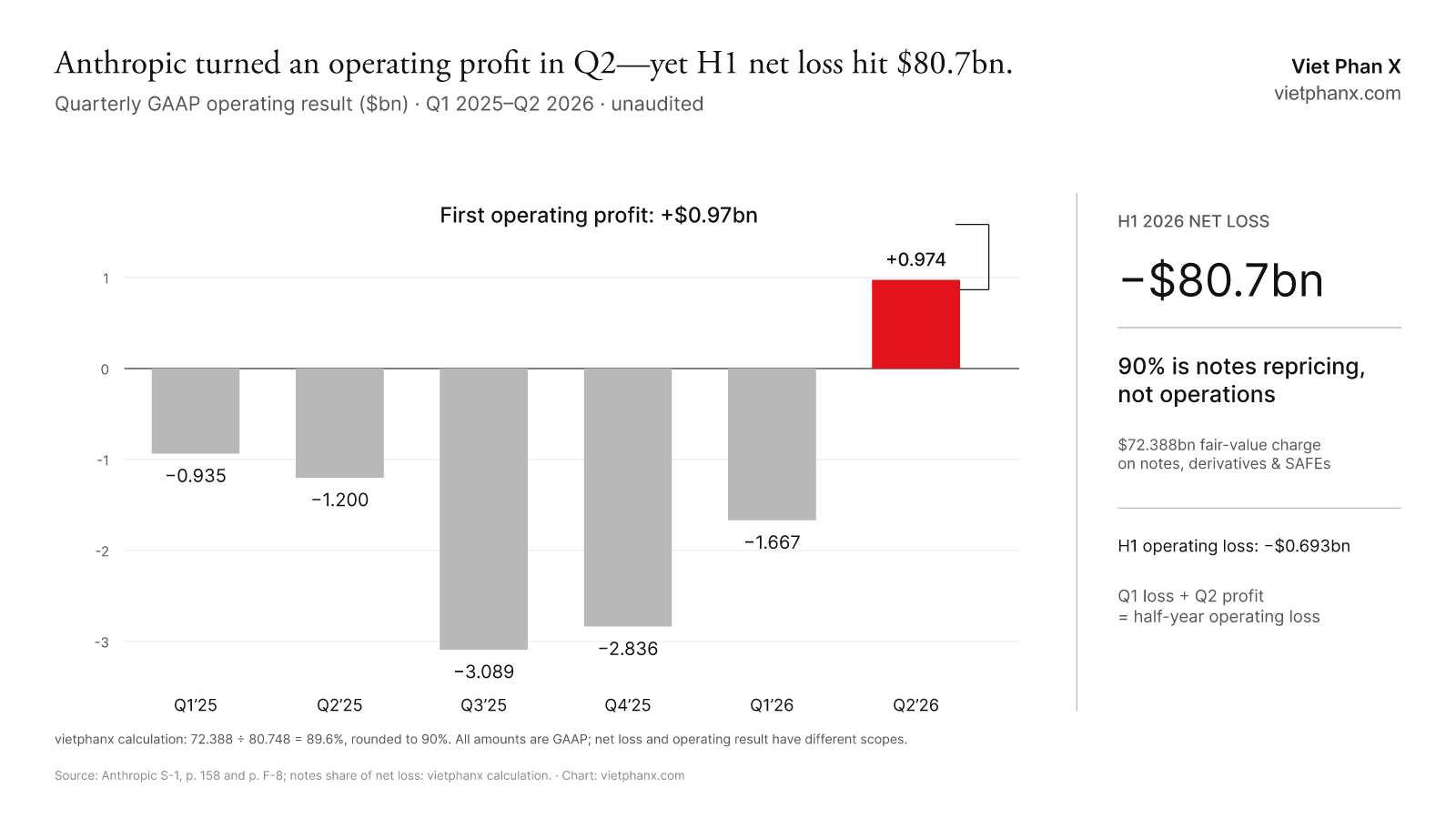
Anthropic lost $80.7 billion in the first half of 2026.
In the second quarter of that same half, it made a $974 million operating profit.
I read that table twice.
Same company. Same filing. Same six months.
Last week I wrote about the six numbers to watch when this filing landed.
Now it's here. So I looked.
Some of what I found is better than anyone expected. Some of it is worrying. And one thing I wrote last week was wrong.
Here's the full breakdown.
Quick disclosure: I pay for Claude every month and use it every day. So I'd like this company to work.
The $80.7 Billion Bridge
Let's start with the scary number.
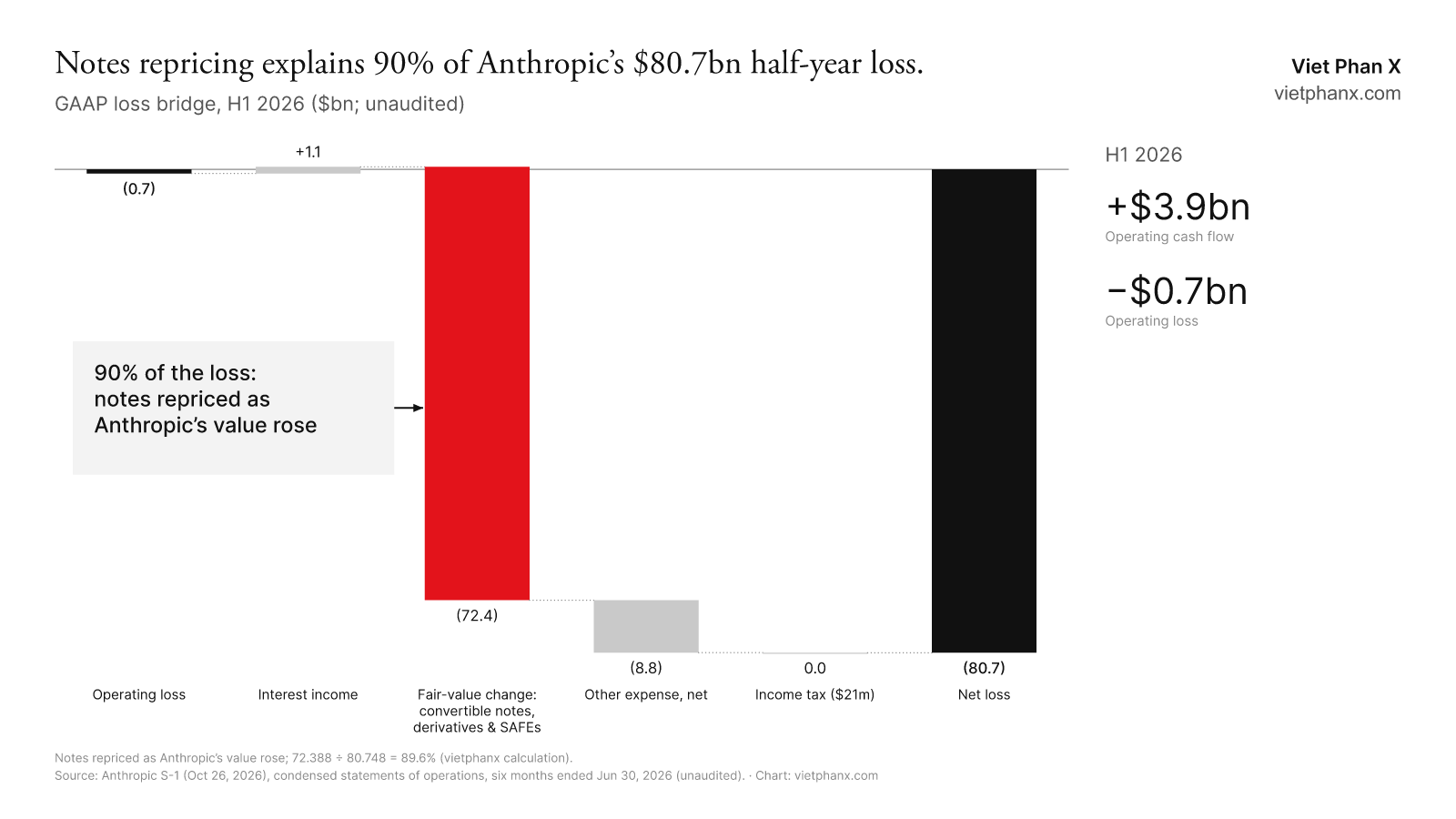
Here's how Anthropic gets from running the business to an $80.7 billion loss:
- Running the business: −$0.7B
- Interest on its cash: +$1.1B
- Repricing its convertible notes: −$72.4B
- Other financing items: −$8.8B
90% of the loss is one line.
So what is that line?
Before the IPO, Anthropic raised money with convertible notes. Think of them as loans that turn into shares later, at a price fixed in advance.
The company's value shot up. So those future shares got a lot more valuable. Accounting rules say the company has to book that difference as a loss.
No cash left the building. The business actually brought in $3.9 billion of cash from operations in those same six months.
But it's not free money either.
That $72 billion is value going to the noteholders. Someone pays for it: every other shareholder, through dilution.
So the loss doesn't mean the business is burning cash.
It means the business got very valuable, very fast, and some early lenders got a great deal.
And this is where I got one wrong. In my last post, I called the roughly $8.7 billion left after the accounting charge the "real" loss.
It wasn't. That was financing items too. The actual operating loss was $693 million. I've added a correction to the old post.
The 30x Hockey Stick
This is the part that made me optimistic.
Anthropic's revenue, quarter by quarter:
- Q1 2025: $0.4B
- Q2 2025: $0.8B
- Q3 2025: $1.4B
- Q4 2025: $2.0B
- Q1 2026: $4.7B
- Q2 2026: $11.6B
30x in six quarters.
Wild.
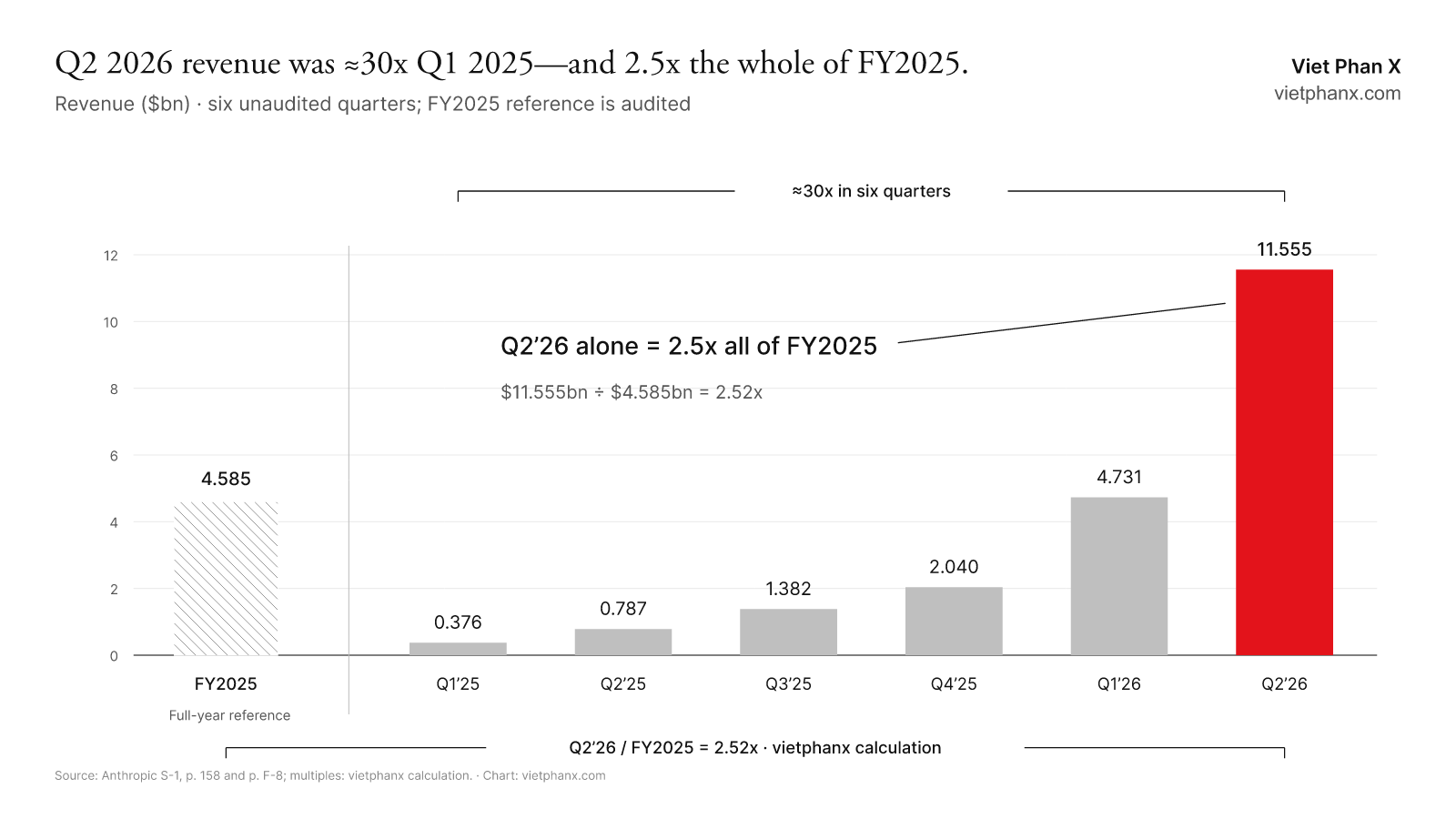
To put that in perspective: all of 2025 brought in $4.6 billion. Q2 2026 alone brought in two and a half times that.
And remember the chart at the top. The operating result was negative for five straight quarters. Down to −$3.1 billion at the worst point.
Then, in Q2 2026, it flipped. +$974 million.
One caveat. The full financial statements stop at June. The filing has some September numbers, but no Q3 revenue total. Q3 revenue was reported by Reuters at about $16.8 billion.
The $321 Billion Lease Pile
Okay. That's the good news.
Now the part that keeps it real.
Buried in the notes, there's a line for leases that are signed but haven't started yet. Mostly data center capacity, switching on between 2026 and 2028. Some run for up to 20 years.
- End of 2025: $50.2 billion
- June 2026: $321.4 billion
I had to check that twice too. That category grew by about $271 billion in six months.
None of it is on the balance sheet yet. It lands on the books as each data center switches on.
Now compare that with what customers have actually locked in. Anthropic's contracted future revenue at the end of June: $10.8 billion.
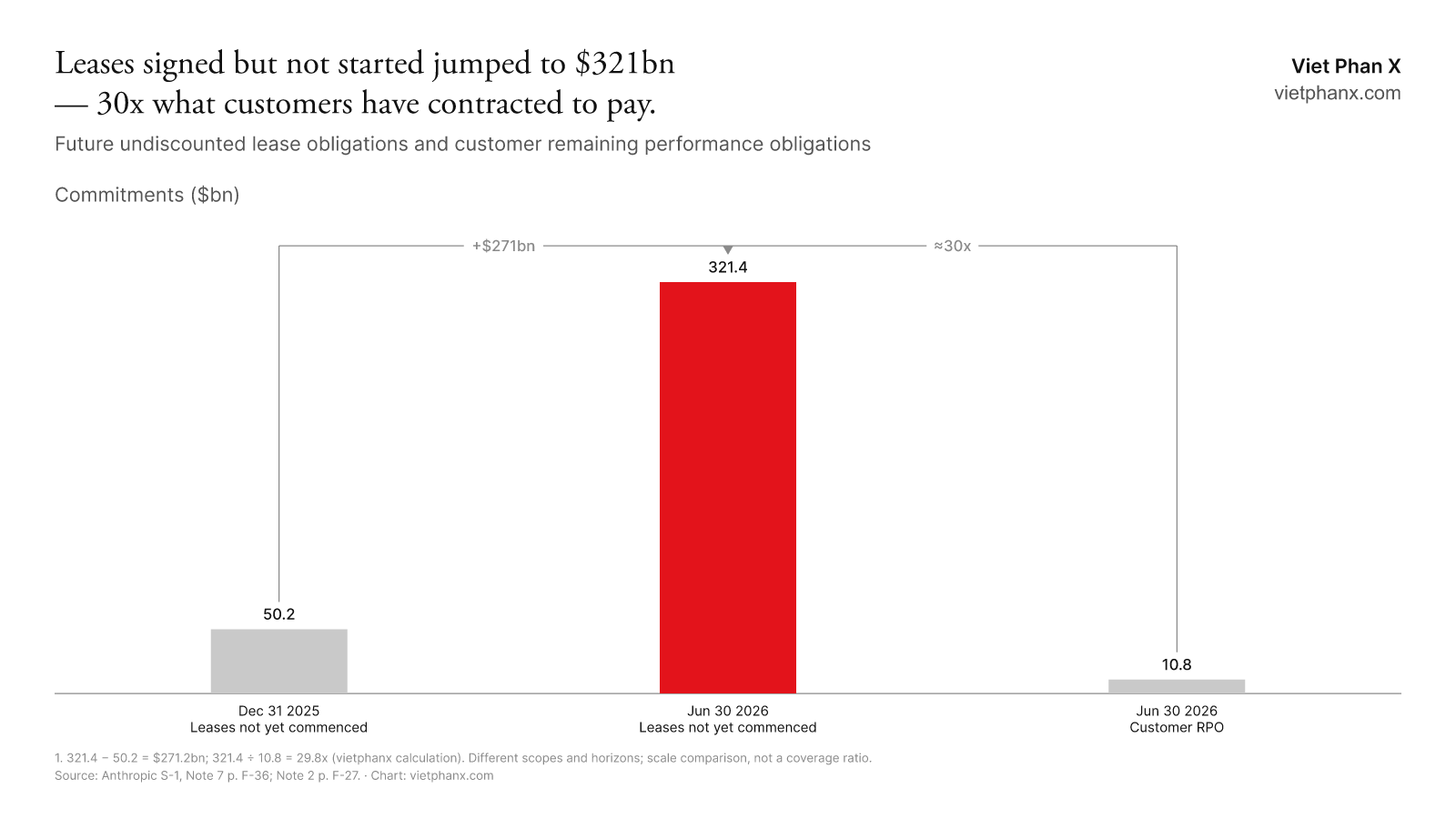
To be fair, that's not apples to apples. Most customers pay as they go, so real future revenue will be much bigger than $10.8 billion.
But it shows the shape of the bet:
The costs are signed for years. The revenue has to be won month by month.
And the filing says it out loud. Capacity is committed long before it comes online, the costs land when it does, and margins can get squeezed while revenue catches up.
So that Q2 profit? It may be the moment revenue sprinted ahead of the bills.
The bills are on their way.
The Landlord Problem
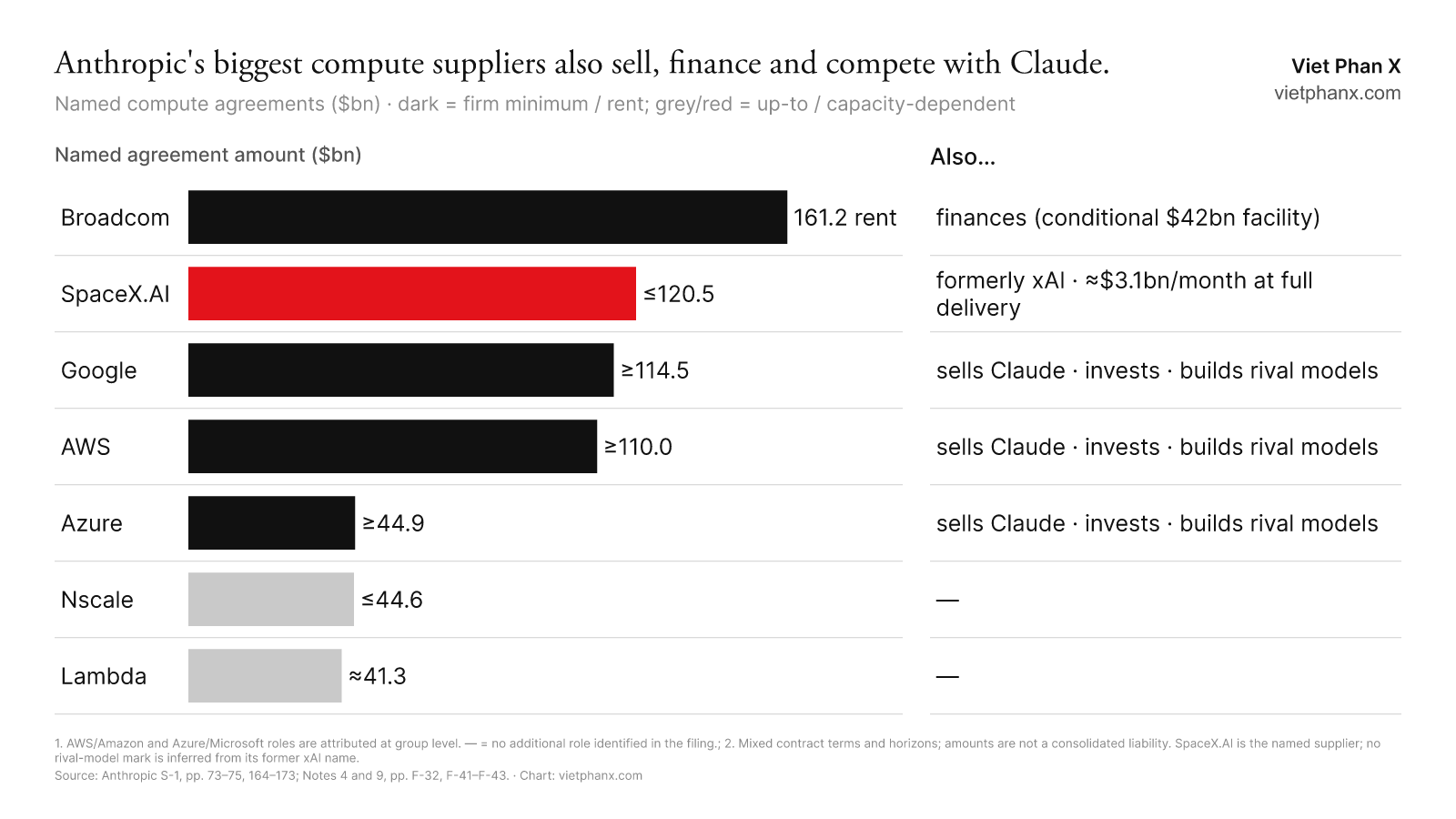
Here's a question I couldn't stop thinking about: who is Anthropic actually renting all this from?
The answer is the strangest list in the filing.
- Amazon sells Claude to its cloud customers, rents Anthropic compute, holds its convertible notes, and builds its own models.
- Google sells Claude, rents compute, has committed billions more in funding, and builds Gemini.
- Microsoft sells Claude and rents compute.
- SpaceX.AI, the former xAI, a rival AI lab, can supply up to $120.5 billion of compute.
That last one is alarming.
At full delivery, the SpaceX.AI deal runs at about $3.1 billion a month. And from early 2027, either side can walk away with 90 days' notice.
And the selling side? About 48% of Anthropic's revenue in the first half came through those cloud marketplaces.
Imagine renting your shop from a mall that sells half your products and runs a competing store next door.
The filing calls it what it is: a potential conflict of interest.
Add up the minimums and you get roughly $431 billion. The deals that depend on delivery add up to another $206 billion. (My sums. The filing leaves its own total blank.)
One piece of good news here: the old fear that "two customers are the whole business" doesn't hold. Over the first nine months of 2026, no single customer was above 10% of revenue. The top five were about 25%. (One customer did hit 11% in the first half.)
The 80% Treadmill
One line in the filing raised an eyebrow:
More than 80% of Anthropic's Q3 revenue came from models released in the previous six months.
Think about what that means.
Customers move to the newest model almost instantly. That's great when you ship the best model.
It also means the revenue has to be won again every cycle. Fall behind for a couple of releases, and a lot of that money can walk.
And the filing shows the treadmill can stop for reasons that have nothing to do with competitors:
- In June, US export restrictions switched off Fable 5 and Mythos 5 worldwide. Anthropic disabled them for every customer until the restrictions were lifted.
- 5–7% of revenue in the first nine months came from customers later found breaking Anthropic's terms. Cutting them off is right. Anthropic says it can't yet tell how much revenue that will cost.
There's an upside version too. In September, Claude wrote over 90% of the code added to Anthropic's own codebase. And its Fortune 500 customers spend on average less than 0.1% of their total expenses on Anthropic.
Plenty of room to grow. As long as the treadmill keeps moving.
Four Prices for One Share
This is the section I'd read twice if I were thinking about the IPO.
The same Anthropic share has changed hands at very different prices this year:
- Amazon's 2023 notes convert at $2.09 a share
- Amazon's 2024 notes convert at $5.05
- In April, executives sold shares in a tender at $25.91
- In May and June, the last private round priced at about $58.90 per share
- The IPO price? Not set yet.
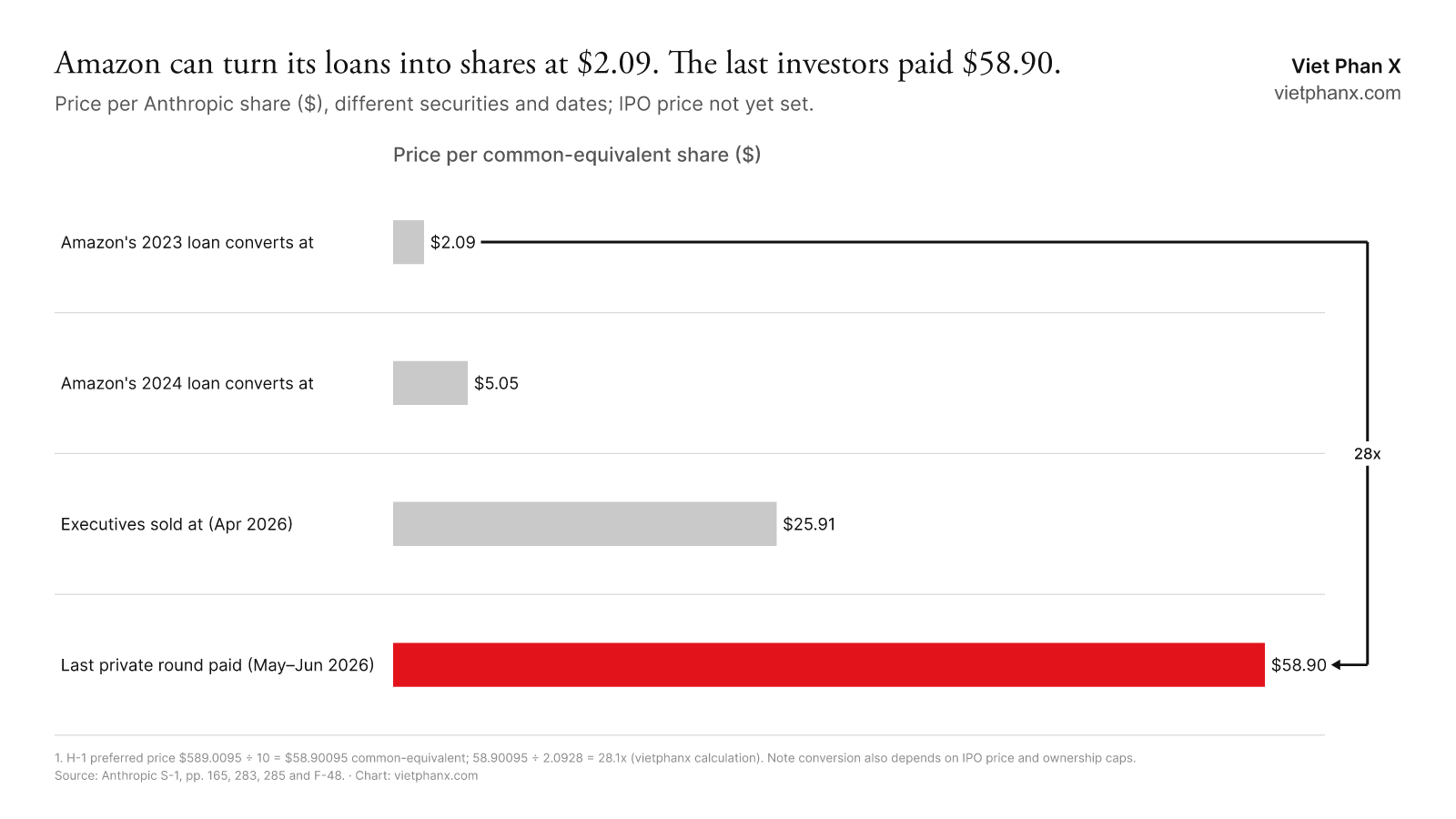
These are different securities on different dates, so it's not a perfect comparison.
But it tells you who got in early, and at what price.
And Amazon doesn't convert everything at once. Anything above its ownership cap rolls over and converts every quarter after the IPO, at the lowest of its fixed price, the IPO price, or the recent market price.
Public buyers come in last. At a price nobody knows yet.
You Get the Shares, Not the Control
If you buy this stock, here's who actually runs the company.
The founders. The seven of them share one special share. That single share carries 50.1% of the shareholder vote. So they win every general vote.
A trust. The Long-Term Benefit Trust picks most of the board. It holds a single special share that carries those board rights, and it makes no money from it.
Everyone else, you included. One vote per share. All the ordinary shares together carry 49.9%. Never a majority.
Two more things to know.
A public benefit fund gets 5% of the company at the start. The board can give it up to 2% more each time the stock rises 50%. New shares for the fund shrink everyone else's slice.
And after 180 days, the founders can sell up to 29% of their shares.
None of this is hidden. It's the design. Anthropic wants its mission to outrank Wall Street pressure.
Just go in knowing the deal: you get the shares, not the control.
Great Business, Bad IPO?
The filing doesn't set a share price yet. The numbers floating around in the press are $1.5 to $2 trillion.
So I did some napkin math.
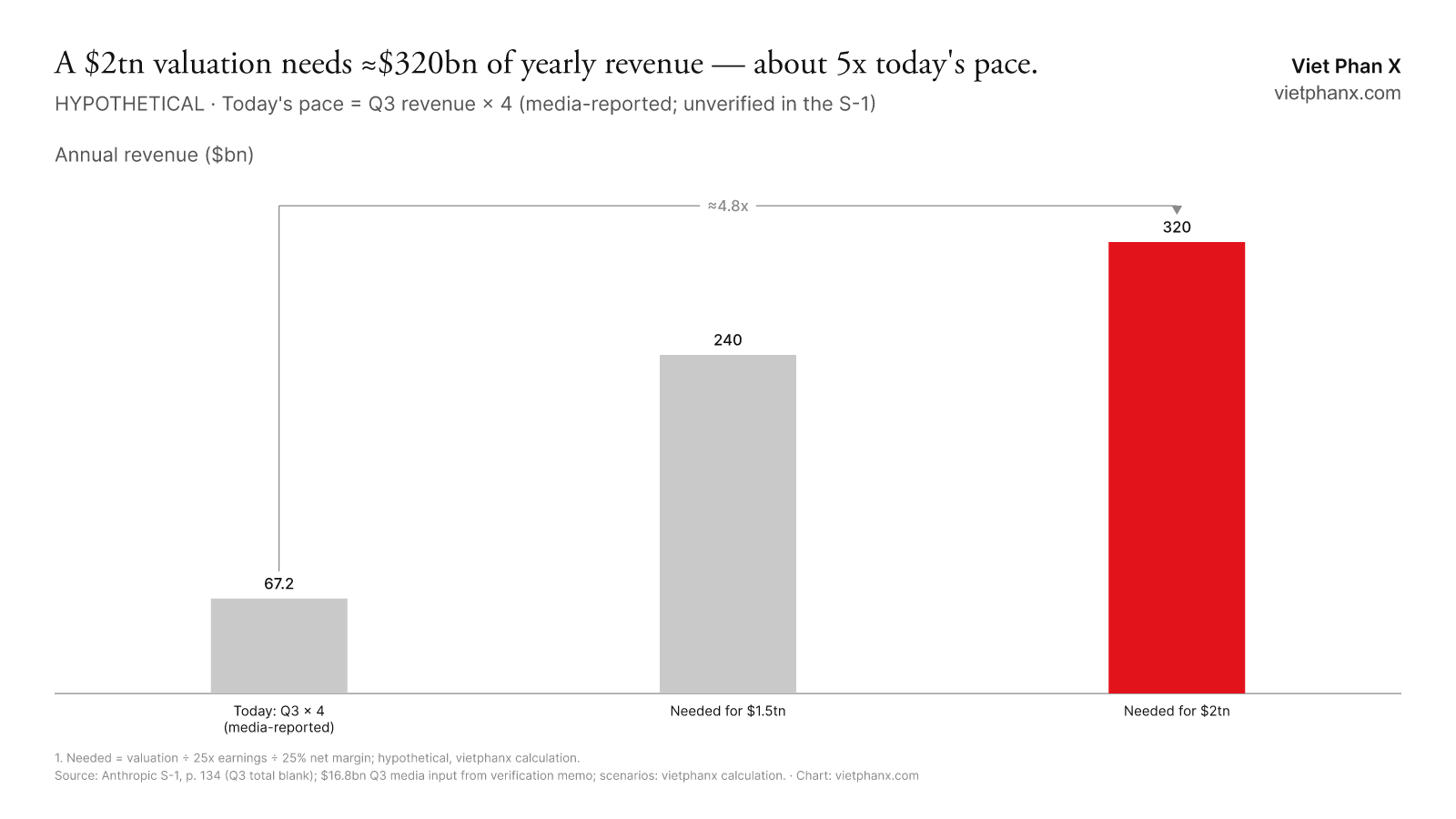
Take that reported Q3 revenue of $16.8 billion and multiply by four. About $67 billion a year.
- At $1.5 trillion, buyers pay about 22x yearly revenue.
- At $2 trillion, about 30x.
Now flip it.
Say Anthropic one day keeps 25 cents of profit on every dollar of revenue. And the market pays 25x those profits.
To justify $2 trillion, it would need about $320 billion of revenue a year.
That's almost five times today's pace.
Anthropic seems to know this.
In the founders' letter at the front of the filing, they share advice they got from other business leaders before going public:
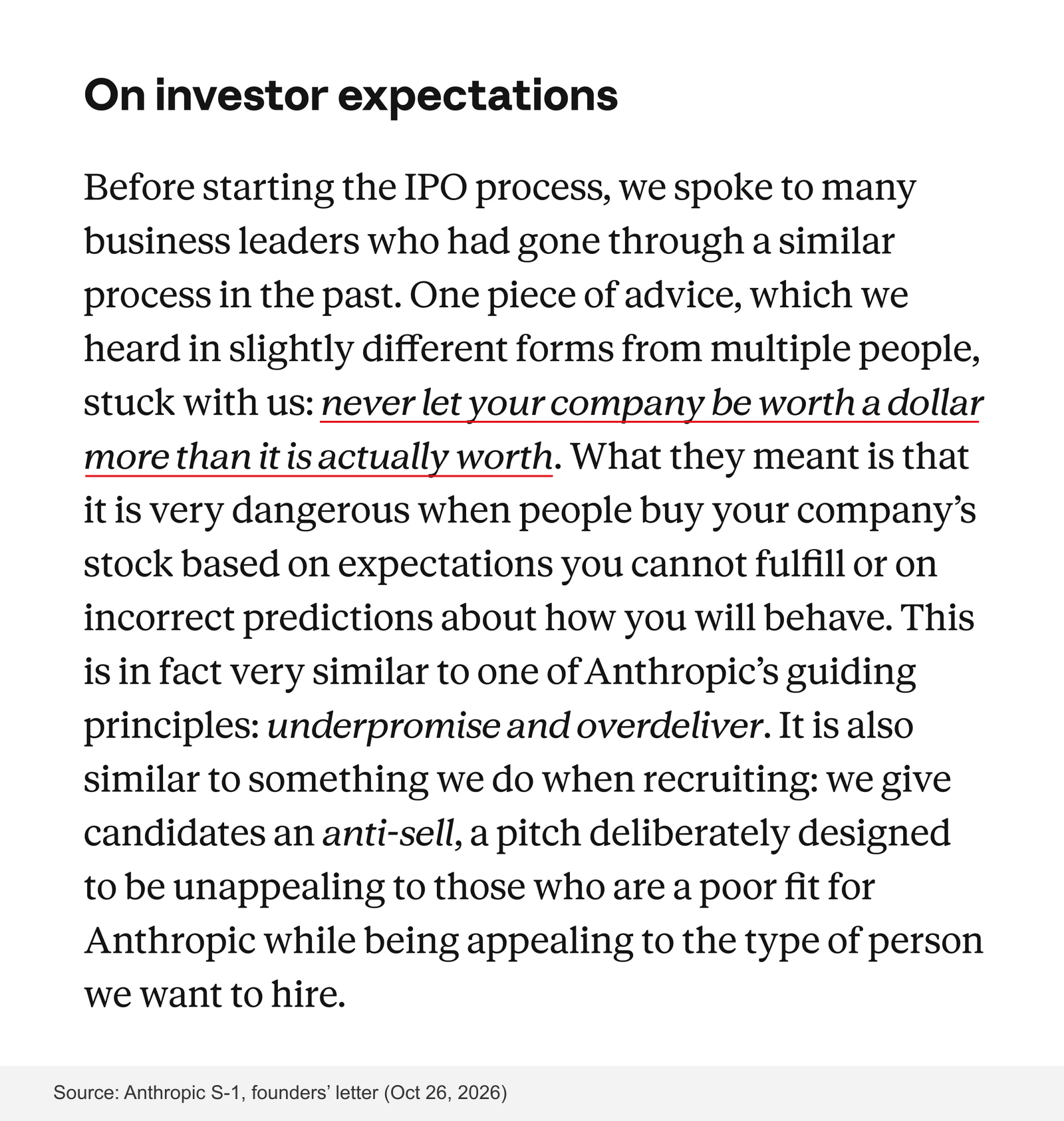
Never let your company be worth a dollar more than it is actually worth.
They say it's close to one of their own rules: underpromise and overdeliver.
The same letter also warns that some of their bets "may seem irresponsibly large at first glance."
But here's the thing.
A company can win, and the people who bought at the IPO can still lose money. If you pay a price that already assumes everything goes right, even a great result only gets you your money back.
The S-1 shows a business that's growing faster than almost anything we've seen, close to breaking even, with $131.7 billion of cash and short-term investments.
The only question left is the price.
When it's set, I'll run the same math. And when OpenAI files, I'll read that one the same way.
This is how I'm reading the filing, not investment advice.

Copyright Viet Phan 2026. All rights reserved.Reuse this content