Claude's Work Inside Anthropic Is Now Worth More Than Its Payroll
Priced at what customers pay, it passed payroll in April 2026. The S-1 also shows what Anthropic refuses to build, and why cheap open models scare it.
By Viet Phan27 October 202610 min read
Claude's Work Inside Anthropic Is Now Worth More Than Its Payroll
Priced at what customers pay, it passed payroll in April 2026. The S-1 also shows what Anthropic refuses to build, and why cheap open models scare it.
Published 27 October 2026. All numbers and quotes come from Anthropic's S-1 unless marked otherwise. This is part three: first the six numbers to watch, then what the S-1 shows about the money.
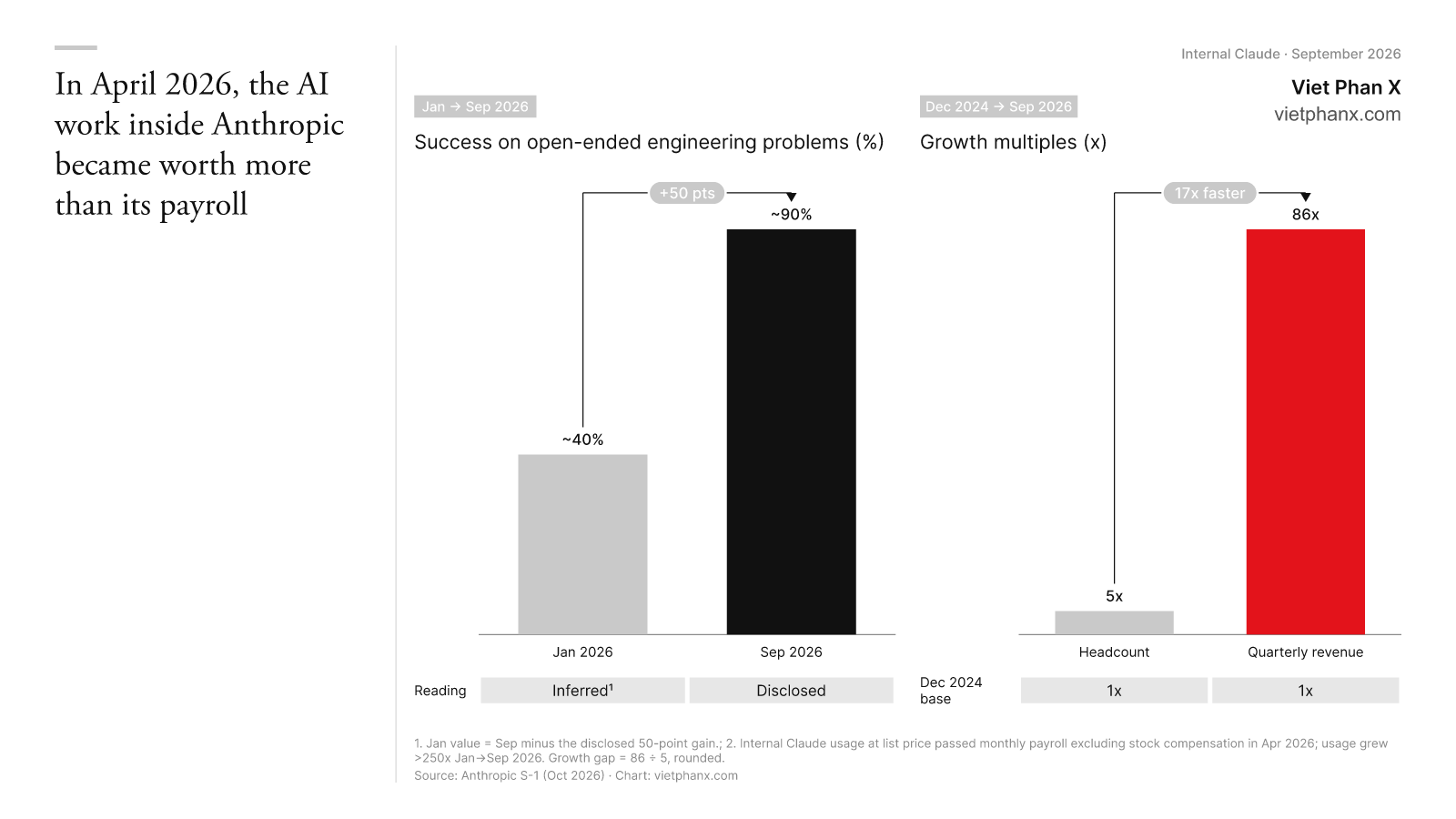
In April 2026, the AI work inside Anthropic became worth more than its payroll.
That's in its S-1. Priced at what customers pay, Claude's internal usage passed the company's monthly payroll (not counting stock pay). It grew more than 250 times from January to September.
That's a sticker price, not a real bill. Anthropic doesn't pay itself list price.
But it shows where the work is going. Headcount grew about five times in under two years. Quarterly revenue grew 86 times.
My last post was about the money. This one is about the plan, and the plan starts here.
Claude Builds Claude
Anthropic has a name for its path forward: "closing the loop." Each Claude helps build the next one.
The filing lists what Claude already does inside the company:
- runs experiments
- generates and processes training data
- automates evaluations and safety audits
- writes and reviews code
And it measures how far that has gone.
On hard, open-ended engineering problems with no clear spec, Claude's success rate went from about 40% to about 90% in nine months.
The filing is also open about the hard part. Its evidence on how fast this is speeding up "is derived from lagging indicators."
In plain words: if the loop starts running fast, Anthropic may only see it afterwards.
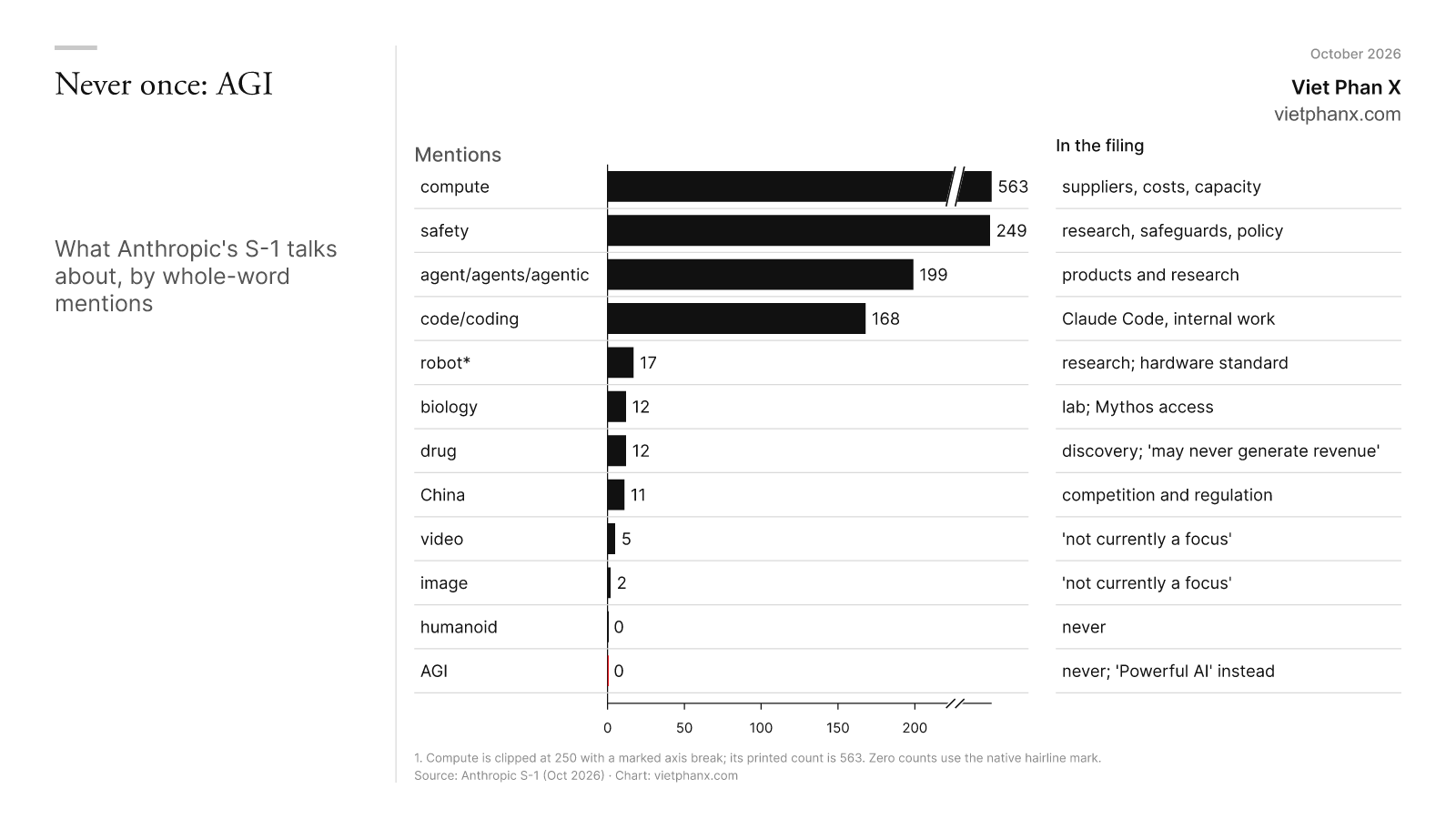
Where does the loop lead? The S-1 never uses the word "AGI." Not once.
The word "superintelligence" shows up exactly one time. It's in a risk factor. It warns that proposed US legislation contemplates nationalizing frontier AI, or ordering it shut down.
The plan is in there anyway, spread across product pages, research notes and risk factors. Here's what Anthropic says it's building, what it chose not to build, and what it's willing to pay for along the way.
One Model, Two Versions
Anthropic's strongest model is sold under two names.
Fable is the version anyone can buy. Mythos goes only to vetted organizations doing cybersecurity and life-sciences work.
They're the same underlying model. The difference is the safeguards. Fable blocks some cybersecurity, biology and chemistry requests, and can send them to a weaker Claude model instead.
Why go to that trouble? Look at how fast capability moves.
ExploitBench is a Carnegie Mellon test of how well an AI can break into software. Claude's scores:
- Opus 4.8: 40%
- Mythos 5, the restricted model: 78%
- Opus 5.5, a regular public model: 91%
All within about four months.
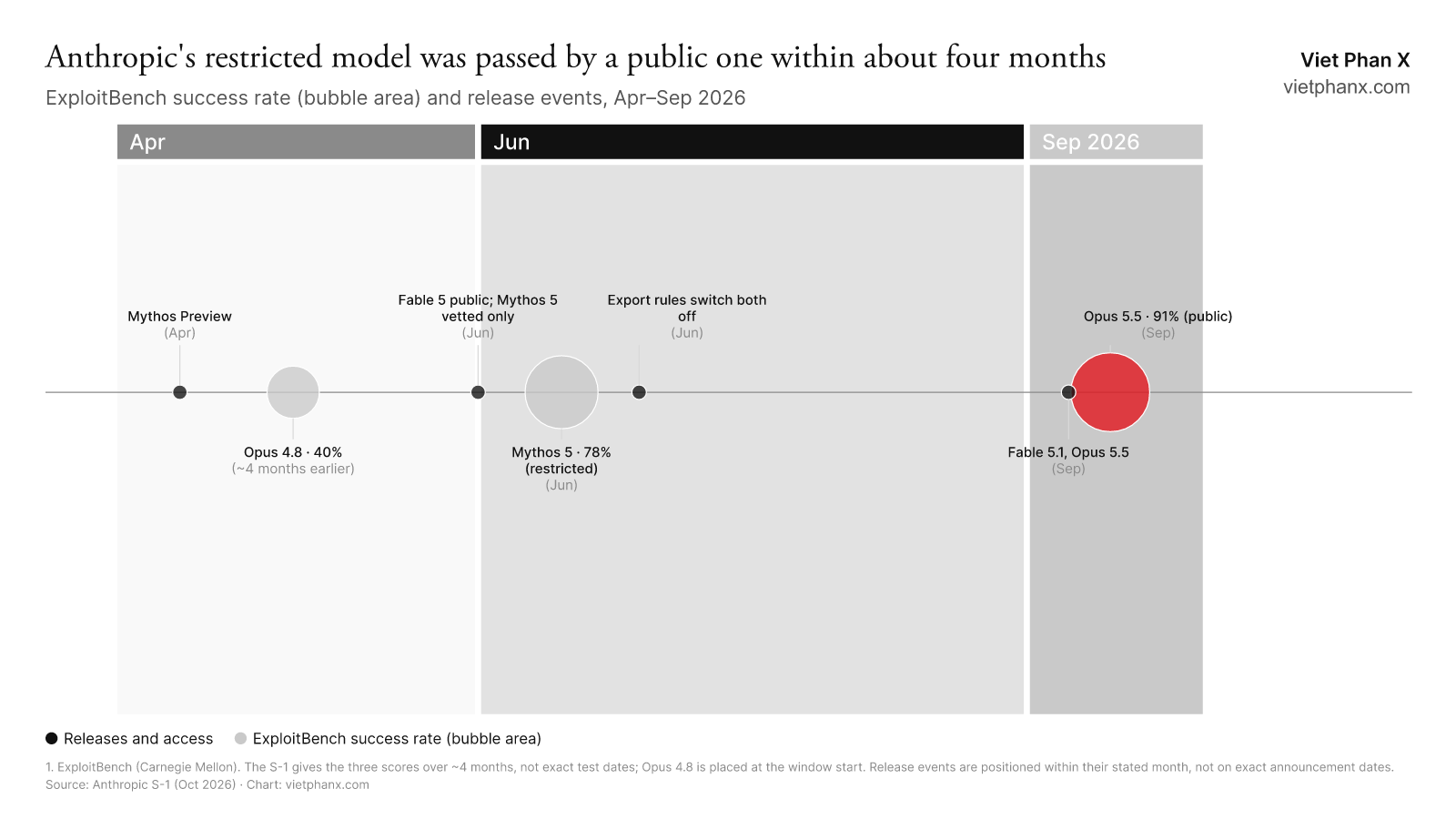
The public model passed the restricted one in about four months. What was held back in June was beaten by a model anyone could buy in September.
So the filing says it plainly: "we do not release every model we develop for general use."
It has also delayed training a new frontier model by more than a month, to better protect the model's weights from theft.
Safety isn't just branding here. It decides when products ship, and who gets them.
Code First, No Pictures
This is the clearest choice in the whole filing:
"We do not currently focus on developing video and image generation models, despite their commercial appeal. That compute instead goes to coding, agentic skills, and safety research."
So no image generator. No video model. The S-1 never mentions a voice product, a device or a wearable.
Why code? The filing gives three reasons:
- the economic impact is large
- safety problems show up there first
- the output can be checked
That last one matters most. Code either runs or it doesn't. So it's easy to check whether the AI got it right.
And it's where the money is. In Q3, Enterprise users who didn't use Claude Code spent under $75 a month on average. The top 5% of Claude Code users spent about 20 times that.
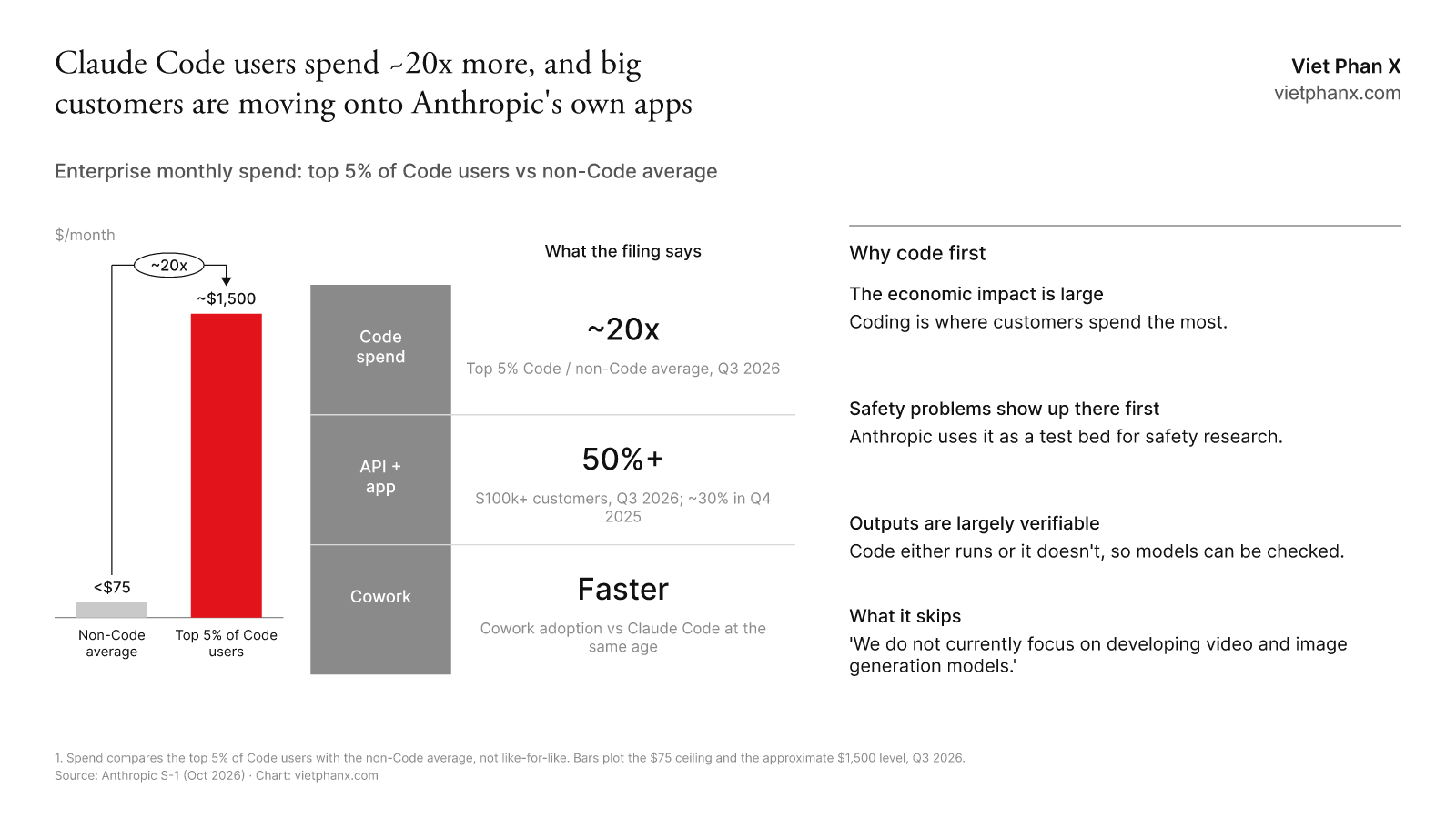
That compares the heaviest users with an average, so it's not a like-for-like gap. It still shows where the spending is.
And big customers are moving onto Anthropic's own apps. Among customers spending $100,000 or more a year, over 50% now use both the API and at least one Anthropic app, up from about 30% nine months earlier.
Coding isn't the end point, though. The filing calls coding "the first such category" to go from experiment to production. Cybersecurity is next.
Then there's Cowork, which works across your files and apps, and clicks through programs that have no integration. Anthropic says Cowork is spreading faster than Claude Code did at the same age.
Biology Labs and Robot Arms
Anthropic isn't only selling AI to scientists. It has started doing science itself.
- It built a molecular biology lab and hired life-sciences experts.
- It bought Coefficient Bio in April 2026, paying in shares.
- Claude Science searches more than 60 scientific databases and returns figures and papers with code you can rerun.
- Bristol Myers Squibb, the Gladstone Institutes, UCSF and the Garvan Institute are named as users.
What about robots?
The word "humanoid" never appears. "Robot" appears 17 times.
Anthropic says it researches how well its models can operate robots. But the way in is a standard, not a robot. Its Model Hardware Standard lets AI agents find and operate lab equipment: microscopes, liquid handlers, off-the-shelf robot arms. It works with any AI model, not just Claude.
The risk factors show what comes with it: handling biological and chemical materials, lab injuries, maybe drug regulation. And any drug candidates it helps find "may never generate revenue."
A software company is now writing biotech risk factors.
How Anthropic Plans to Beat Google and OpenAI
The S-1 names exactly two main competitors: Alphabet and OpenAI.
Meta isn't named. Neither is DeepSeek, or any other Chinese lab. Neither is Grok. SpaceX.AI does appear, but as a compute supplier. (I covered that deal in my last post.)
The plan to win has three parts.
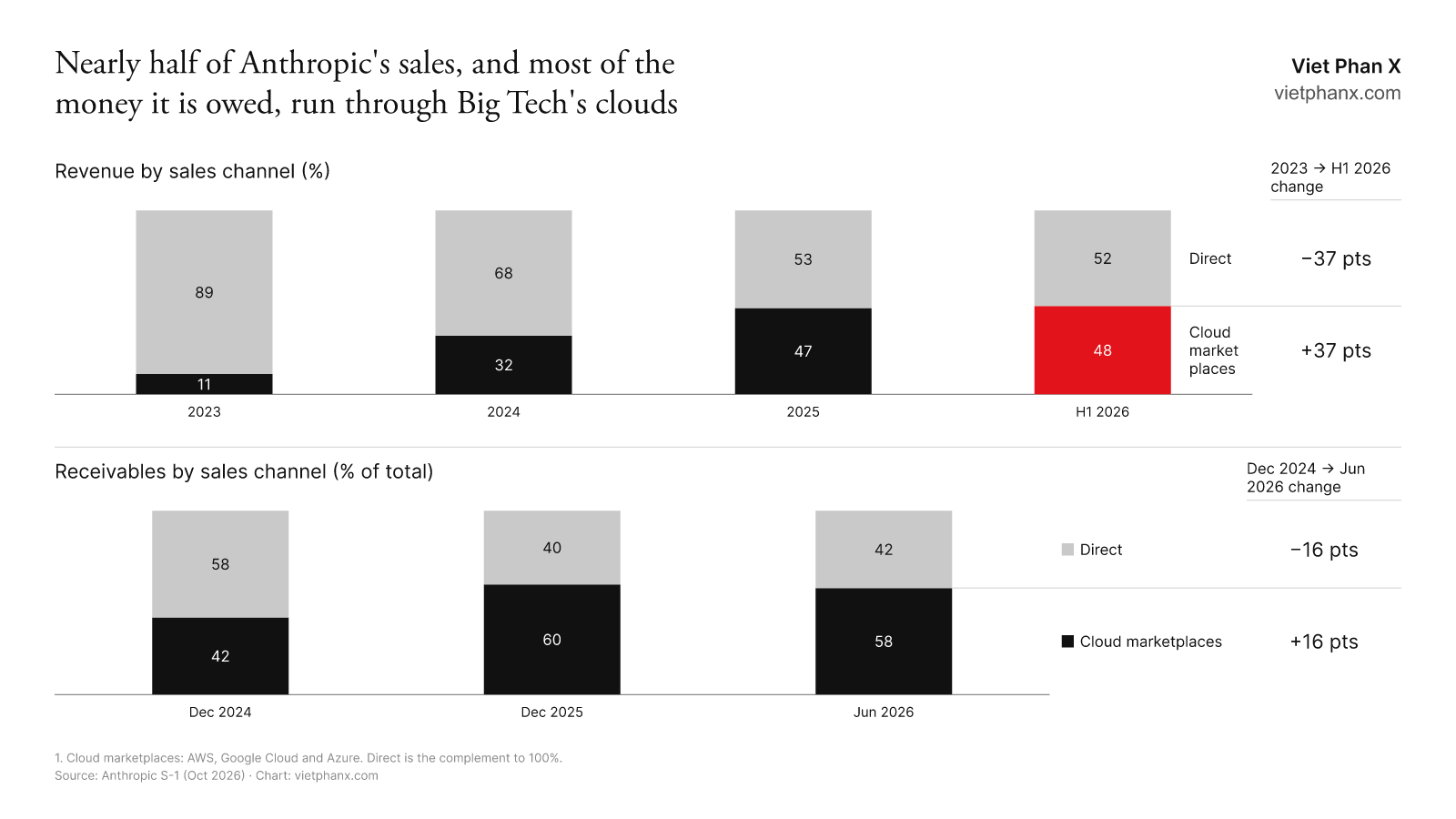
1. Sell through Big Tech. Claude is sold on AWS, Google Cloud and Microsoft Azure. The share of revenue coming through those cloud marketplaces went from about 11% in 2023 to 48% in the first half of 2026. One of those shops belongs to a named competitor: Alphabet's Google Cloud sells Claude. And the clouds also collect the cash: 58% of the money customers owe Anthropic sits with them.
2. Train people outside the company. Its partner network reports over 150,000 certified practitioners across more than 4,000 organizations. Anthropic committed $100 million to that network in 2026, and another $100 million to a new academy that aims to train 10,000 engineers by the end of 2027.
3. Win the individual first. Most adoption so far has been organic: a developer starts using Claude, then their company signs up.
That's also the weak spot the filing admits. If a rival with a bigger consumer app wins those individual users first, Anthropic's "pipeline of enterprise opportunities could be reduced," in ways its current sales team may not be able to make up.
Its business customers start as individual users. Lose the individuals, and the pipeline shrinks.
And one more line that raised an eyebrow. If AI models start to look alike, the filing says, competition "could increasingly depend on access to large-scale compute rather than on model development capability."
So the edge could move from research to compute. Anthropic rents most of its compute. Some of it from a rival lab. It has even signed arrangements that involve running power stations.
Open Models and the Race to the Bottom
I expected the filing to call open models dangerous. That's the usual line: anyone can download them, so anyone can misuse them.
It doesn't.
In the S-1, open models are a business problem, not a safety one. Anthropic describes them as models "released by state actors and international and domestic research organizations" that "prioritize cost efficiency over maximum intelligence."
And it says what they could do:
- "capture a portion of the market for certain use cases"
- "exert pricing pressure on our offerings"
- convince customers that frontier gains "do not justify the additional cost," so they move to "smaller, cheaper, or open-source alternatives"
The phrase "race to the bottom" never appears. But that's what those lines describe.
Anthropic's answer is to cut its own prices. In September:
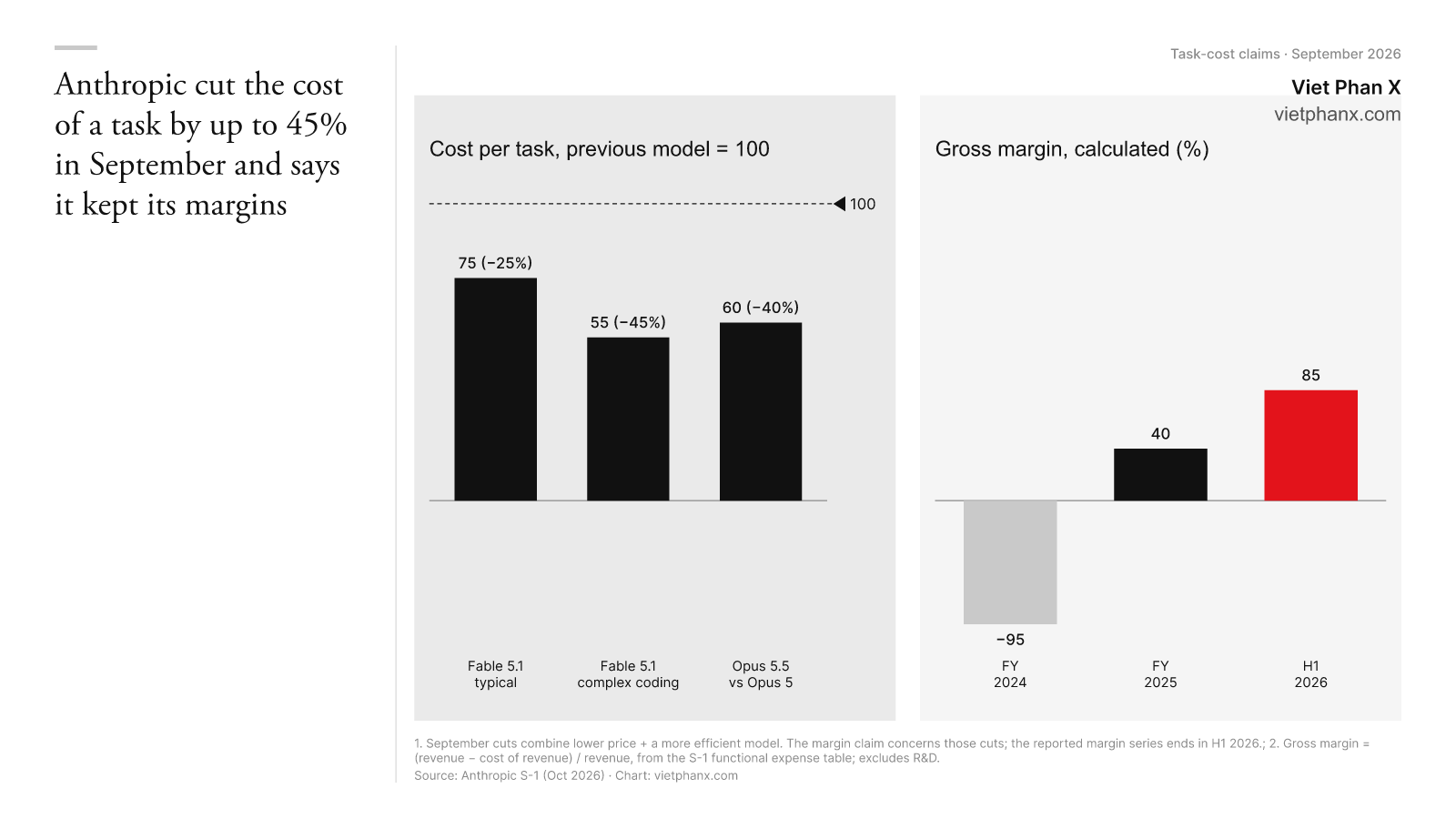
- Fable 5.1 cut the cost of a typical task by about 25%, and up to 45% for complex coding
- Opus 5.5 cut the cost per task by about 40% compared with Opus 5
Part of that is a lower price, part is a more efficient model. Anthropic says it kept its margins anyway. The filing has no margin figure after September yet. But margins were already climbing fast before the cuts: by my calculation from the filing's cost table, gross margin went from about 40% in 2025 to about 85% in the first half of 2026.
This worries Anthropic more than its rivals, and the filing says why. Many competitors "pursue broader development across AI modalities." Anthropic doesn't. So any pricing pressure on its core models has a "direct and disproportionate impact" on its revenue.
That's the cost of skipping pictures.
My take: for normal users like me, open models are good news. They push prices down for everyone, and I think they're part of why Anthropic keeps cutting.
One irony to finish. The only place the filing links open source to safety is Anthropic's own open source. Its lab-and-robot protocol is open, and the filing warns that others may run it in setups "from which our safeguards have been removed."
Costs That May Never Pay
Anthropic is a public benefit corporation. The filing spells out what that can cost a shareholder.
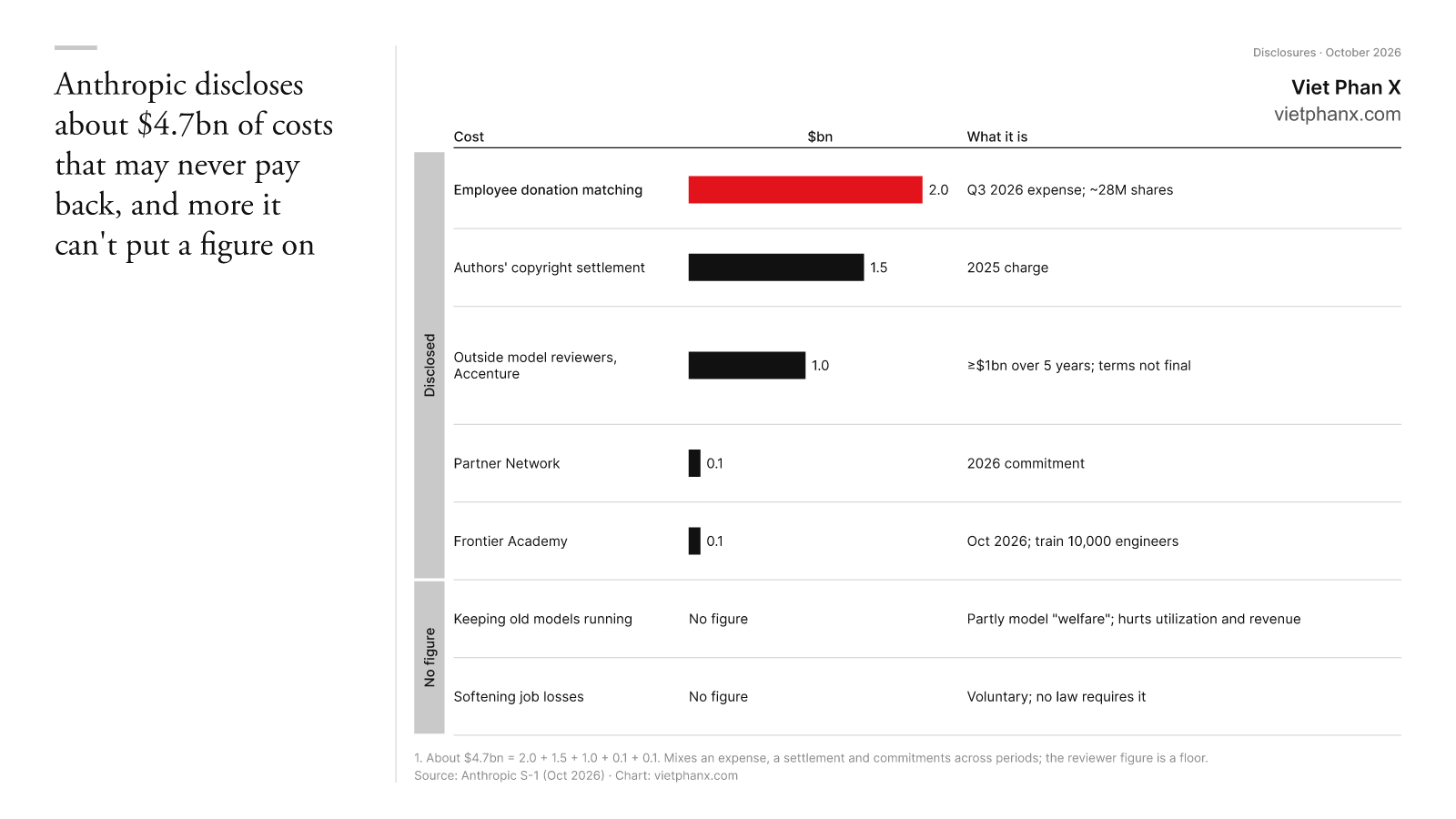
- $2.0 billion, booked in Q3 2026, for matching employees' charitable donations. Paid in about 28 million shares in October.
- $1.5 billion to settle a copyright lawsuit brought by authors over the books used in training.
- At least $1 billion over five years with Accenture, to bring in outside reviewers for its models. The terms aren't final.
Then the costs with no price tag yet.
- It may keep old models running longer. One of the reasons it gives is the models' "welfare". The filing says that can hurt "infrastructure utilization, and revenue."
- If AI starts destroying jobs quickly, Anthropic "may from time to time voluntarily elect" to spend money softening the blow. No law requires it. It may get nothing back.
- It refuses to let its models run fully autonomous weapons or mass surveillance. The filing notes the government has suggested it could use the Defense Production Act to force those limits off.
Who checks that all of this serves the mission? The board, against five mission goals. And the filing says it won't measure its public benefit "against an objective third-party standard."
"Powerful AI" Within a Few Years
So what is Anthropic actually building toward?
It doesn't say AGI. It says "Powerful AI," and defines it:
- as good as top human experts in most professional and scientific fields
- able to use everything a remote worker uses: text, audio, video, the computer itself
- able to work on its own for "hours, days, or weeks"
- able to run many copies that work together
- able to control lab equipment and robots
And it gives a rough date: Powerful AI "will become widely available within a few years."
The product version is millions of Claude agents working in parallel. Anthropic's phrase for it is "a country of geniuses in a data center."
Put the bets side by side and you can see where each one stands today.
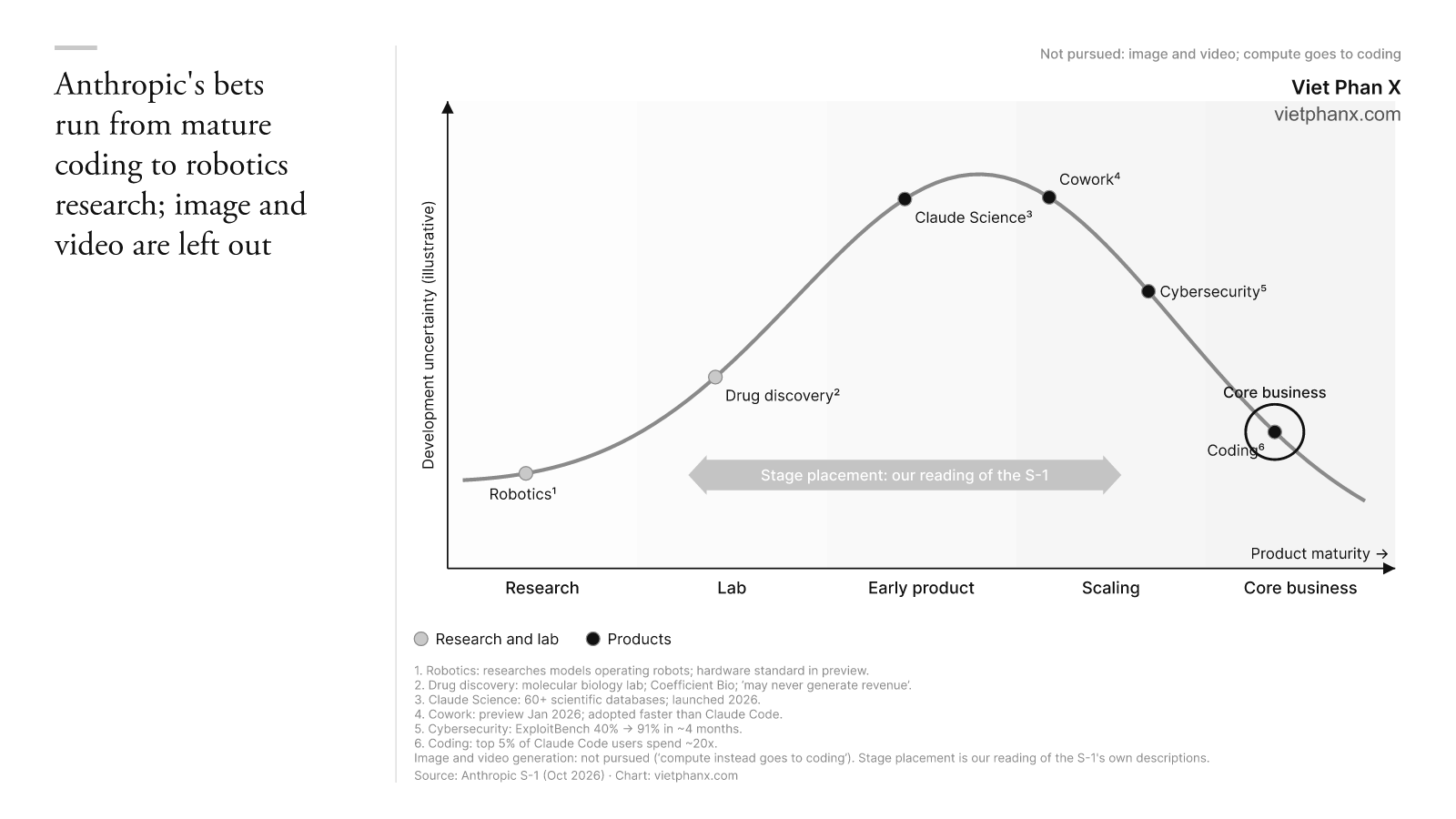
That's the plan. It's all in the filing. It's just not where most people looked.
What the filing doesn't give you:
- a date for any of it
- a gigawatt figure for the compute behind it
- a revenue number for coding, science or Cowork
If you buy this IPO, you aren't buying the $16.3 billion of revenue. Everyone already has that number.
You're buying that list of five abilities. And a bet that nothing stops Anthropic on the way: not safety rules, not the courts, not a rival with more compute.
The risk factors tell you which of those Anthropic worries about most.
This is how I'm reading the filing, not investment advice.

Copyright Viet Phan 2026. All rights reserved.Reuse this content