CoreWeave's Two Prices for Money: 16% on Its Own Name, 7% on Its Customers'
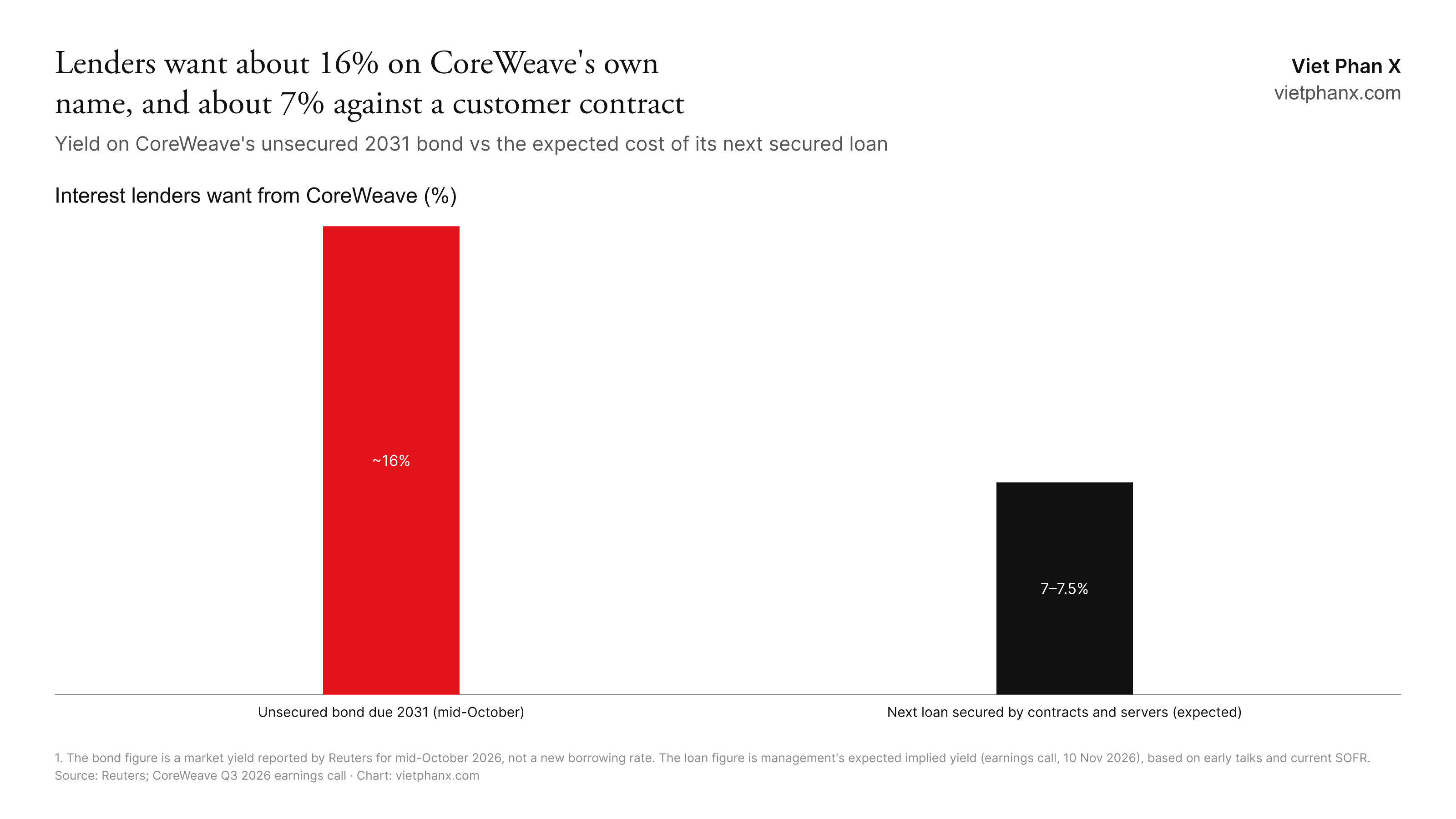
Revenue rose 168%, but the news was the debt: about 16% on CoreWeave's own bonds, about 7% on its next loan, backed by customer contracts.
By Viet Phan12 November 20263 min read
An update on a public forecast from November 1. Prices as of the November 12 close.
16%.
That's about what CoreWeave's bond due in 2031 was yielding in mid-October, Reuters reported.
On Tuesday, the company's finance chief, Nitin Agrawal, drew the line on the earnings call:
"At current yields, we do not intend to issue additional parent-level unsecured debt through 2027."
In plain words: CoreWeave won't borrow more on its own name at that price.
The Strong Quarter
The quarter itself was good.
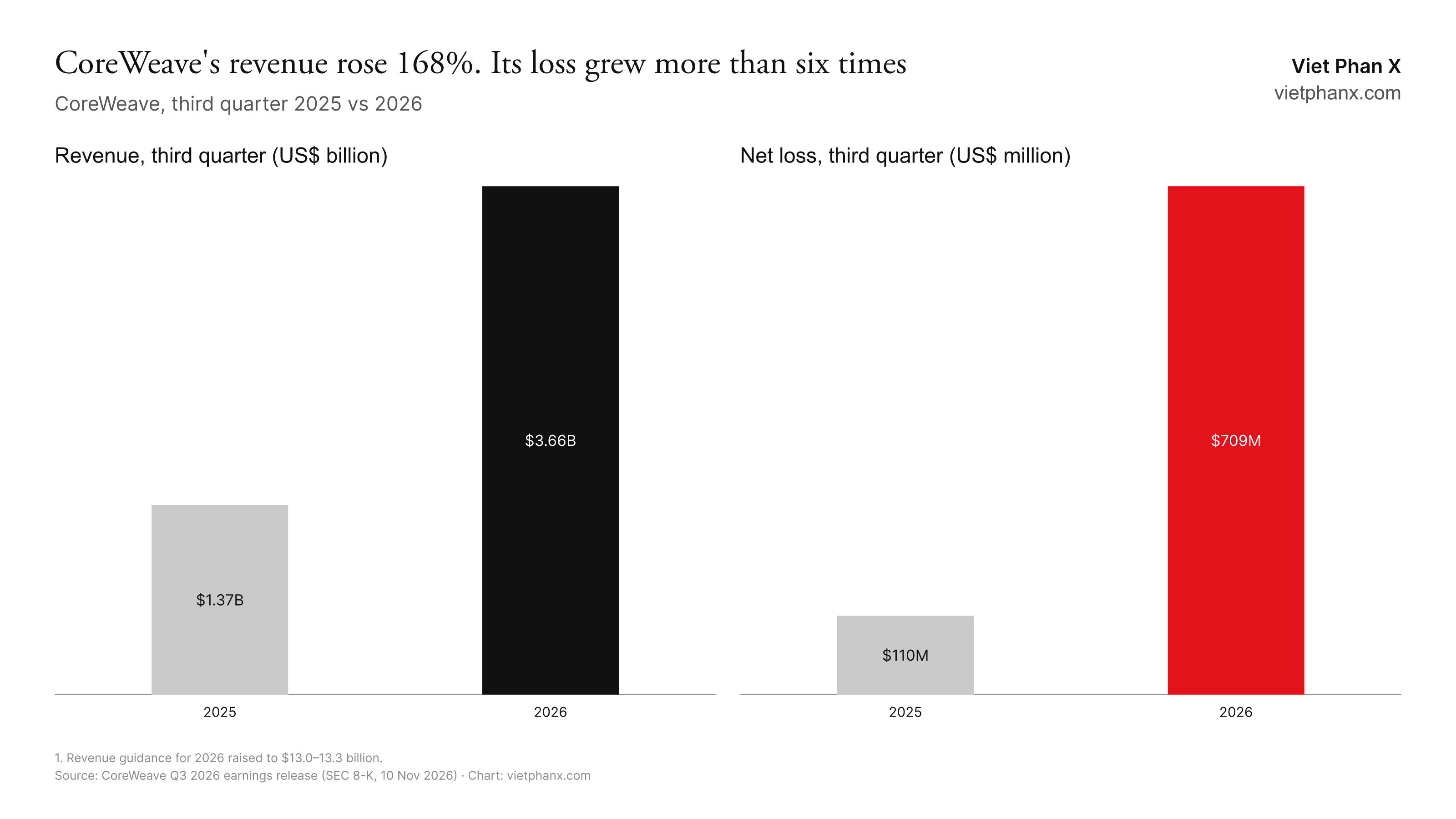
Revenue was $3.66 billion, up 168% from a year earlier and above the $3.55 billion analysts expected, according to LSEG. CoreWeave raised its 2026 revenue forecast to $13.0–13.3 billion. The stock rose about 8% after hours.
The loss grew faster. CoreWeave lost $709 million in the quarter, against $110 million a year earlier.
The Two Prices
So where does the money for 2027 come from?
Management named four places:
- Prepayments from customers.
- Financing from the hardware makers.
- Loans secured by specific customer contracts and the servers behind them.
- Cash the business generates.
The loans are the big one. Agrawal expects the next one to launch "in the coming weeks" and to cover over 90% of what the new capacity costs.
The expected interest: about 7–7.5%.
Think of it as a car loan instead of a credit card. The bank lends cheaper when it can point at the car.
Here, the car is the servers, and the paycheck is a signed contract with an AI lab. Lenders like both. Agrawal said CoreWeave's existing secured loans still trade "around par value."
The Customers' Name
CoreWeave owed $46.9 billion at the end of September. It plans to spend $37–39 billion on new capacity this year.
More and more of that will rest on its customers' contracts.
The biggest customers are the AI labs. One of them, Anthropic, is expected to start trading on the Nasdaq on November 19, targeting a valuation of up to about $1.4 trillion.
Nvidia sits on the other side of the same bet. It invested $2 billion in CoreWeave in January, sells it the chips, and co-signs for other AI customers.
Two days after CoreWeave's call, Nvidia's finance chief became its interim CEO.
The Freeze Bonus
The week before, voters across the US approved dozens of local measures restricting data-center development. Texas elected a governor who campaigned against data-center tax breaks.
CEO Mike Intrator said the overwhelming majority of CoreWeave's power in Texas is already online, or fully permitted and under construction.
His view: if building slows across the industry, installed compute becomes scarcer, and GPU rental prices may stay higher for longer.
The Forecast
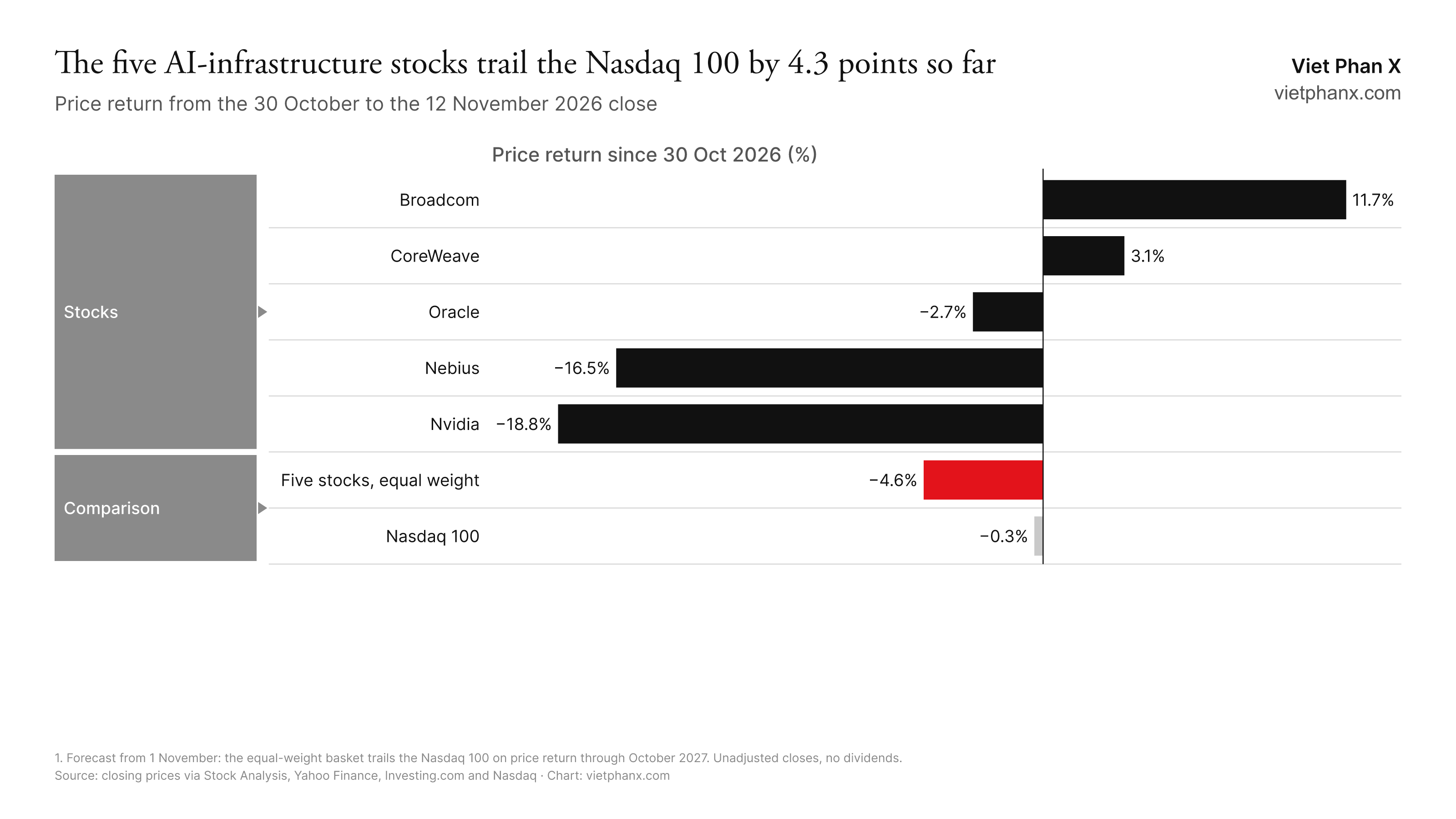
Forecast from November 1: CoreWeave, Nebius, Oracle, Broadcom and Nvidia, in equal weights, trail the Nasdaq 100 on price return through October 2027.
Opened at the October 30 closes. By November 12, the five stocks were down 4.6% and the Nasdaq 100 down 0.3%: 4.3 points in the forecast's favour.
CoreWeave's own stock is up 3.2% since then. Nvidia is down 18.8%.
Closes on the last trading day of October 2027. Wrong if the five stocks match or beat the index.
A loan at 7% backed by an AI lab's contract is only as good as the lab.

Copyright Viet Phan 2026. All rights reserved.Reuse this content