Three Governors Already Froze Data Centers. 78% Chance Another State Does by June.
Three US governors froze new data centers with a signature, no vote needed. I put 78% on another state by June, and history says what comes next is rationing.
By Viet Phan9 November 20269 min read
Forecasts as of 8 November 2026. They resolve on 30 June 2027 unless marked otherwise.
America's first statewide data-center freezes have already happened.
Three of them, in three months.
New York went first. On July 14, Governor Kathy Hochul, a Democrat, paused environmental permits for new data centers of 50 MW or more, for a year.
Then Texas. On August 3, Governor Greg Abbott, a Republican, stopped new data-center grid hookups until the queue is audited. On September 21 he went further and halted state environmental permits for data centers until an audit is done.
Texas. The state that sells itself on building anything, anywhere, fast.
Then Oregon. On October 9, Governor Tina Kotek, a Democrat, stopped air and water permits for new or expanded ones until July 2027.
None of them needed a vote. All three acted by order or by a letter to a state agency.
Then on November 3, Democrats won big. Several of them had campaigned on pausing data-center construction.
The headlines wrote the same story: blue wave, data-center freezes, AI build-out in trouble.
I ran the numbers on every state where a new freeze is on the table. The headlines got the first part right.
The rest they got wrong.
- 78%: another state freezes by June. At least one adopts a new statewide freeze by June 30, 2027.
- Watch the governors, not the legislatures. In most of the likeliest states, a governor or a regulator can freeze alone. In Arizona and Virginia, the governors who could act have said no, and a new law would likely come too late.
- A freeze rations the build-out. Every big freeze before this one ended in rules about who gets power. None was simply lifted.
- The industry may ask for the pause.
The Strict Freeze
First, what counts.
Most of what gets called a freeze this winter won't count here.
A state counts if it:
- stops new data centers statewide for at least 90 days,
- covers ordinary ones of 20 MW and up, about the power use of 15,000 American homes,
- decides it after the election, from November 7 on,
- has it in force by June 30, 2027.
These don't count:
- A town or county ban.
- A pause on crypto mining only, or on state land only.
- The three orders already signed. A state that keeps its old order hasn't made a new decision.
The wording matters more than I expected. With a looser test, my Georgia number jumped 20 points.
Nothing in Georgia had changed.
The Town-Line Freeze
The towns got there first.
I've collected 45 US towns and counties that adopted a data-center pause or ban in 2026, each with a dated public source. 44 are still in force.
Other trackers count between 200 and 950, depending on what they include. All of them show the same shape.
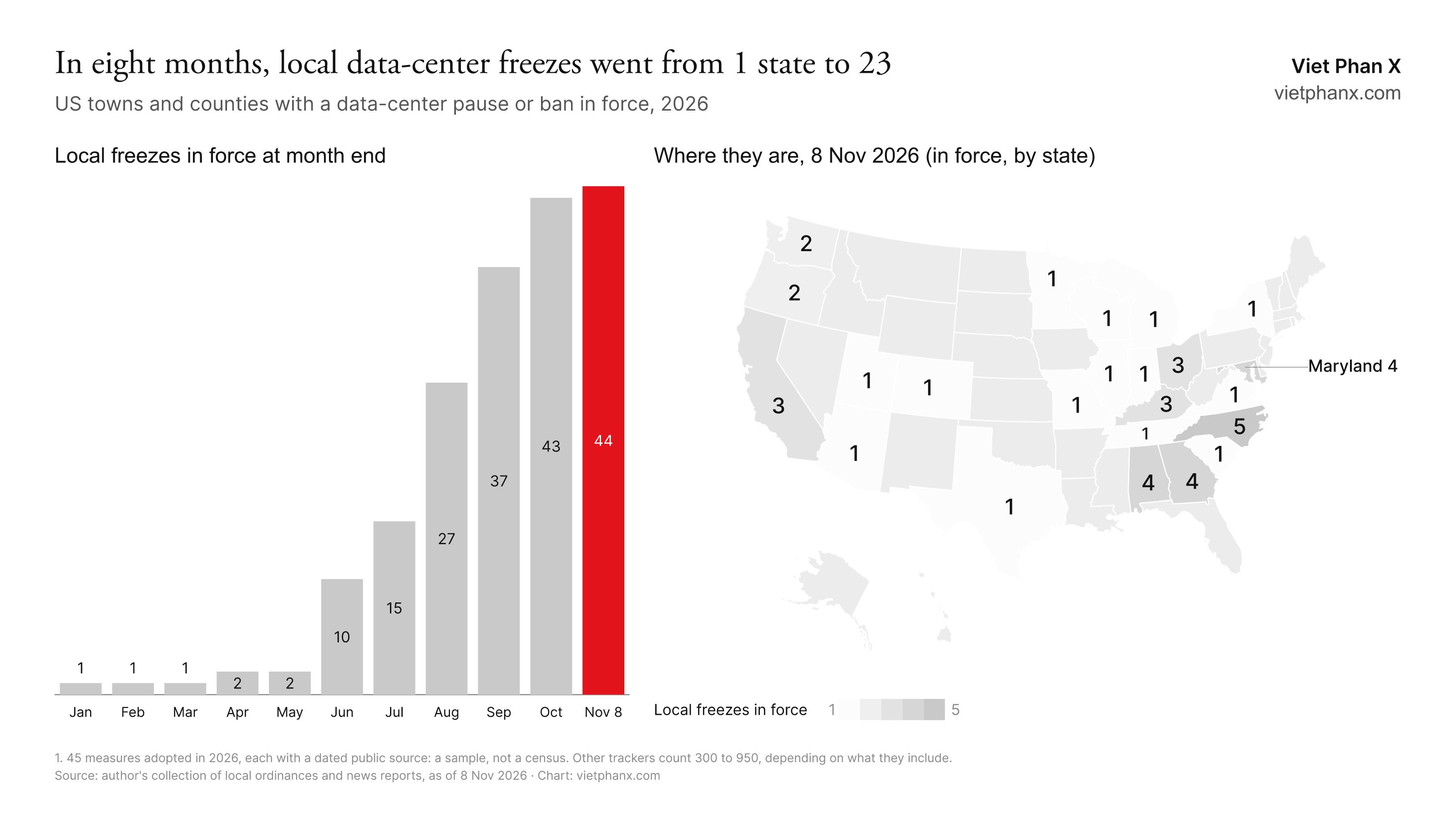
Until May, there were two.
By November, there were 44, in 23 states, from Washington to Georgia.
Every one of those towns is in a state where a governor now hears the same complaint statewide: my power bill went up, and the data center got a discount.
The Signature Problem
If you don't follow US politics, think of each state as a company.
The legislature is the board. It can vote for a ban. But both of its chambers have to pass it, and then the governor has to sign.
The governor is the CEO. An executive order is a CEO memo. It's fast and needs no vote, but a court can strike it down.
The utility commission is the building manager. It decides who gets plugged into the grid, and it can stop new hookups on its own.
All three freezes so far were CEO memos.
So for each state, I looked at who can stop construction by June, and whether they want to.
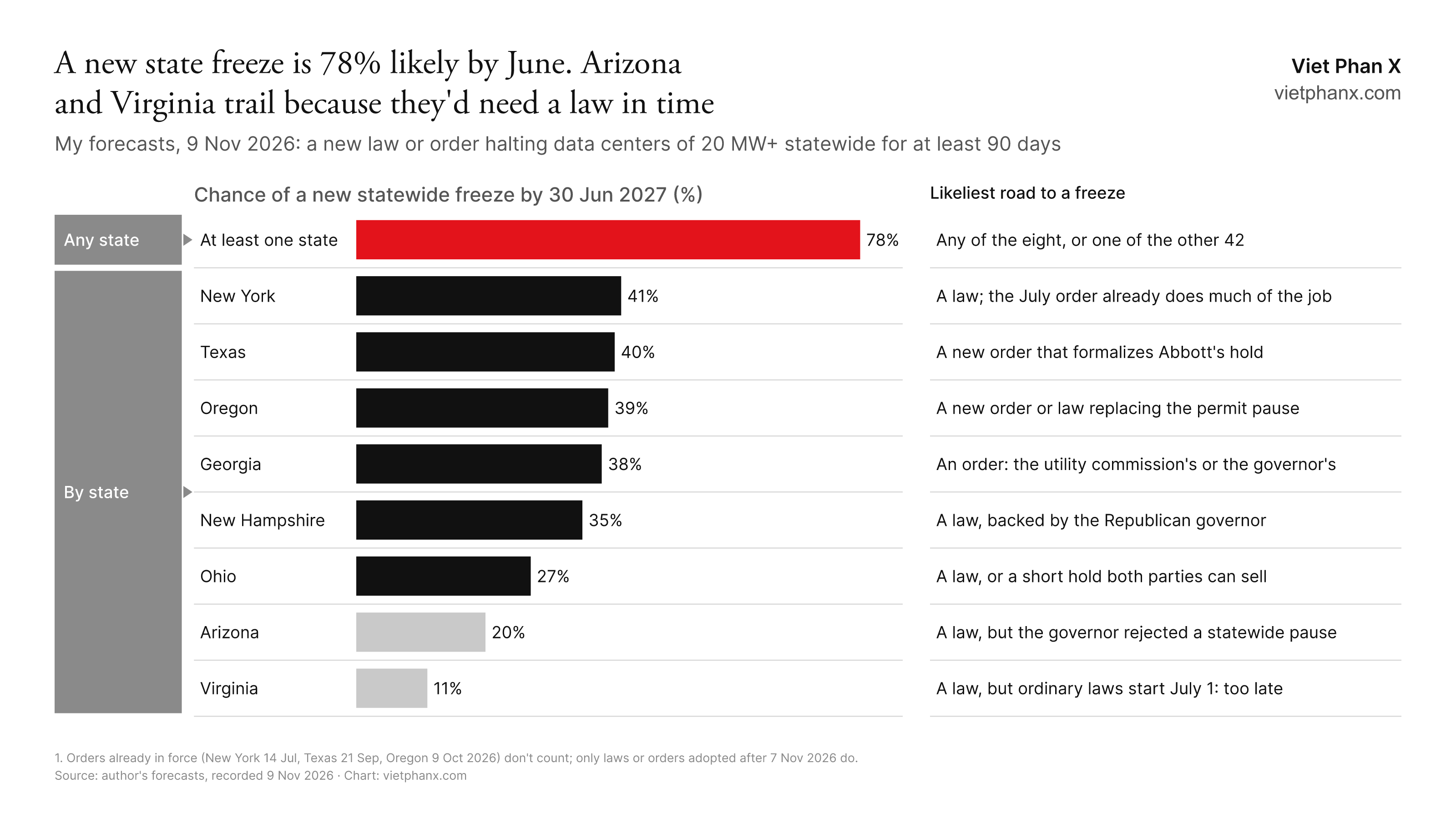
The top four are within three points. New York 41%, Texas 40%, Oregon 39%, Georgia 38%. Read them as a tie.
New York: 41%
The first state to freeze could freeze again.
It's also the exception to the CEO memo. Here the board is the likelier road: lawmakers already passed a moratorium in June. It still sits unsigned. If Hochul signs it, now or in 2027, it counts.
The risk: Hochul's order already does the job, so there's less pressure to pass a law by June.
Texas: 40%
It has already frozen twice, under Abbott.
The new governor, Democrat Gina Hinojosa, campaigned on a moratorium. Democrats also flipped the state House.
The risk: she keeps Abbott's holds instead of signing her own. That doesn't count.
Oregon: 39%
Kotek's permit pause runs to July 1, 2027.
The state says it lacks the power for a broader ban, so she has asked lawmakers for statewide rules early in 2027.
A new law before June would count. Letting the old pause run would not.
Georgia: 38%
Governor-elect Keisha Lance Bottoms made a statewide pause a priority.
Republicans kept the state Senate, so a law is a long shot.
If Georgia freezes, the building manager, its utility commission, is the likelier one to do it.
New Hampshire: 35%
The state nobody is watching.
Republican Governor Kelly Ayotte has backed a pause, and Democrats won both chambers.
A Democrat and a Republican have each filed a moratorium for 2027.
The risk: it gets folded into a budget that passes too late.
Ohio: 27%
Governor-elect Amy Acton wants a moratorium, on one condition: developers pay their own grid costs.
Republicans kept both chambers. She needs their votes.
Arizona: 20%
Democrats took the legislature. On August 31, the state's attorney general called for a pause.
Three days later, Governor Katie Hobbs said: "I don't think a statewide moratorium is the answer."
She's the one who signs.
Virginia: 11%
The world's biggest data-center market, and the least likely to freeze.
The reason is the calendar. Laws passed there in 2027 take effect on July 1.
One day after my deadline.
New York and Oregon are run entirely by Democrats too, and they're two of the top three. Arizona and Virginia are at the bottom.
Same party. The difference is who can act without a vote.
The Rationing Rule
Say a state does freeze. Does the AI build-out stop there?
History says no. I went through every big data-center freeze I could find since 2019, plus two crypto-mining bans that worked the same way.
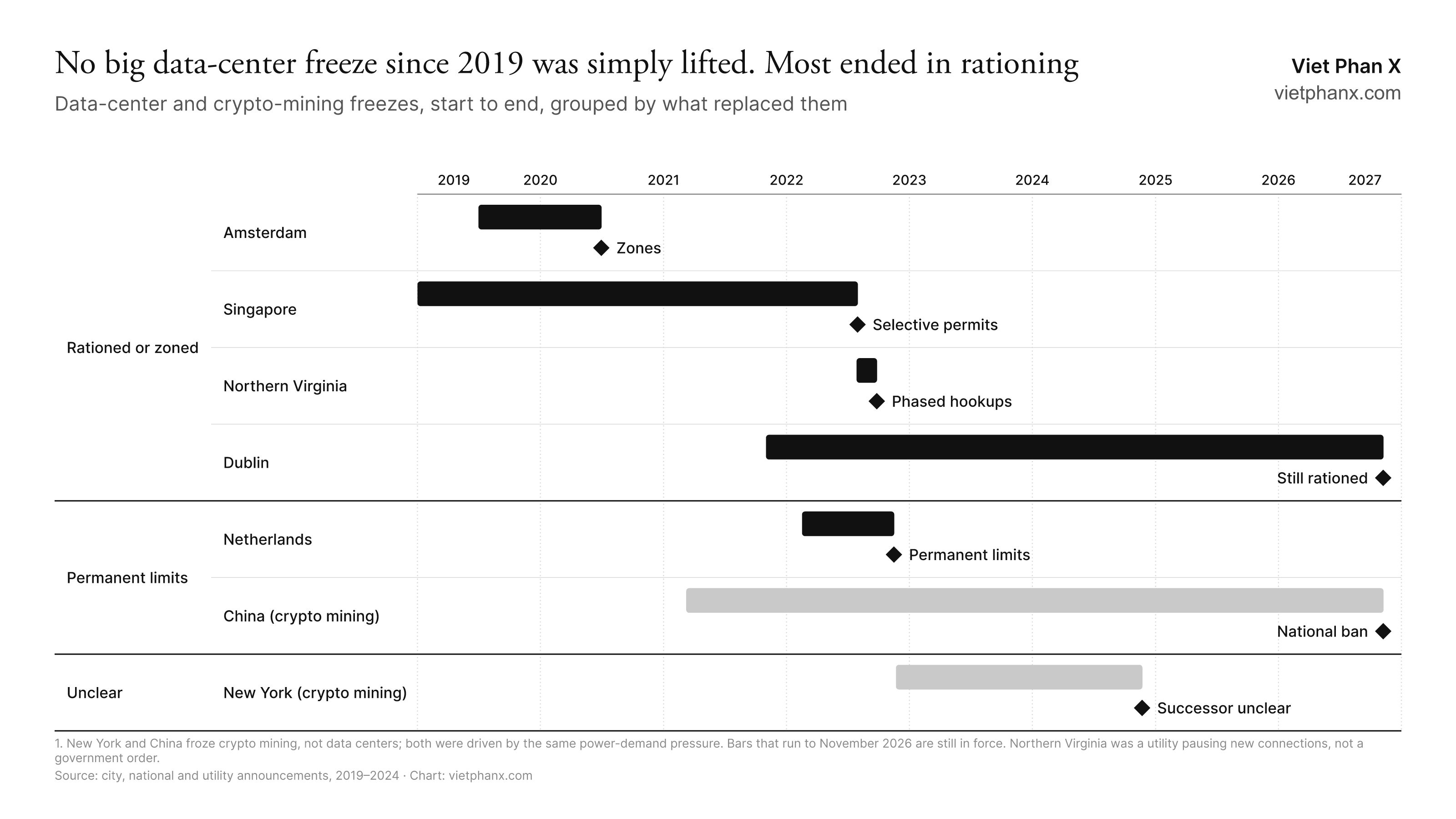
- Amsterdam paused for about a year, then reopened in designated zones.
- Singapore paused for three years, then allowed new capacity only through selective permits.
- Northern Virginia's main utility paused new connections for about two months in 2022, then phased hookups in.
- Dublin's grid operator rationed connections from 2021, and rules in 2025 and 2026 made that formal.
- The Netherlands turned a nine-month pause on giant campuses into permanent limits.
Not one was simply lifted. Each ended in rules for who gets power, and when.
So one of my calls is about what comes after: 65% that a state which freezes then adopts binding rules for who gets power, by the end of 2027.
The Industry Pause
This is the part I didn't expect.
In most of these states, the same possibility keeps coming up:
The industry asks for the pause.
It sounds backwards until you look at the grid queues. They're clogged with speculative projects: land bought, a connection requested, no tenant, no money yet. A real data center waits behind them.
A 90-day statewide hold with clear rules clears out the speculators. It replaces a patchwork of 45 local bans with one process. And it lets the companies that can actually pay for their power go first.
It would look like a defeat for the industry.
But it would work like a fast lane.
Three Roads in Georgia
Georgia shows how a freeze actually gets made. It has three roads to one, and each runs on its own clock.
Back to the company.
The building manager: the utility commission. Democrats won a 3–2 majority on November 3. It can stop new large hookups to the grid statewide, with no vote in the legislature.
That's the road that moves my number most. If the commission orders a halt by June 30, Georgia goes from 38% to 84%.
The CEO: Governor Bottoms. She can sign an order. In September she wasn't sure she had the power to act alone. Since the election, she has said she will sign one.
If a court blocks her order within 90 days, it doesn't count.
The board: the legislature. It needs both chambers, and Republicans kept the Senate. The long shot.
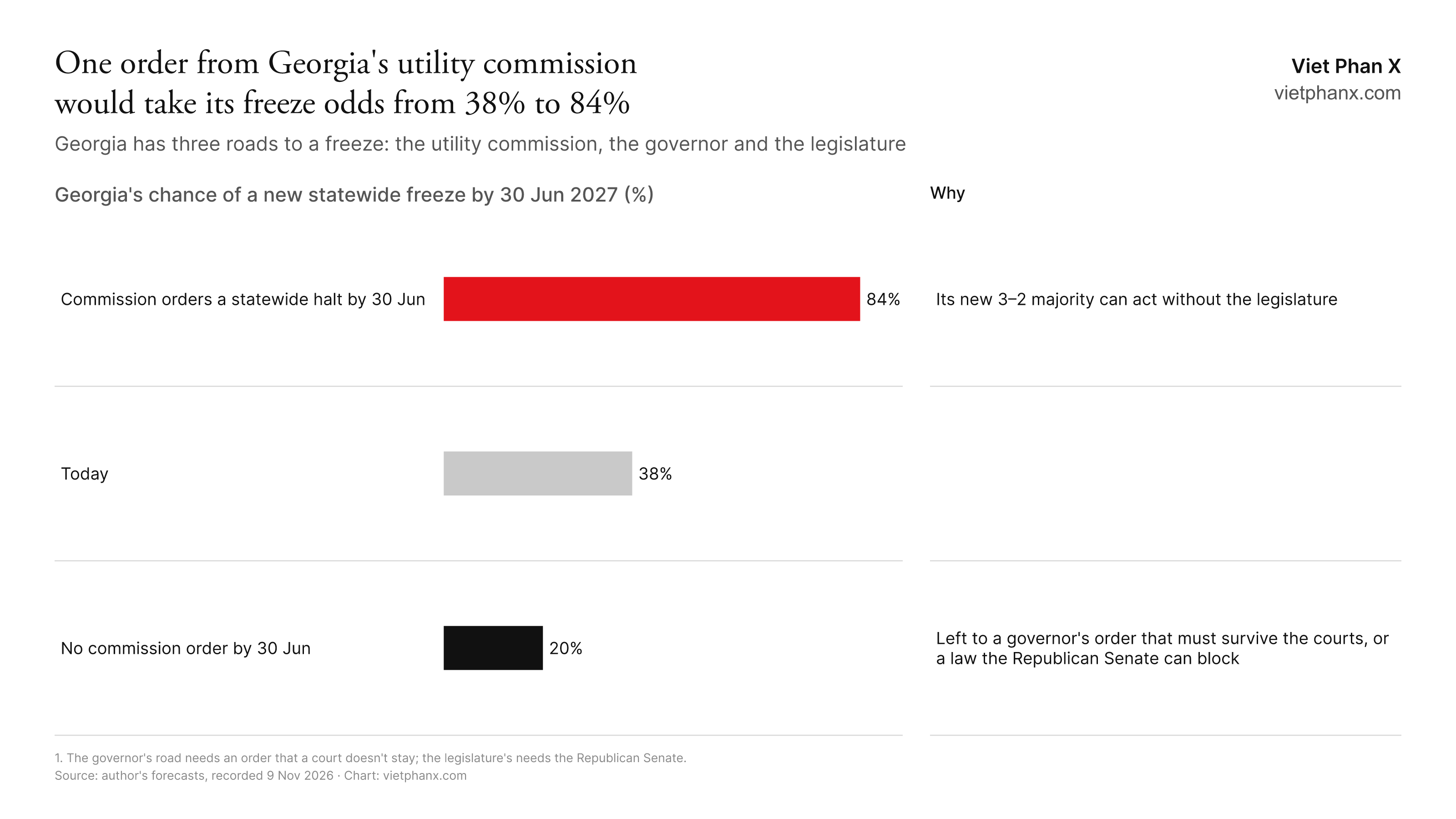
The likeliest Georgia outcome has no pause in it.
The commission makes data centers pay their own grid costs, and lets them keep coming.
Rationing again, minus the freeze.
What Would Change These Numbers
A forecast is only useful if you know what would move it.
For six of the states, here's the one event that would move my number most. If it happens, use the first number. If its deadline passes and it hasn't, use the second.
| If this happens… | State | Then | If not |
|---|---|---|---|
| A new executive or agency order formalizes Abbott's hold | Texas | 84% | 12% |
| The utility commission orders a statewide halt by June 30 | Georgia | 84% | 20% |
| Both chambers pass a moratorium by April 30 | New Hampshire | 83% | 13% |
| Both chambers pass a freeze bill by April 30 | Ohio | 84% | 9% |
| Both chambers pass a moratorium by May 31 | Arizona | 81% | 10% |
| The governor endorses a pause by March 1 | Virginia | 78% | 3% |
In every state, the swing event is a governor, a legislature or a regulator acting.
The biggest swing is Virginia. If its governor endorses a pause by March 1, it goes from 3% to 78%.
One sentence from one person.
The Forecasts
Five calls, recorded on 9 November 2026. Each one is tracked on the Future page. The other states' numbers are in the chart above.
Measure: a new law or order adopted after November 7, 2026, halting approvals or construction statewide for at least 90 days, covering data centers of 20 MW or more, in effect by June 30, 2027. Wrong if no state does.
Same measure. Keeping Abbott's August and September holds doesn't count. Closes June 30, 2027.
Same measure. Wrong on the route if Georgia freezes by law.
Wrong if Virginia adopts a freeze that meets the measure by June 30, 2027.
Measure: a state that adopts a freeze also adopts binding allocation rules for new large data centers (caps, queues, designated zones, or rules that make them pay their own grid costs) by December 31, 2027. Void if no state freezes.
What would show these calls are built wrong: Arizona or Virginia freezing before Texas, Georgia, New York and Oregon would mean I misread who decides. No freeze anywhere would mean promises turn into orders slower than I think. A freeze lifted with no rationing would mean I misread history.
The probabilities come from my own prediction models, recorded before this post went out.
Corrected 10 November 2026: Texas froze twice (August 3 and September 21), not once; the Netherlands pause lasted nine months, not two years; New York's legislature already passed a moratorium in June; Texas and Oregon acted by letter to an agency, not by executive order.

Copyright Viet Phan 2026. All rights reserved.Reuse this content