Google's Cloud Doubled. And That's the Problem.
Cloud grew 103% and the stock had its worst post-earnings day on record. Cloud eats cash, search makes it, and search is slowing, so Google now sells stock and borrows.
By Viet Phan29 October 20265 min read
Google's cloud business doubled in a year.
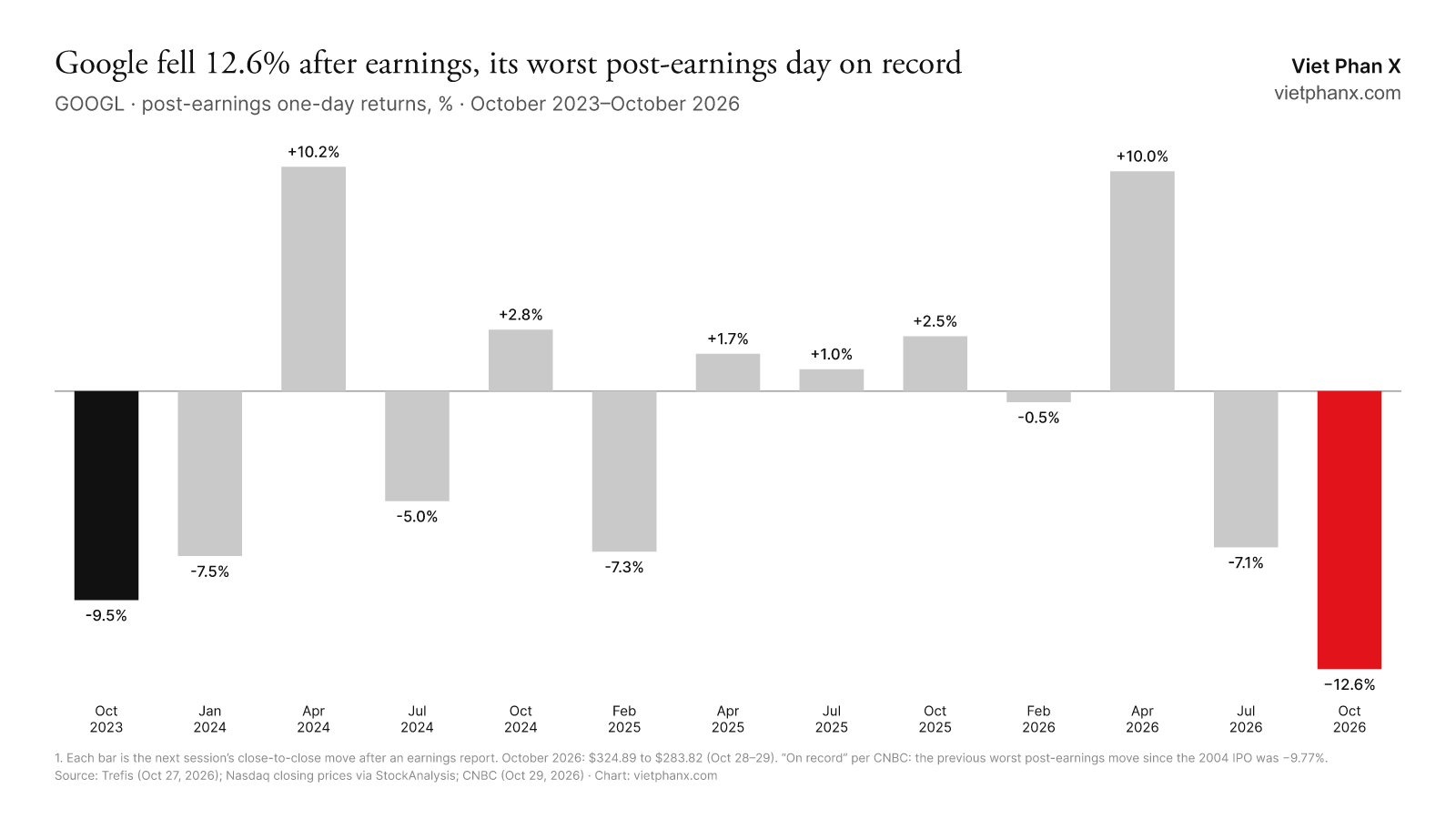
The next day, the stock had its worst earnings day ever.
That isn't a contradiction. Cloud eats cash. Search makes it.
And search is slowing, partly because AI Mode earns less per search.
This year, Google's own cash stopped covering the bill. It sold stock and borrowed the rest.
Here's what I found.
Same night, different verdict
Alphabet reported on October 28. Revenue was $127.6B, up 25%. Cloud, the part of Google that sells AI, was $30.7B.
The next day the stock closed at $283.82, down 12.6% from $324.89. CNBC counts it as Google's worst post-earnings day since it went public. In the twelve reports since October 2023, the worst before this was −9.5%.
Microsoft reported the same evening. Its stock barely moved: −0.2%.
Same night. Same AI story. Very different reaction.
So the market wasn't selling "AI". It was choosing.
More searches, slower money
Search is still Google's engine. $63.4B this quarter, half of all revenue.
On the call, Sundar Pichai said Search queries grew at their fastest rate in five years.
Revenue didn't follow. Search revenue growth went from 19% to 17% to 12% in two quarters. Against the quarter before, it grew by just $79M.
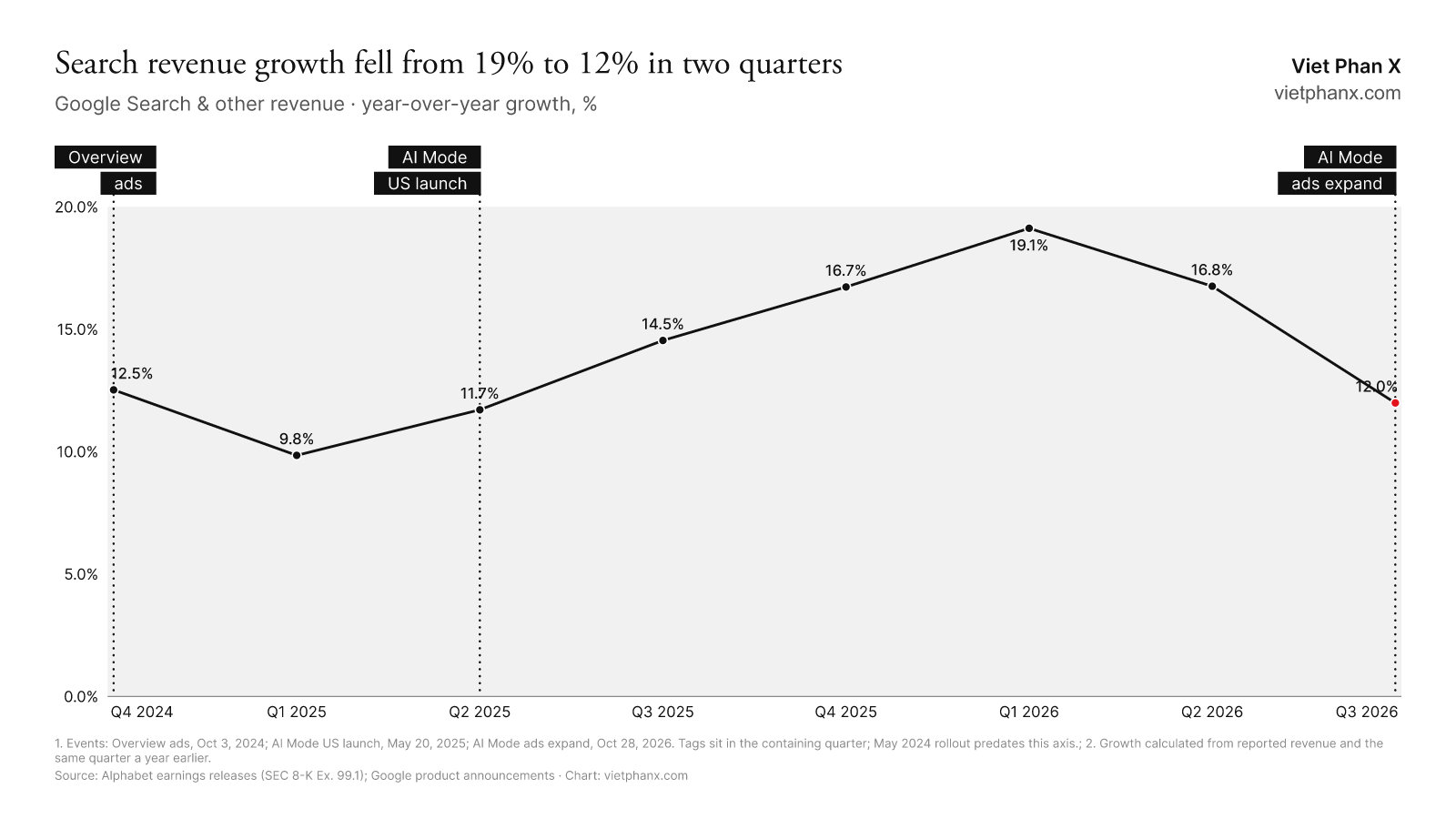
More searching, slower money. How?
An analyst asked exactly that. Philipp Schindler, Google's chief business officer, named currency as the biggest factor. Then he pointed to "lower monetization" in AI Mode, the chat-style search Google launched in May 2025.
That's Google saying it out loud: the AI version of search earns less than the old one.
More clicks, smaller price rises
The 10-Qs show the mechanism.
Before AI Mode, Google grew mostly by charging more per click. Paid clicks grew 2–6% a year. Cost per click grew 7–8%.
After AI Mode, it flipped. This year paid clicks grew 13%, 13% and 8%. Cost per click growth fell to 5%, 3% and 4%.
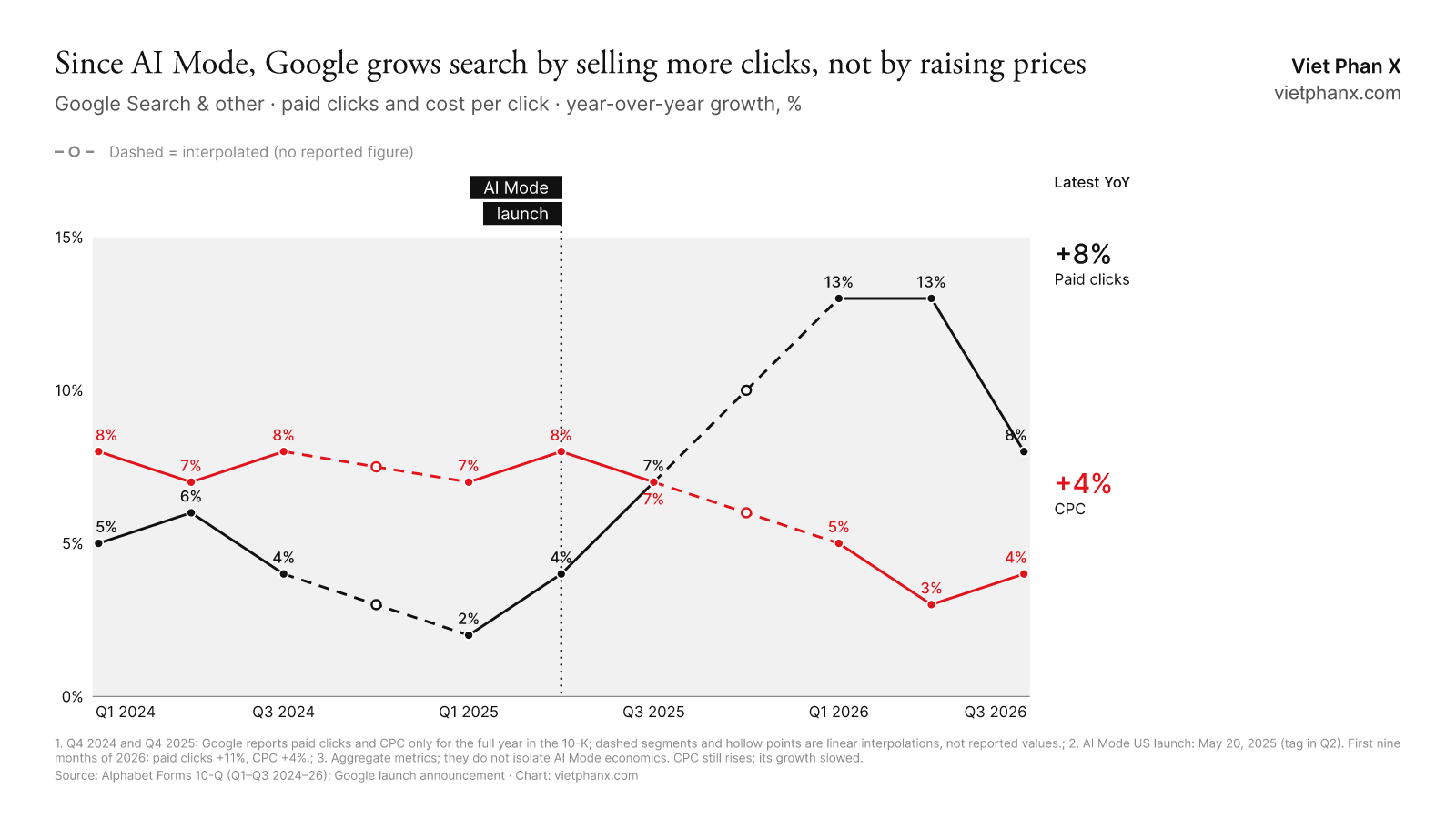
Google now grows search by selling more clicks, not by raising prices. Prices still rise, just slower. And in Q3 the click boom cooled: 8%, down from 13%.
The cash miss wasn't capex
Most headlines say the same thing: Google's AI spending binge burned its cash.
That's only half right.
Capex was $51.4B this quarter. Analysts expected about $55.1B. Google spent less than expected.
The surprise was on the other side. Operating cash flow fell 13% from a year ago, to $42.3B. That includes a $5.2B payment for an old EU fine and a build-up of TPU chips in inventory.
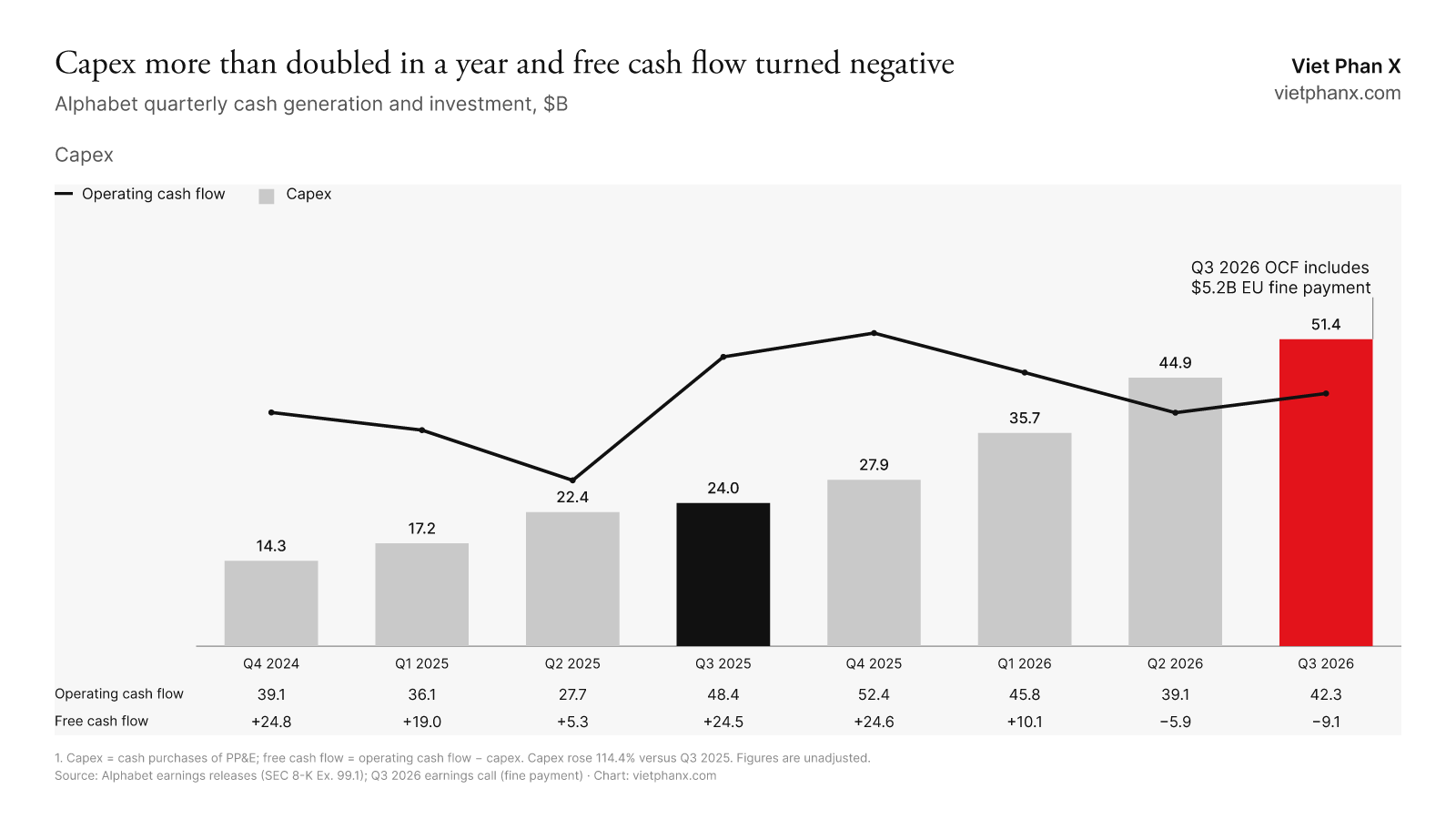
Put together, free cash flow was −$9.1B. A year ago it was +$24.5B.
It's the second negative quarter in a row.
A plan that only goes up
The spending plan has one direction.
In February 2025, Google planned about $75B of capex for the year. It raised that to about $92B.
For 2026, it started at $175–185B. It's now at $195–205B.
For 2027, analysts now expect about $312B. Management only said capex will "increase significantly".
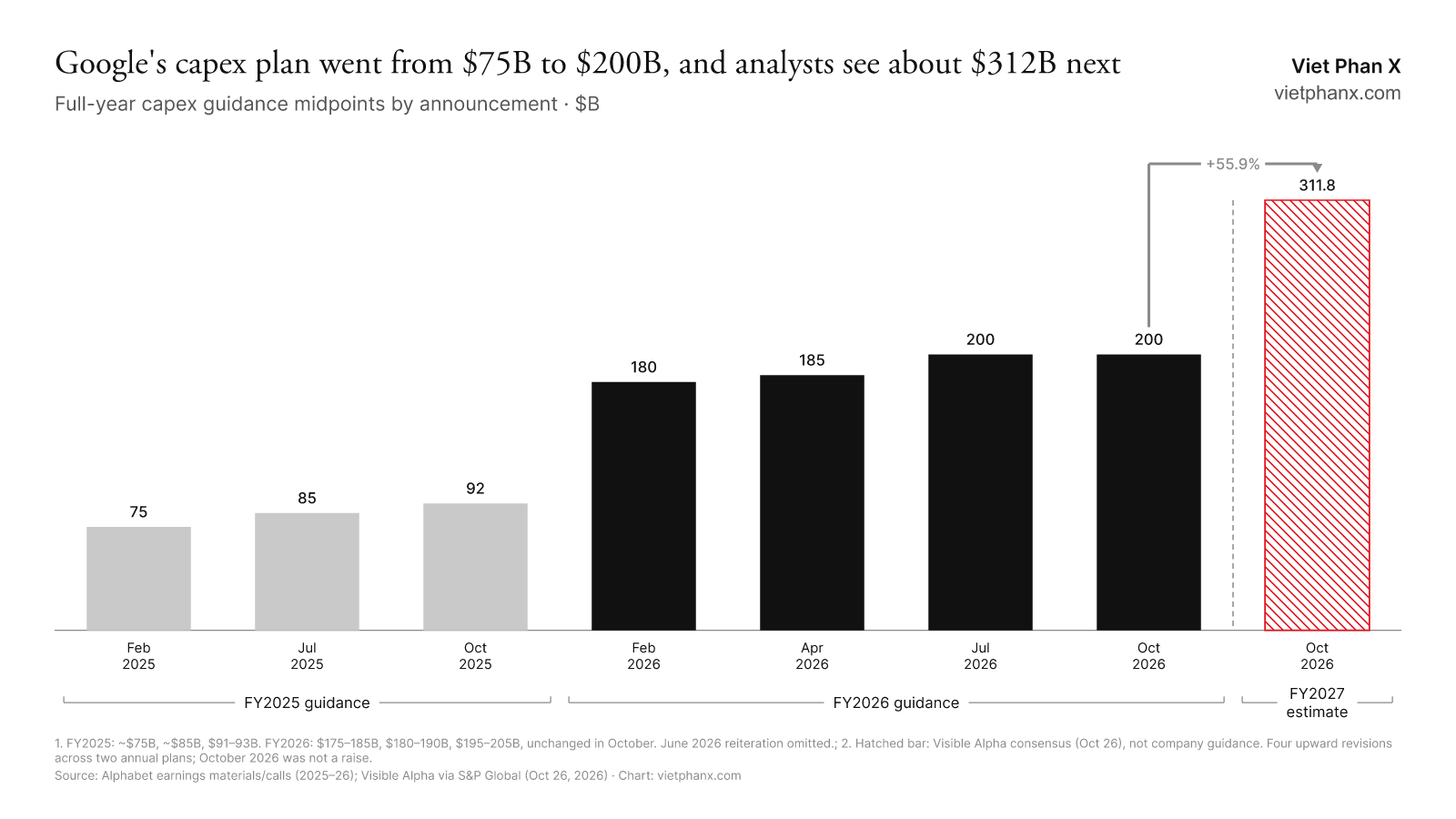
To hit this year's range, Google has to spend $63–73B in the fourth quarter alone. More than any quarter so far.
Who pays for the data centers
This is the chart I'd show anyone asking who pays for AI.
Over the last twelve months, Google made $179.6B of operating cash. Capex ate $159.8B of it. That's 89%.
So where did the rest come from?
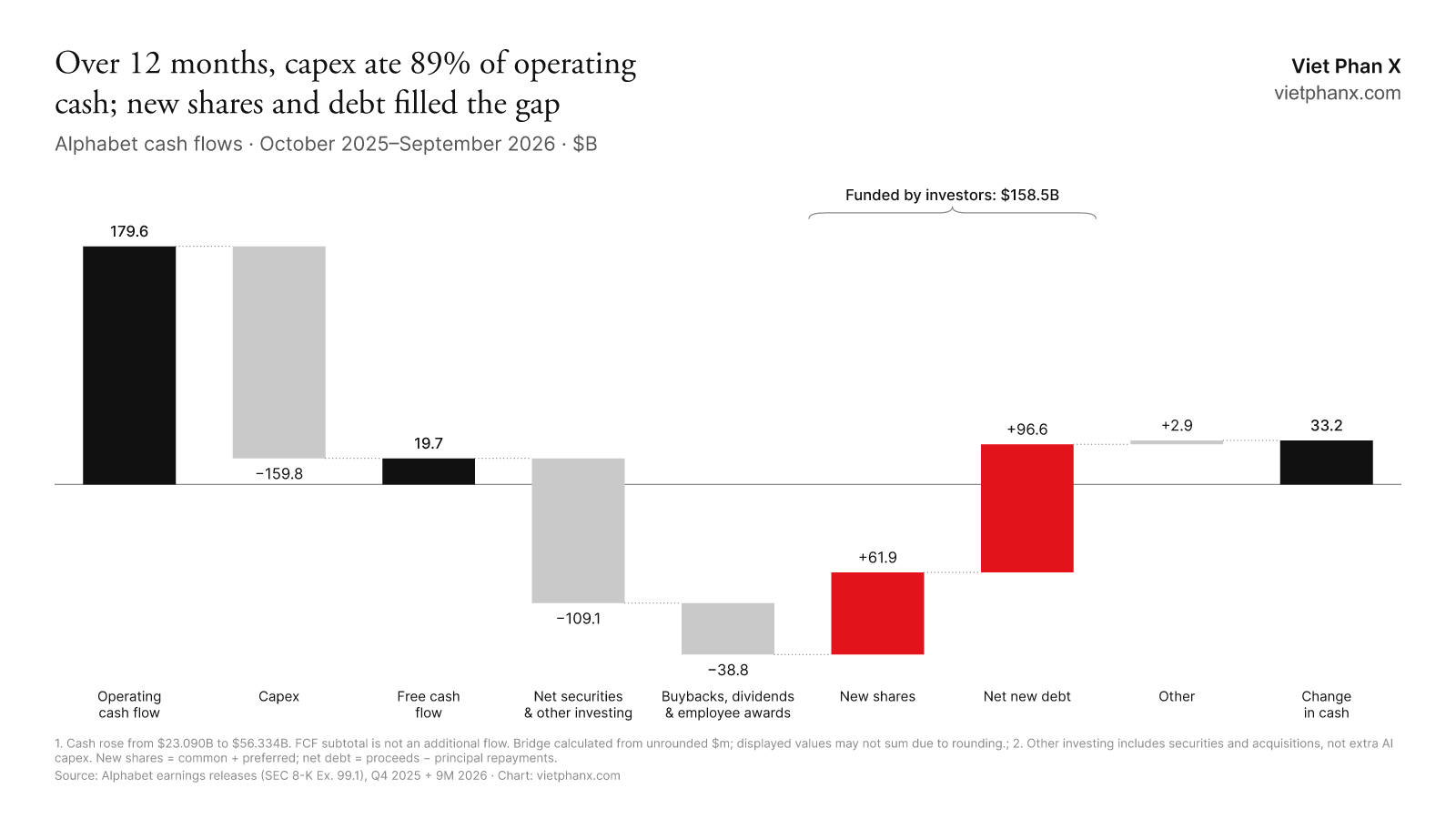
From investors. New shares brought in $61.9B. Net new debt brought in $96.6B. Together, $158.5B.
Almost exactly what Google spent on capex.
I'm not saying the bond money went straight into servers. Cash is cash. But the picture is clear: a year ago, Google paid for its build-out from its own pocket. Now outside money covers the same amount.
The buyback machine reversed
Google used to be one of the biggest buyers of its own stock. $11.5B in Q3 2025 alone.
In 2026, it bought back zero.
It sold stock instead. $30.5B of common shares and $19.1B of preferred shares in Q2. Another $12.4B through an at-the-market program in Q3, about 36 million shares sold straight into the market.
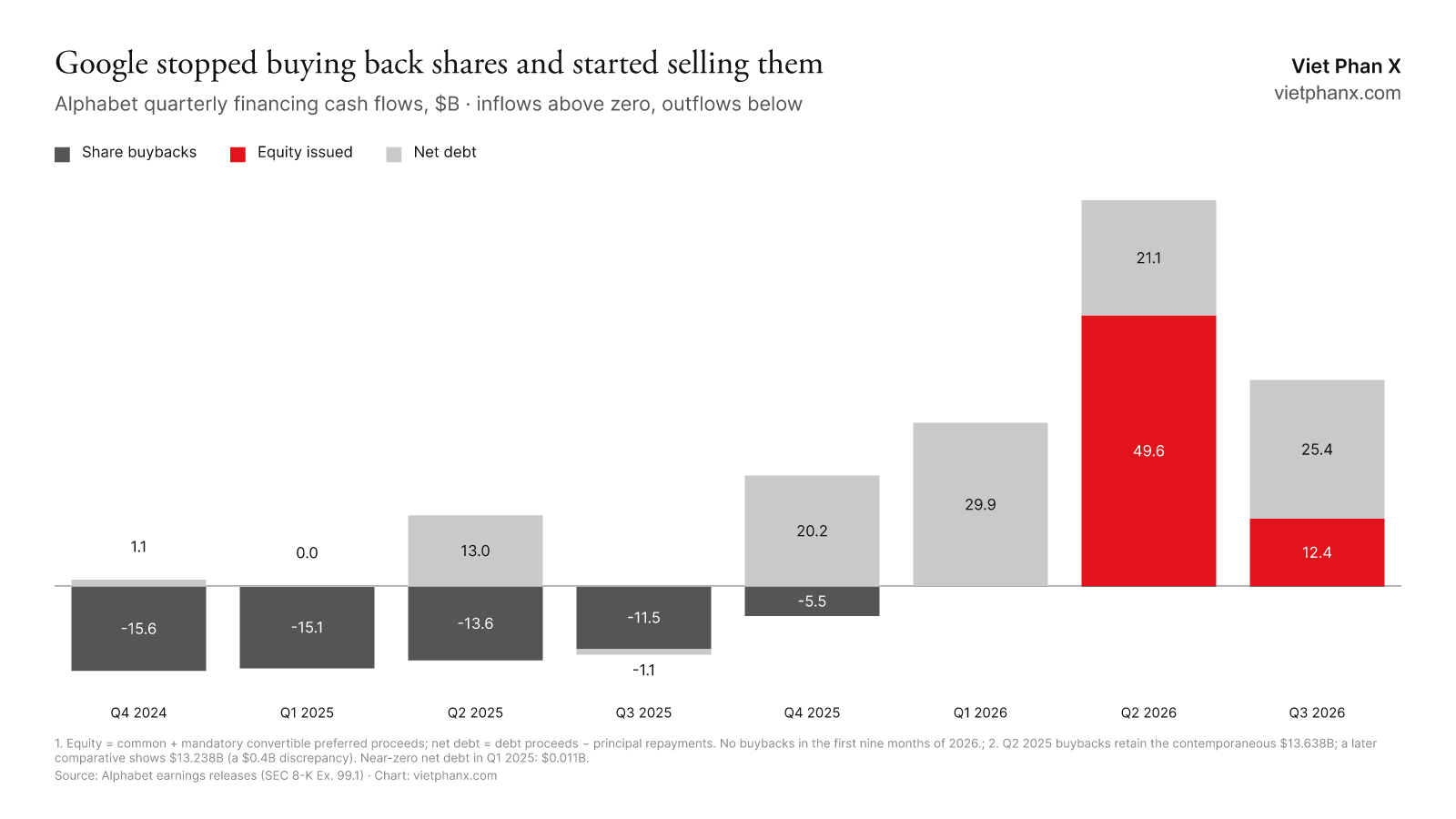
About $27.6B of that program is still left.
For shareholders, that's the real change. Google used to buy back its stock by the tens of billions. Now it sells it.
Google is turning into a cloud company
Why would Google do this? Because the part of the business that's growing needs the money.
At the end of 2024, Cloud was 12% of Google's revenue. Now it's 24%. It brings 27% of operating income, with a 36% margin.
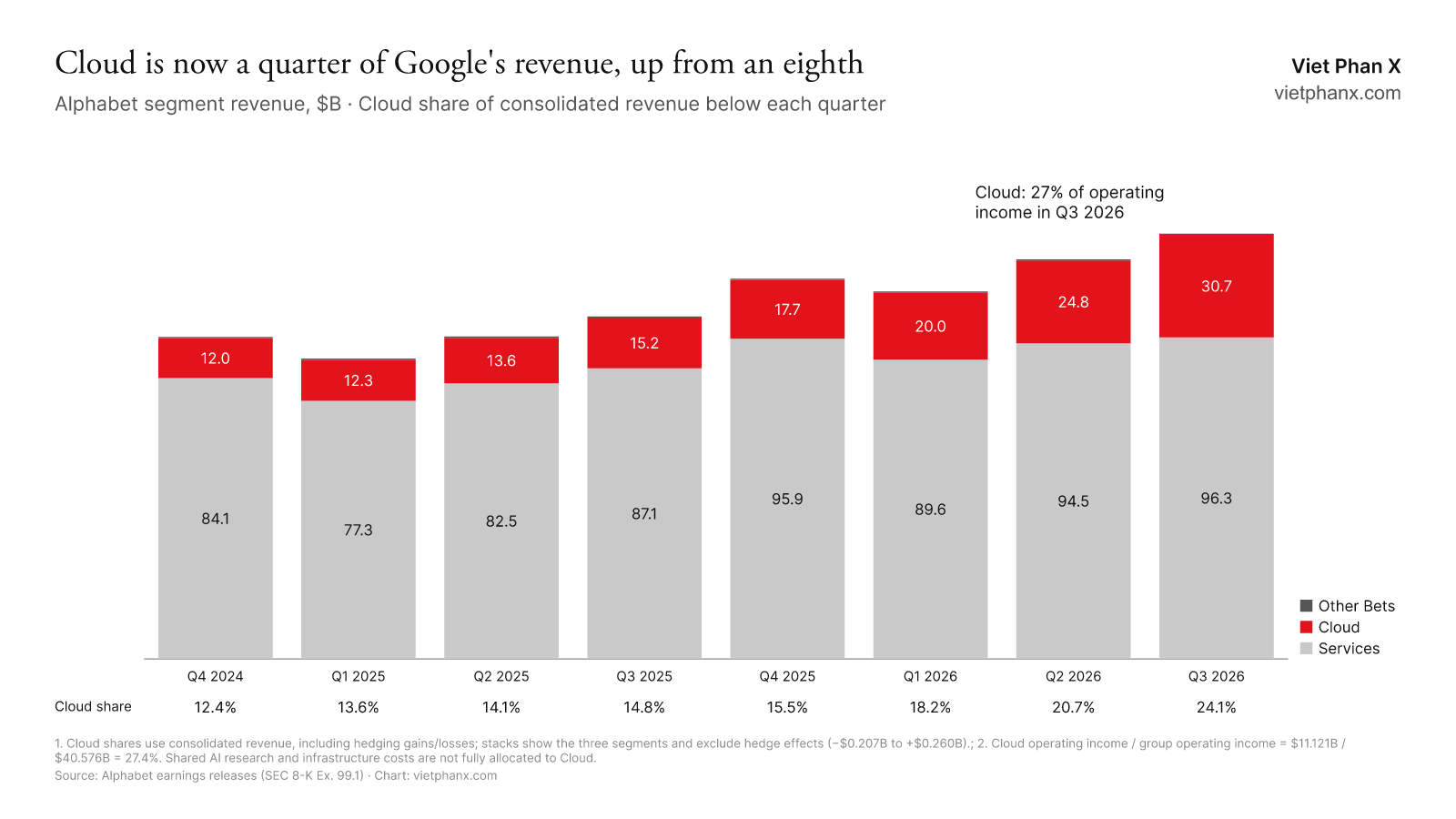
Cloud is the business AI labs rent their compute from. Including Anthropic, which rents compute from Google while Google builds Gemini against it.
That's the swap. Search is a business that throws off cash. Cloud is a business that eats it before it pays back: chips, data centers, power.
Google is moving from the first kind to the second, and it's paying for the move with investors' money.
Not just Google
Google isn't the first to be punished for this.
Meta fell about 7% after its earnings a week ago, on the same worry: a steep bill for the AI build-out. Oracle slipped after its last quarter too.
So I put five of the biggest AI spenders side by side. One number: how much of their operating cash goes into capex.
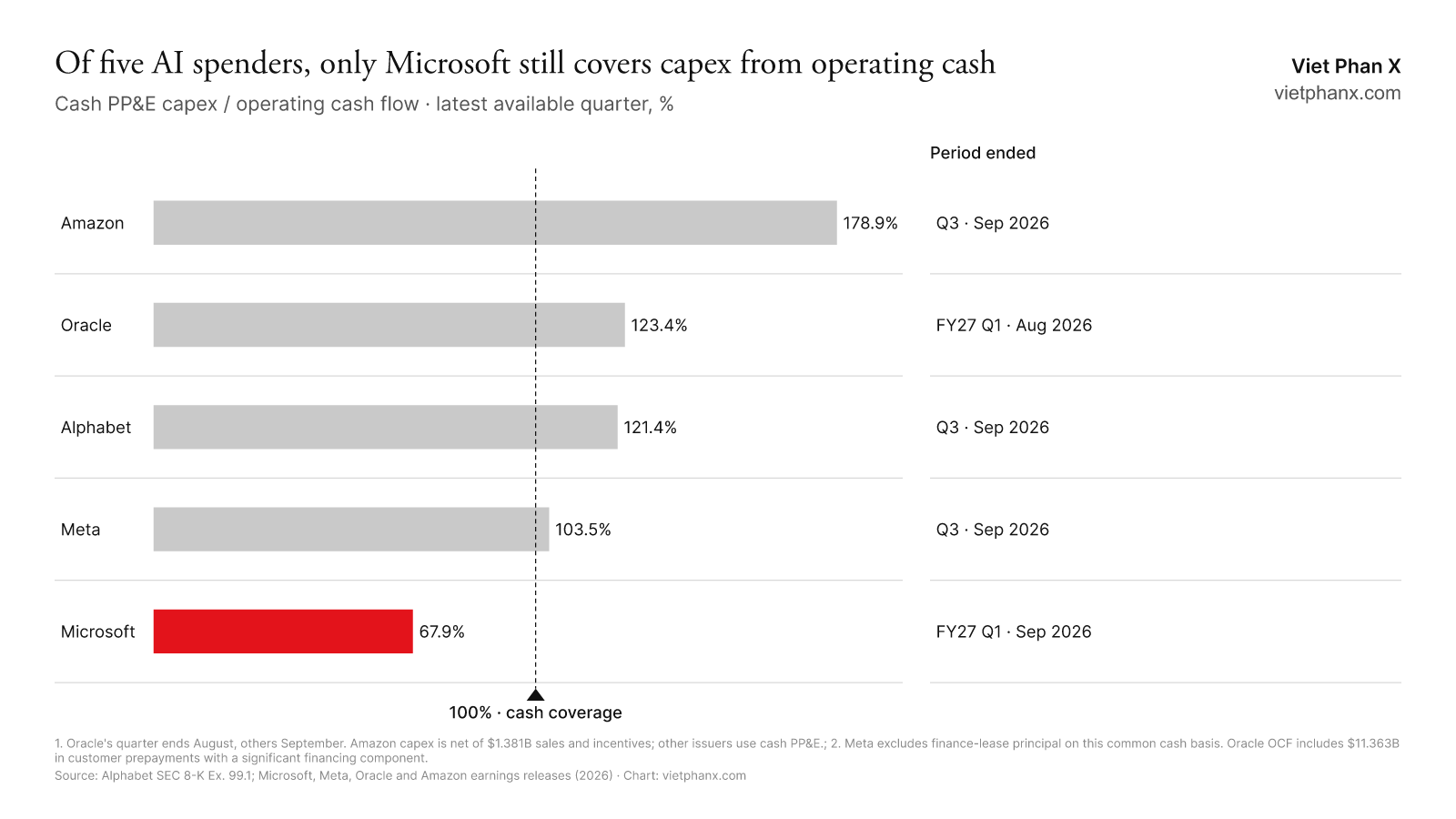
Four of the five spend more on capex than their business brings in. Amazon 179%, in a quarter it reported the same day Google's stock fell. Oracle 123%. Alphabet 121%. Meta 104%.
Only Microsoft is under 100%, at 68%. And Microsoft was the one the market left alone.
The market isn't asking whether AI demand is real. Cloud doubled, and Google says it can't build capacity fast enough.
It's asking who pays for the build-out. Microsoft pays from its own cash. Meta, Oracle and now Google lean on outside money, and the market treated them the same way.
Google still prints money from search. The question is how long search can pay for the thing that's replacing it.

Copyright Viet Phan 2026. All rights reserved.Reuse this content