AI needs every office worker on Earth to pay $205 a month. The typical company pays $15.70.
AI spending needs a customer that does not exist yet: the build-out runs for a decade, while the typical company pays $15.70 per employee a month and the rush to buy is already slowing.
By Viet Phan1 November 20269 min read
On Friday, NBC reported more than $1 trillion erased in the tech selloff.
My feed said the AI bubble had popped.
So I did some simple math.
Janus Henderson, an asset manager, ran the numbers on a 15% return for everything being built. It needs about $2.5 trillion of AI revenue a year by 2030.
There should be about a billion knowledge workers on Earth by then.
If they paid it all, that's $205 a month. From every one of them.
The typical corporate buyer of AI spends $15.70 per employee today.
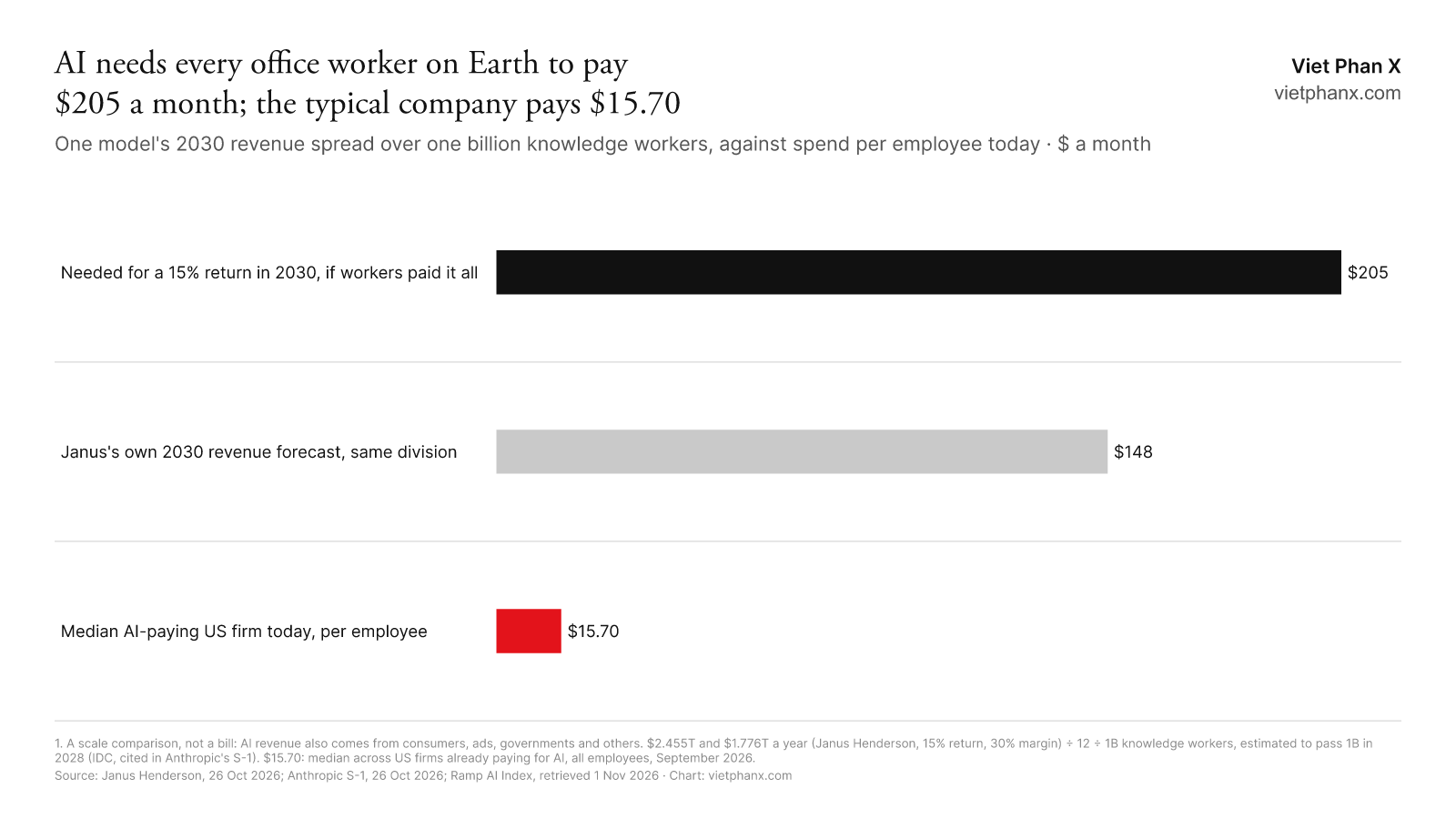
Nobody will send office workers that bill. Consumers, ads and governments will pay part of it. But it shows the size of the hole.
Would your company pay $205 a month for you?
I want to believe it will. But I can't find who pays.
The $15.70 reality
Start with the good news for AI. Businesses are buying it.
Payment data from more than 85,000 US businesses shows 56% now pay for AI. Three years ago it was 26%.
That's the number people quote. Then look at how much they pay.
The median company paying for AI spends $15.70 per employee a month. The median within the top 10% of firms is about $813. Within the top 1%, about $9,568.
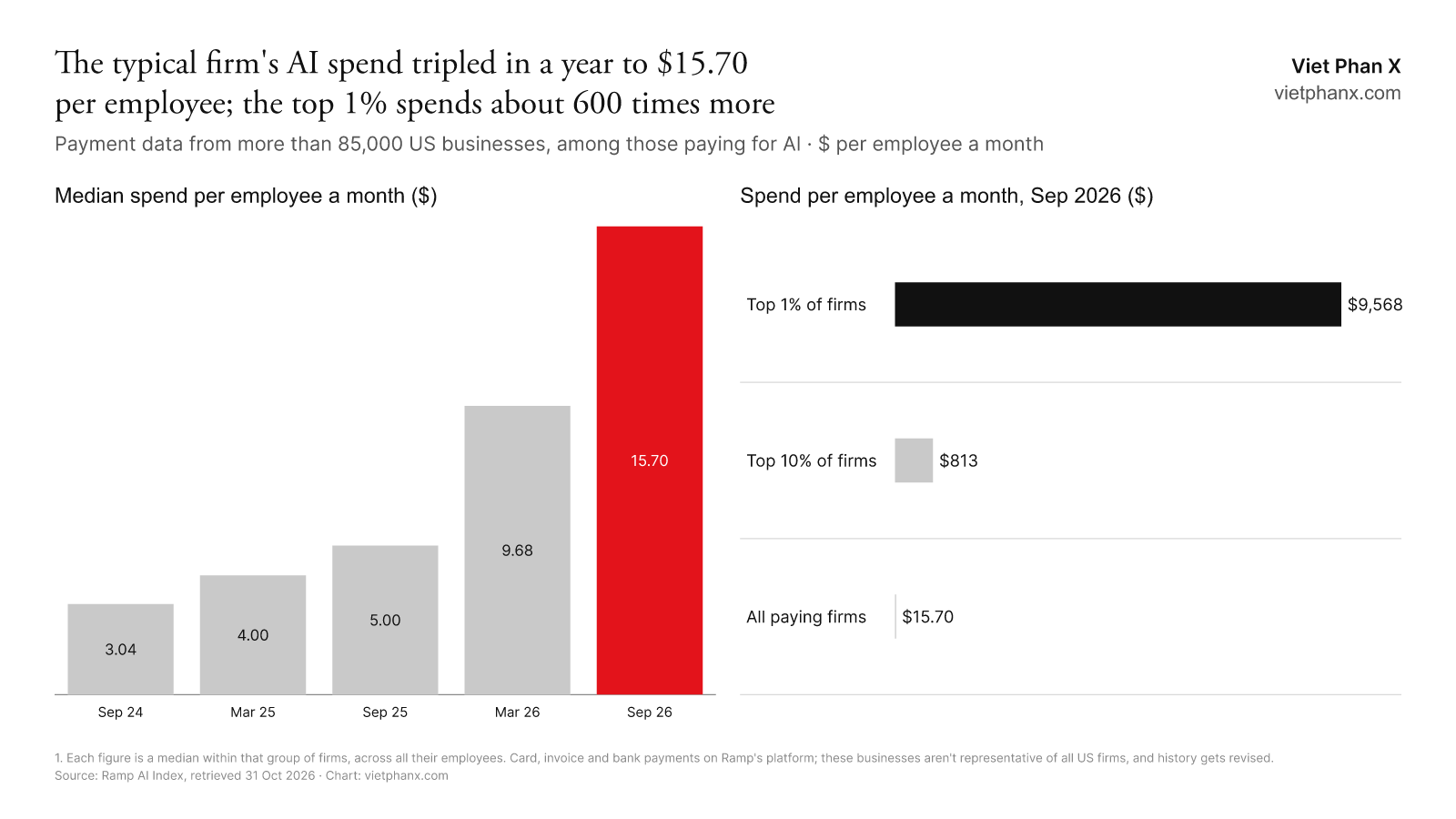
That's across all employees, including people with no AI seat. A company can pay $19 each for a few GitHub Copilot Business seats and still land near that number.
To be fair, it tripled in a year, from $5.00. It's growing fast from a very small base.
The same data shows how top-heavy this is: 1% of firms generate 80% of OpenAI and Anthropic spending.
So who are they? Ramp's lead economist says they skew toward technology and AI companies. Apollo, using Ramp's data, says 80.4% of the top 1% of AI spenders are venture-backed, against 13.1% of the median spender.
My read: a lot of the biggest AI spending is venture money flowing back to AI labs.
The rush is slowing
Year-on-year growth makes all of this look unstoppable. It also looks backward, so I checked month by month.
In March, the share of businesses paying for AI rose by 2.41 points in a single month. By September the gain was 0.62. For Anthropic the drop was steeper: 6.74 points down to 0.24.
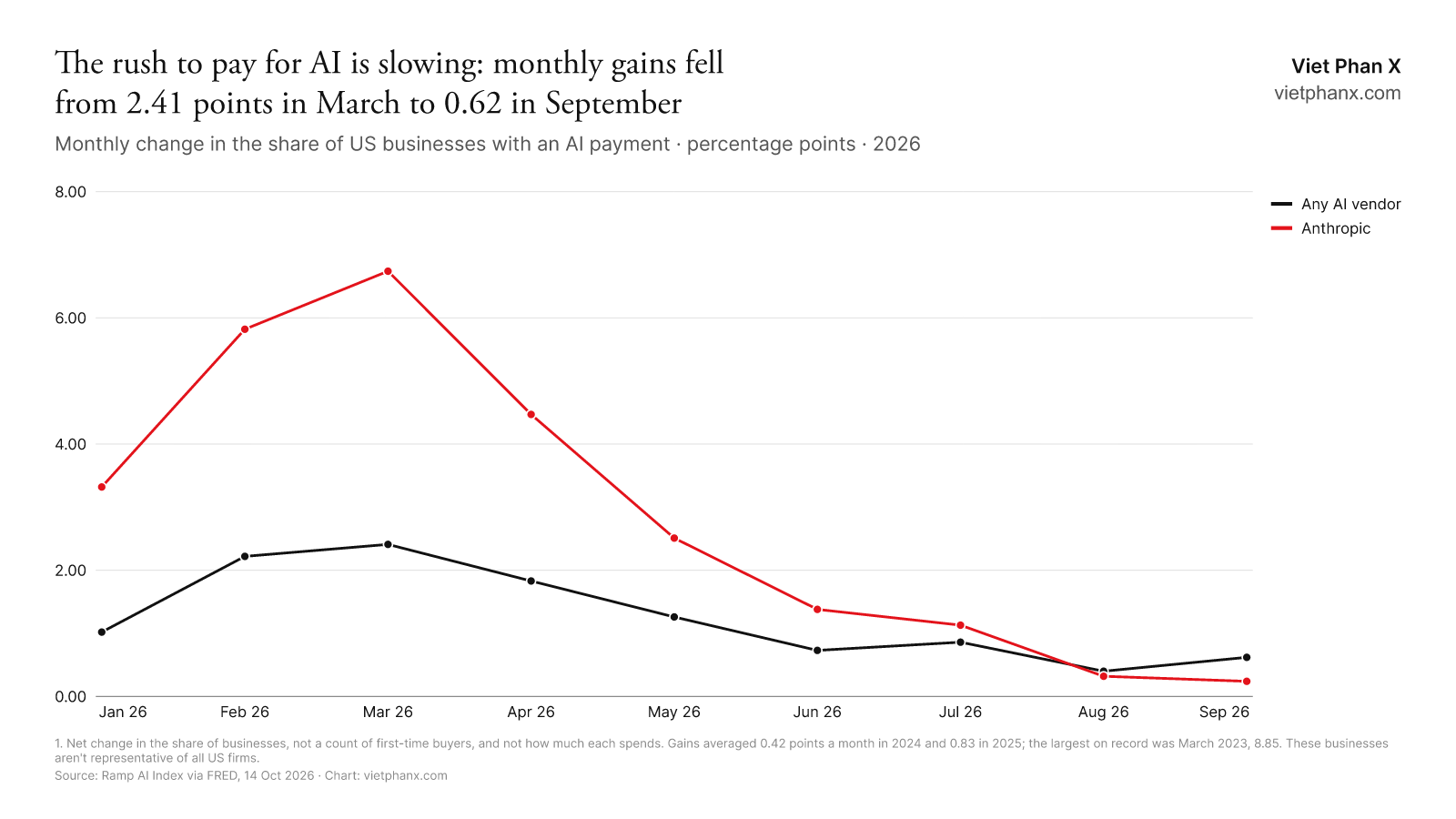
My read: the models jumped in early 2026 and companies rushed in, and that rush is fading.
This measures the share of businesses in that data paying, not how much they pay. Spending kept climbing, but it's cooling too: the median rose 29% in March and 6.5% in September.
The rush of early 2026 is over, and September is back to the old pace. If it falls below that, that's the start of saturation.
Only 13% report big value
Why would the rush slow down? Ask the people signing the invoices.
Gartner surveyed 2,002 CIOs and technology executives this year. Only 13% said their company had seen significant or transformational value from AI. 51% expect AI to raise their technology costs.
McKinsey found the same gap. 44% of companies are scaling AI across the business. 37% attribute any EBIT contribution to it, and McKinsey calls that share broadly unchanged on the year.
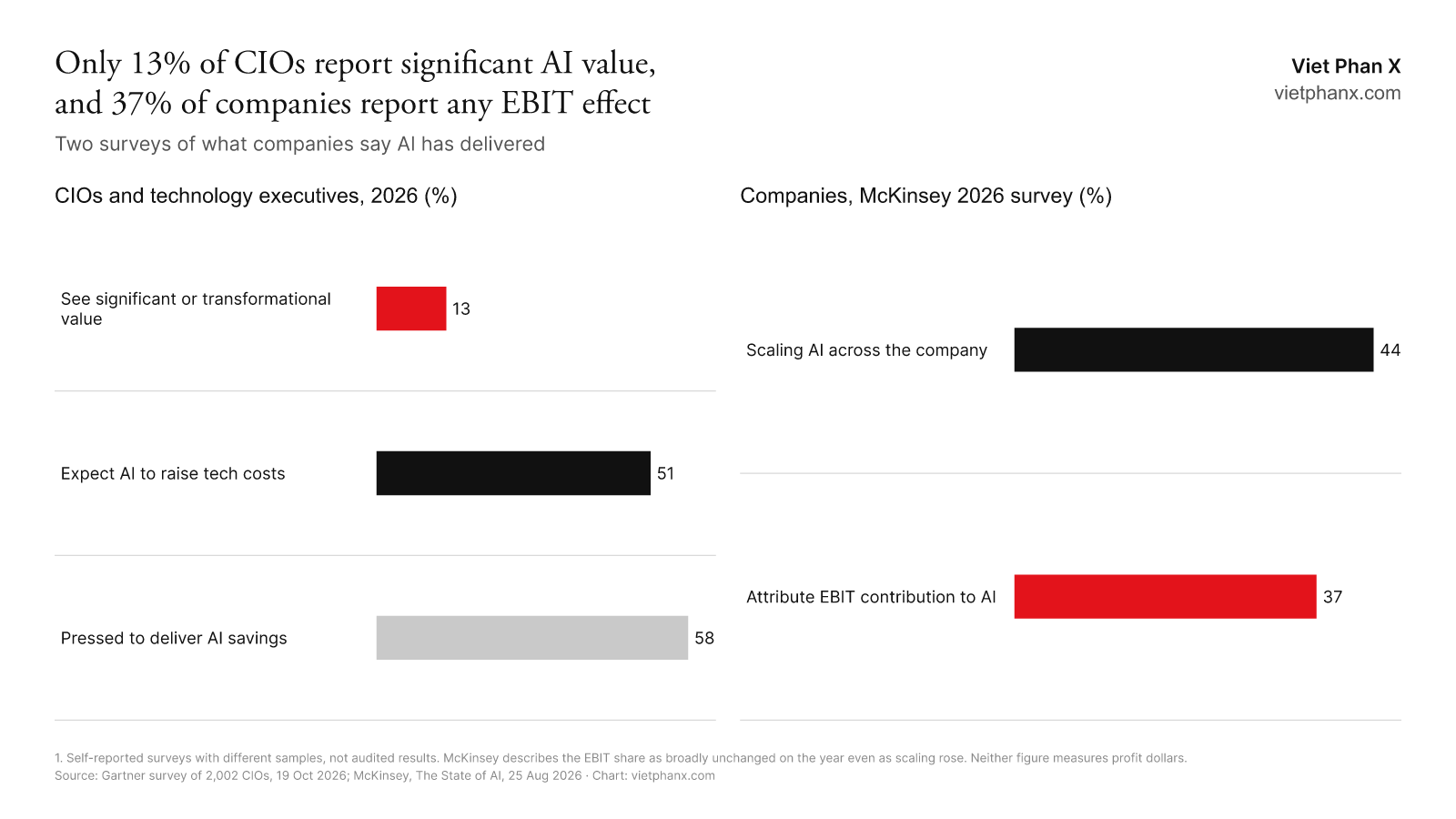
These are surveys, and they don't measure profit dollars. They do show more rollout without more companies reporting a result.
There are real gains at the task level. Workplace studies found 26% more completed developer tasks and 15% more support issues resolved per hour. An early-2025 trial found experienced developers 19% slower.
In what I've read, those gains aren't showing up widely as company profit. And I expect that once a model is good enough for a job, a company stops paying up for the newest one.
Coding moves to the cheap seats
Coding is where I see AI working best, and where I'd guess the top 1% spends.
I also think it's where customers will shop hardest on price.
On OpenRouter, a platform developers use to reach many models, Chinese labs went from 6% of tokens to 62% in under two years. Their estimated share of spending went from 1% to 27%. Open-weight models list at about a quarter of the price of closed ones.
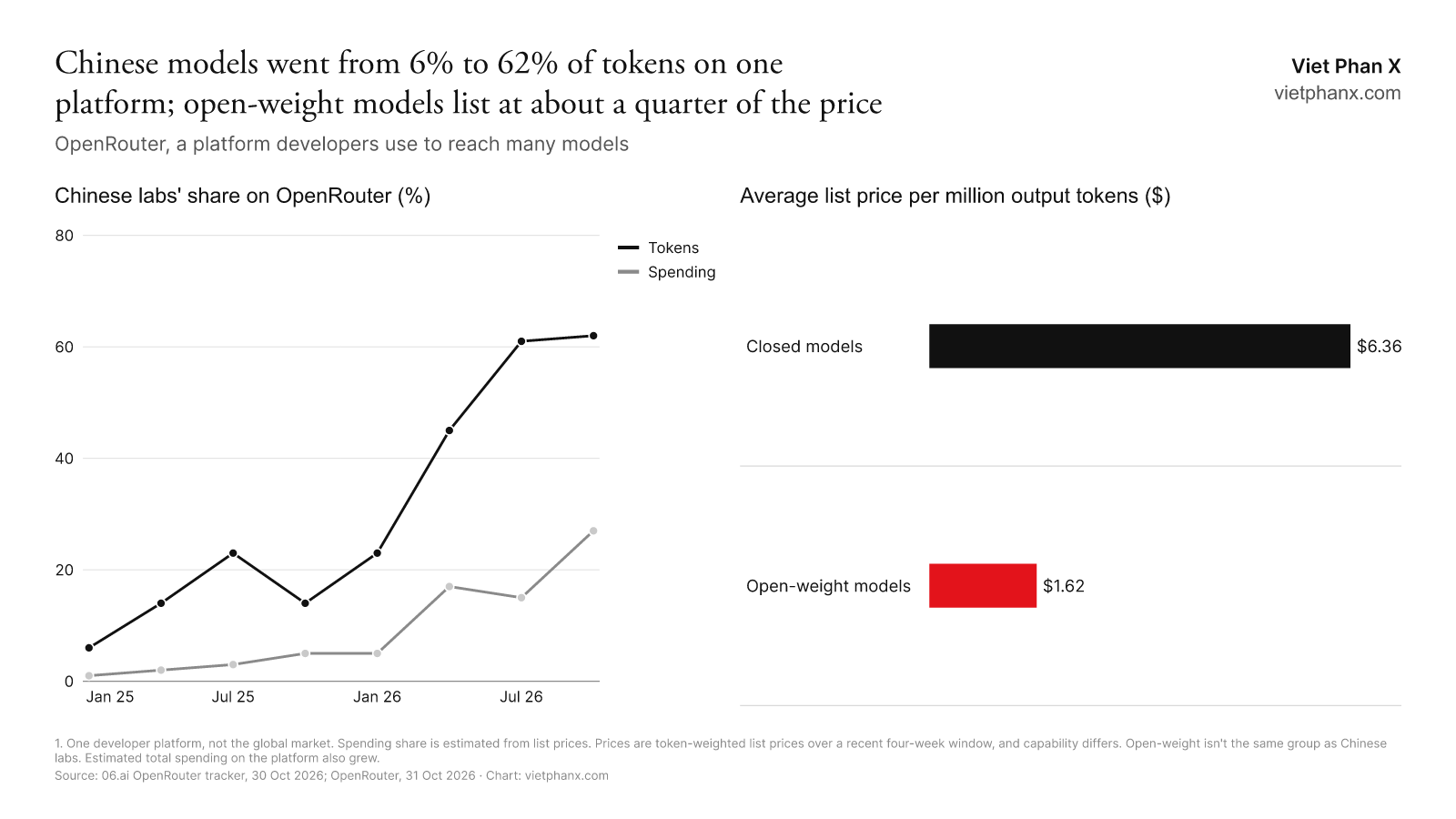
This is one platform, and its estimated total spending still grew. Cheaper tokens may well bring more usage.
But look where the big vendors are heading. GitHub moved Copilot to usage billing in June. Separately, Microsoft says 90% of queries in its Copilot now go through automatic model routing.
My read: the heaviest customers have the most reason to go cheaper.
The bill
Now the other side of the ledger.
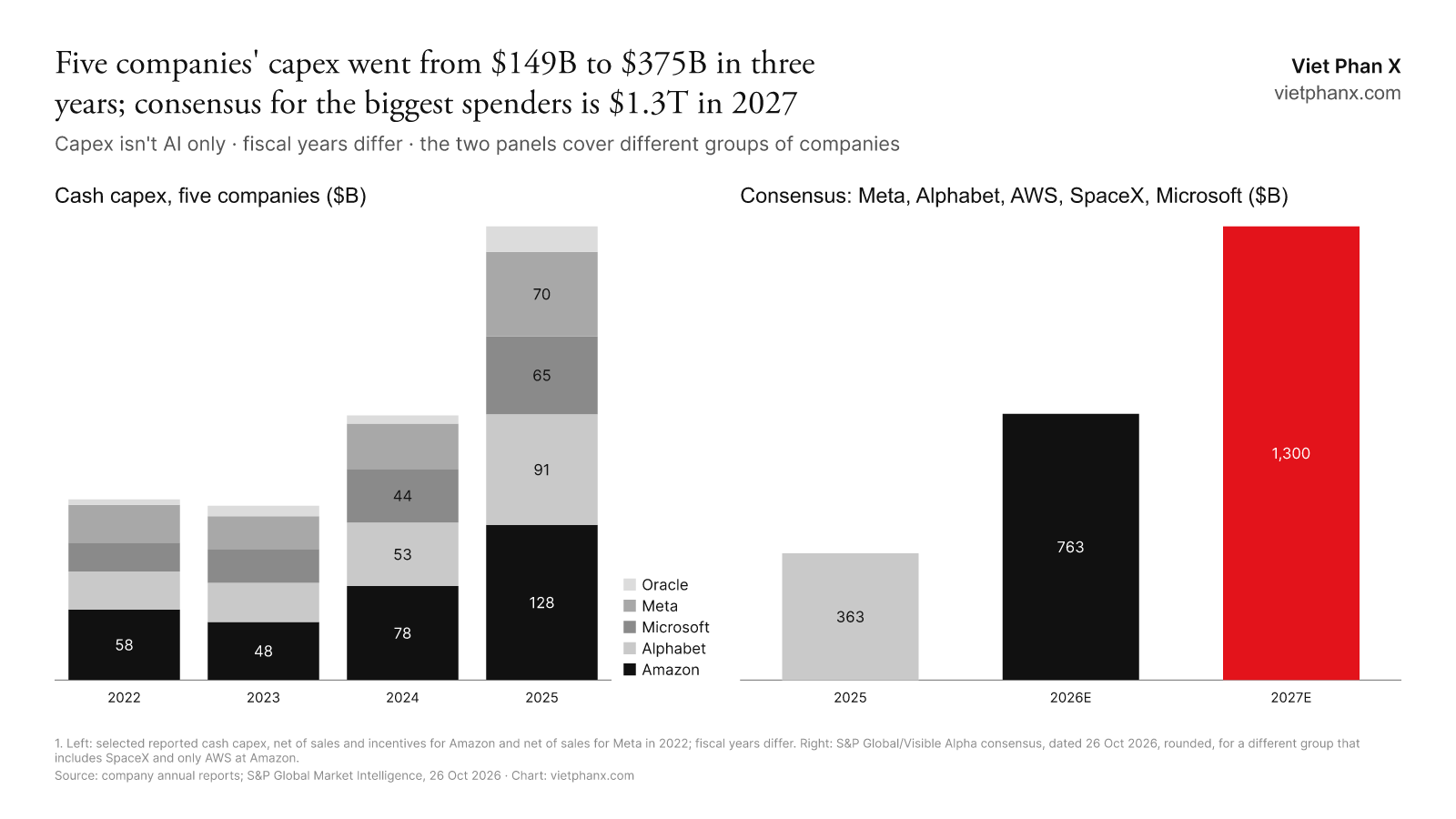
Amazon, Alphabet, Microsoft, Meta and Oracle spent $149B on capex in 2022. In 2025 it was $375B. Not all of that is AI, but management teams name AI as a major driver.
Analysts expect $763B this year and $1.3 trillion next year from a group of the biggest spenders: Meta, Alphabet, AWS, SpaceX and Microsoft.
To see how long this lasts, I laid out the contracts.
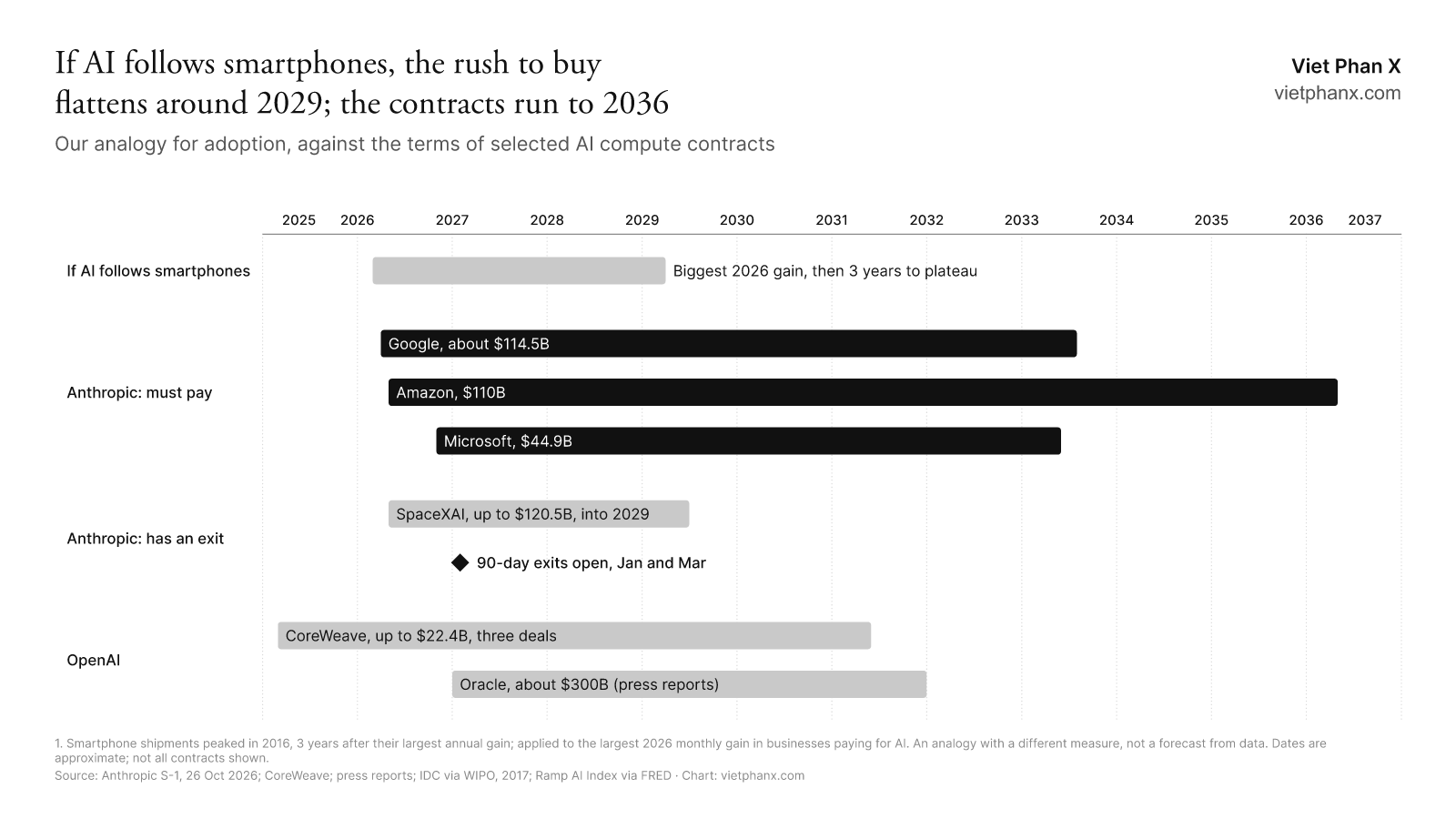
Anthropic alone has promised at least $110B to Amazon through April 2036, about $114.5B to Google through July 2033, and $44.9B to Microsoft through May 2033. Subject to narrow exceptions, it pays whether or not it uses the capacity. That's the landlord problem I wrote about.
How long can the rush last? The closest case I know is the smartphone. Shipments peaked in 2016, three years after their biggest annual jump in units. The biggest monthly gain in businesses paying for AI this year came in March.
If AI follows the same path, the rush flattens around 2029. The contracts run to 2036.
The gap
Back to the $2.5 trillion.
Janus Henderson's forecast for 2030 is $1.776 trillion, and that already counts growth from enterprise, governments and physical AI. To earn its 15% return, it needs $2.455 trillion.
That leaves $679B a year.
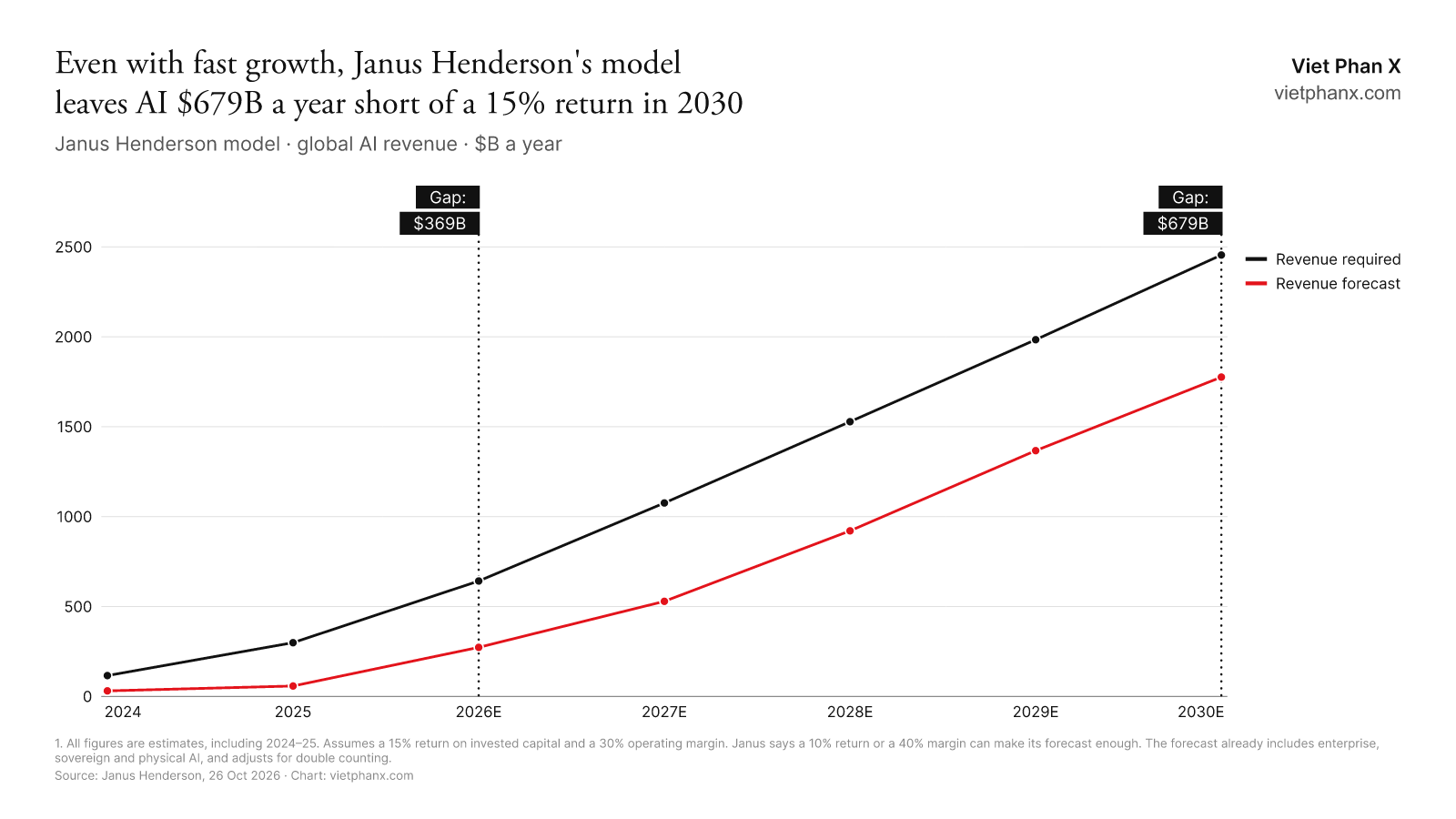
Change the assumptions and the gap moves. Janus says a 10% return or a 40% margin would make its forecast enough. So this isn't a measured shortfall. It's what that return would take.
The obvious candidate to fill it is still small: Gartner puts AI agents and assistants at about $29B of spending this year.
I want that revenue to show up. I just can't find the customer.
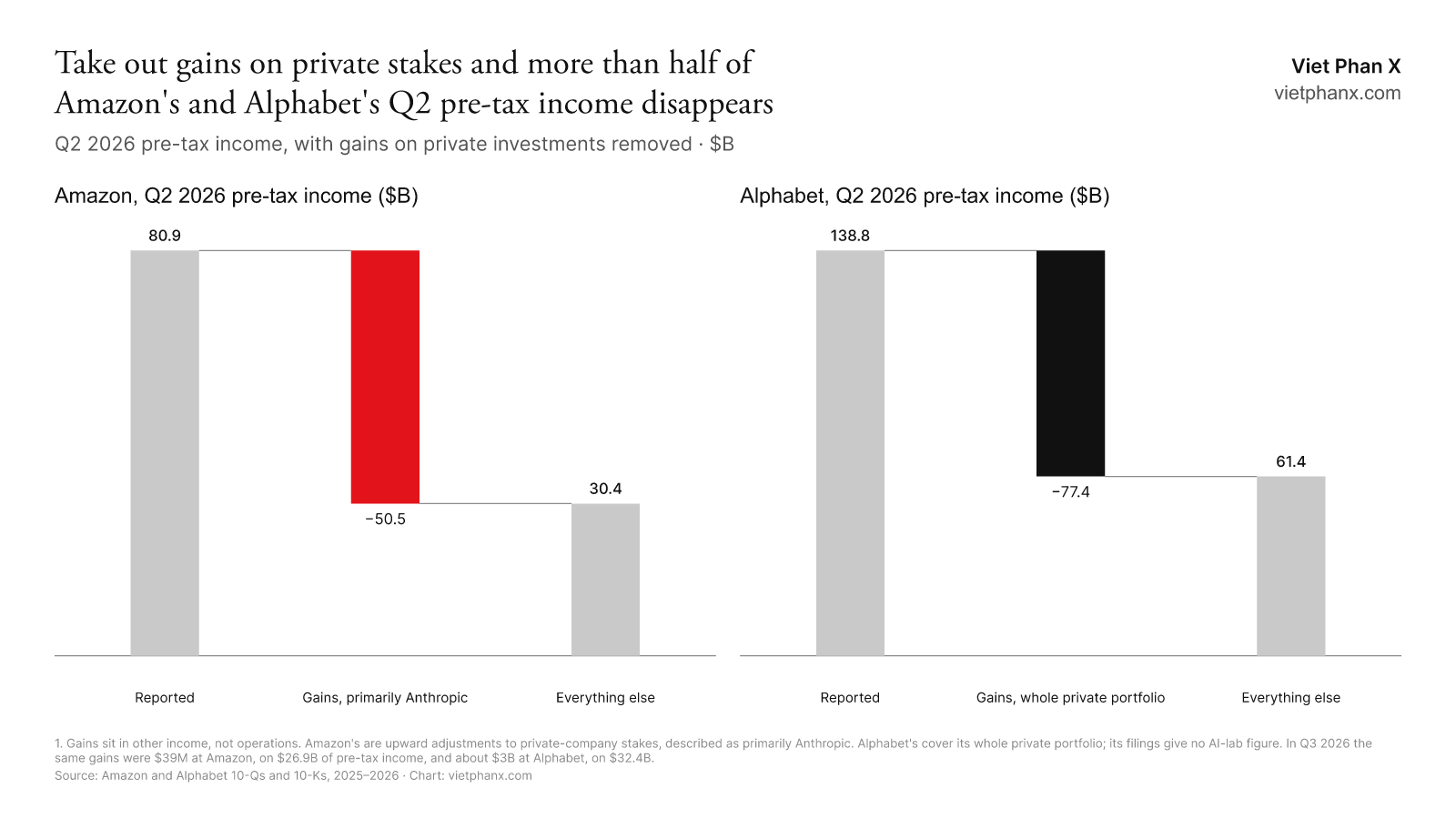
62% of Amazon's Q2 pre-tax income was on paper
Here's why this matters if you don't work in AI.
Amazon and Google invest in AI labs. The labs promise to buy compute from them. The labs raise money at a higher price. The stakes get marked up, and a gain lands in reported income.
In Q2, Amazon's private-stake gains, described as primarily Anthropic, were 62% of its pre-tax income. Alphabet's gains across its private portfolio were 56%. Its filing doesn't say how much of that is AI labs.
Amazon now carries about $289B in Anthropic and OpenAI shares and convertible notes. That's more than the $168B of operating cash it made in the last year, and Google is already leaning on outside money for its build-out.
Those are real gains under the accounting rules. They just aren't cash, and they depend on what someone will pay for those stakes next.
Q3 shows how much that matters. Amazon's gains fell to $39M, and its pre-tax income fell from $80.9B to $26.9B. Alphabet's gains fell to about $3B, and its pre-tax income fell from $138.8B to $32.4B.
If you own a broad US index fund, you very likely own Amazon and Alphabet, and with them, a slice of this.
The other side
I could be wrong, and the strongest evidence comes from the companies themselves.
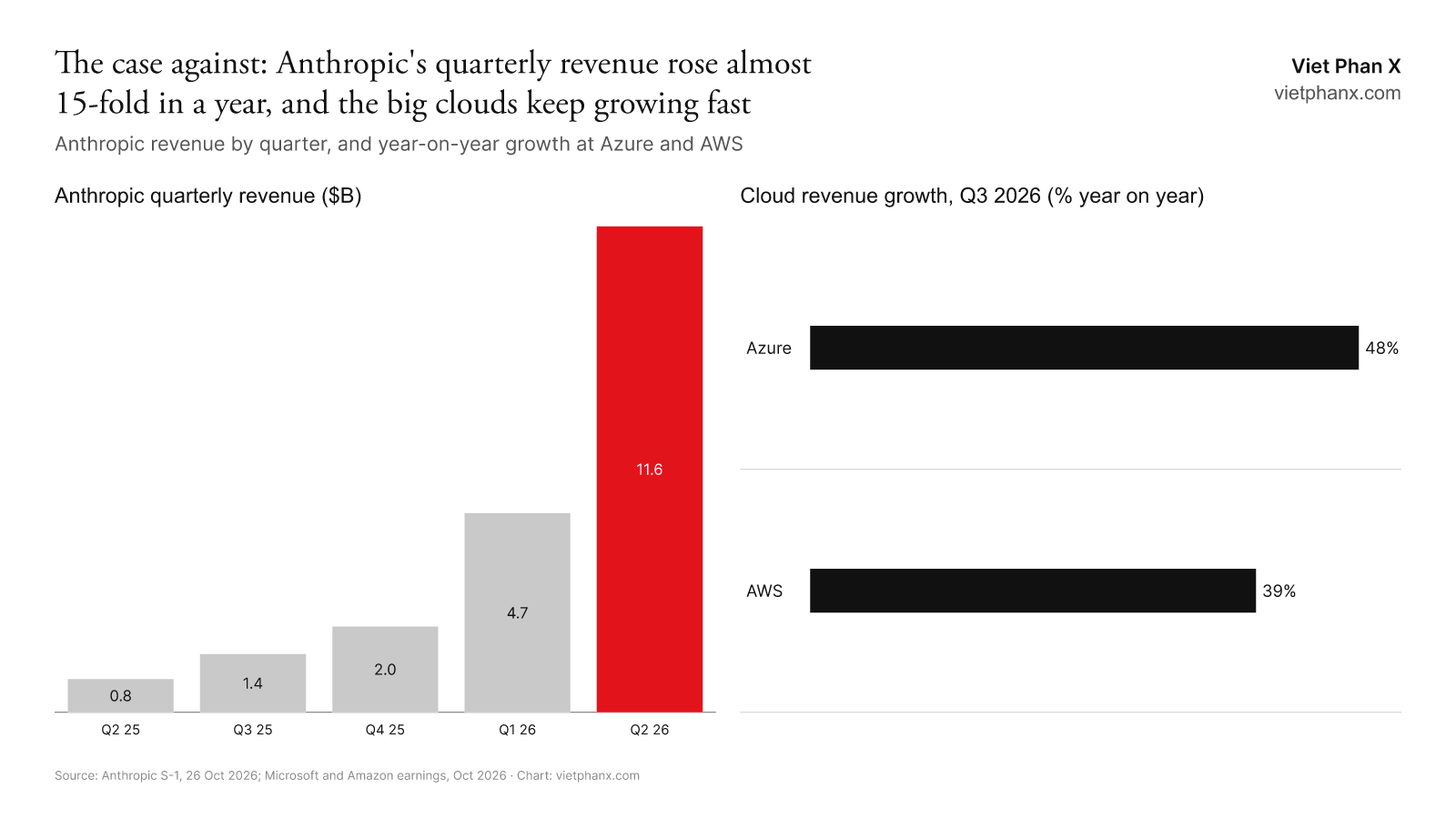
Anthropic's revenue went from $787M in Q2 2025 to $11.6B in Q2 2026.
More than 11,900 customers brought it $100K or more over the last year, up from about 200 at the end of 2024. It reports about 900% net revenue retention.
In the quarter ended September, Azure revenue grew 48% year on year. AWS grew 39%, its fastest in nearly five years.
Microsoft says Copilot customers using its usage credits grew more than 75% in a quarter.
Agents are the biggest unknown. A person asks a question and stops. An agent can run all day. If agents take off outside coding, the number of paying firms can flatten while tokens keep climbing, and the $15.70 won't stay $15.70.
But that has a ceiling too. A company that measures productivity will pay up to what it gets back.
Look at what people pay from their own pockets. The standard plans cost about $20 a month. The hard-core plans cost about $200, and ChatGPT's top one costs $500. My read: most people pay that only when it makes them money, and everyone else stops at $20 to $50.
The math at the top of this post prices every office worker on Earth like a hard-core user.
One thing would help settle this: how many companies renew across vendors, and at what price. I couldn't find that series anywhere. Until someone publishes it, both stories can be true.
Railways and fiber
This has happened before, and that's why I still want to believe.
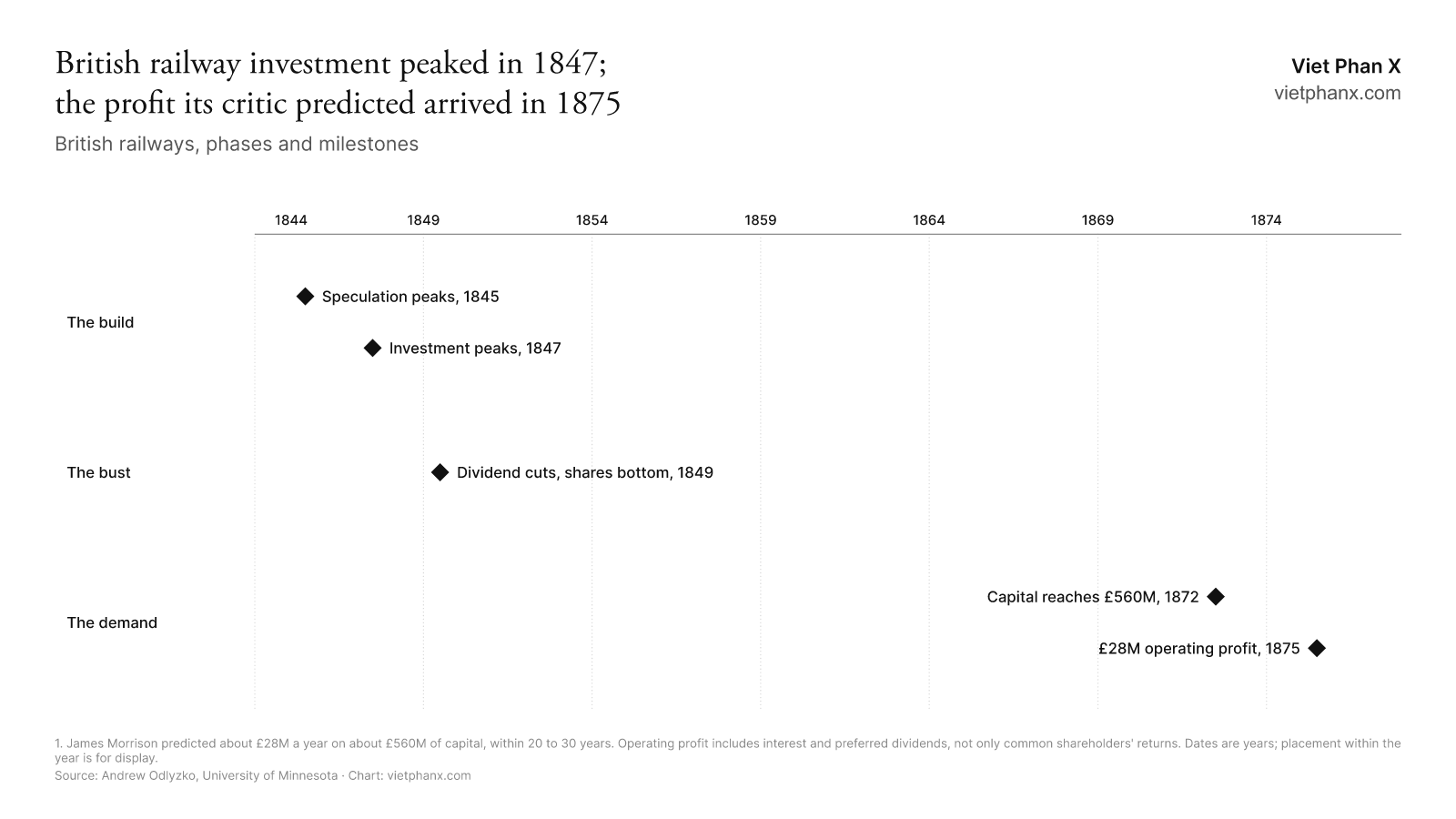
British investors poured money into railways in the 1840s. James Morrison, a critic at the time, said railway capital might earn £28M a year within 20 to 30 years. It took about 29. He was close, the trains got built and people rode them. Many of the investors who bought during the mania still lost money.
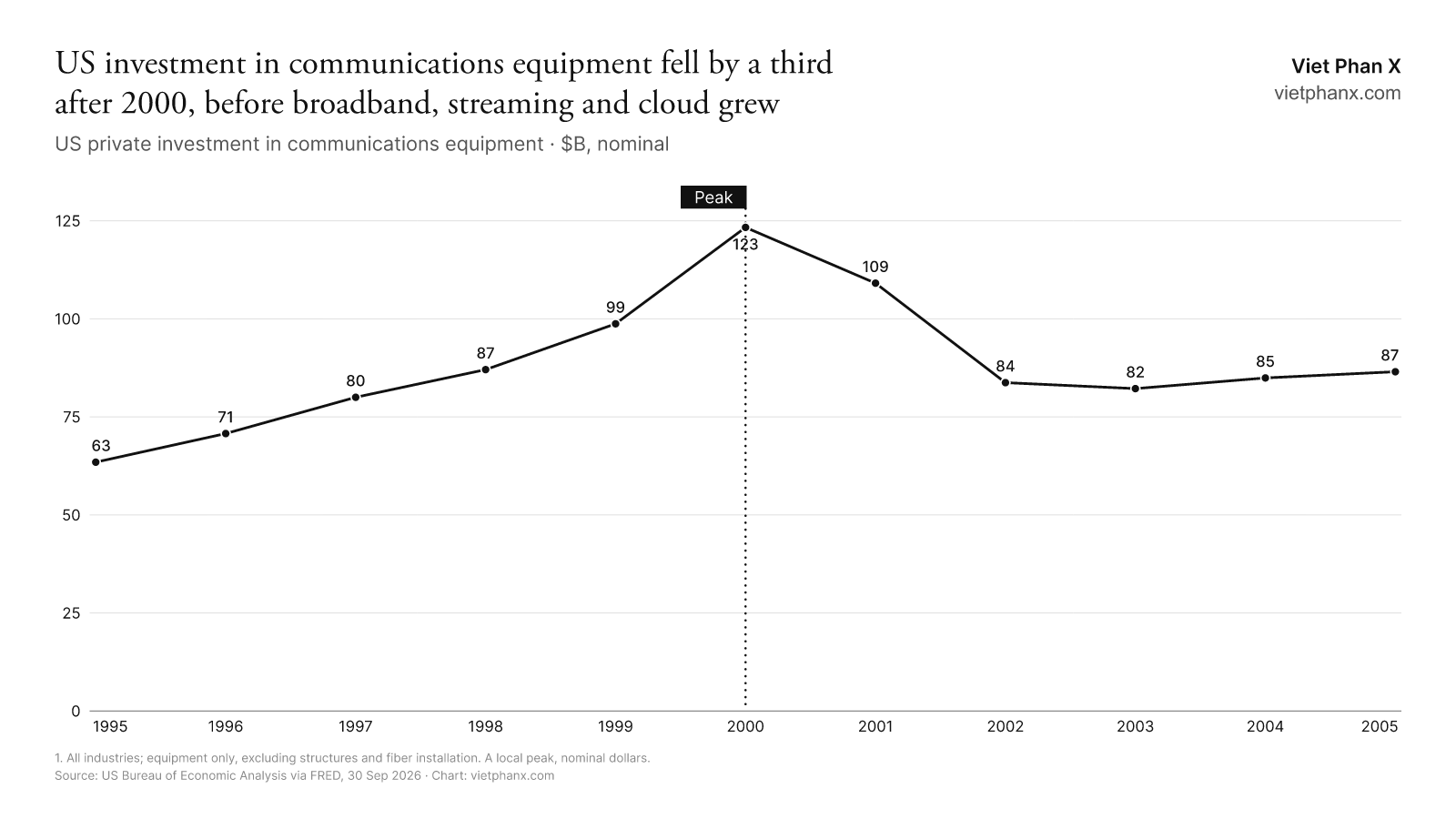
US investment in communications equipment hit a high of $123B in 2000 and fell by a third by 2003. A press report in 2001 said only about 5% of the fiber in the ground was lit.
Then broadband, streaming and cloud arrived. Plenty of the demand came. Many of the companies that built for it went bankrupt first.
That's how I see AI. The demand may come. It may be enormous. But I can't yet see what fills that gap, and the contracts are already signed.
The forecast
Forecast 1: The typical company's AI bill tripled last year. It won't double in the next.
It's $15.70 per employee a month today, so the line is $31.40. If it keeps adding what it added in September, it reaches about $27. If it keeps September's percentage growth, about $33. Another year like the last one, about $49.
Measure: median AI spend per employee, Ramp AI Index. Closes on the first published figure for September 2027. Wrong if it's $31.40 or more. If Ramp stops publishing, the forecast is void.
Forecast 2: AI infrastructure stocks trail the Nasdaq 100 through October 2027.
CoreWeave, Nebius, Oracle, Broadcom and Nvidia, in equal weights. Four of the five are also in the index, at about 11% of a Nasdaq 100 tracker fund.
Measure: price return, tracked as a virtual $100,000 short on the five against $100,000 long the index, with no real money. Set in equal dollars and never resized, with splits adjusted and dividends excluded. Opens at the last close before this post and closes at the last close on or before October 31, 2027. Wrong if the five stocks match or beat the index.
Forecast 3: The rush to buy AI flattens by 2029.
In September, the share of businesses paying for AI still rose 0.62 points in a single month.
Measure: share of US businesses on Ramp paying for AI, Ramp AI Index. Closes on the first published figure for December 2029. Wrong if the share rose 2 points or more over the prior 12 months. If Ramp stops publishing, the forecast is void.

Copyright Viet Phan 2026. All rights reserved.Reuse this content