Nvidia Will Back the Companies Buying Its Chips. After the Banks Do.
Nvidia sold $115.8 billion in a quarter. In the same release, it wrote that its $32 billion of promises to smaller cloud companies start only once they've found their own loans. Last week I gave 3% that Nvidia cuts at least $1 billion of them by June 2027. I now give 35%.
By Viet Phan18 November 20266 min read
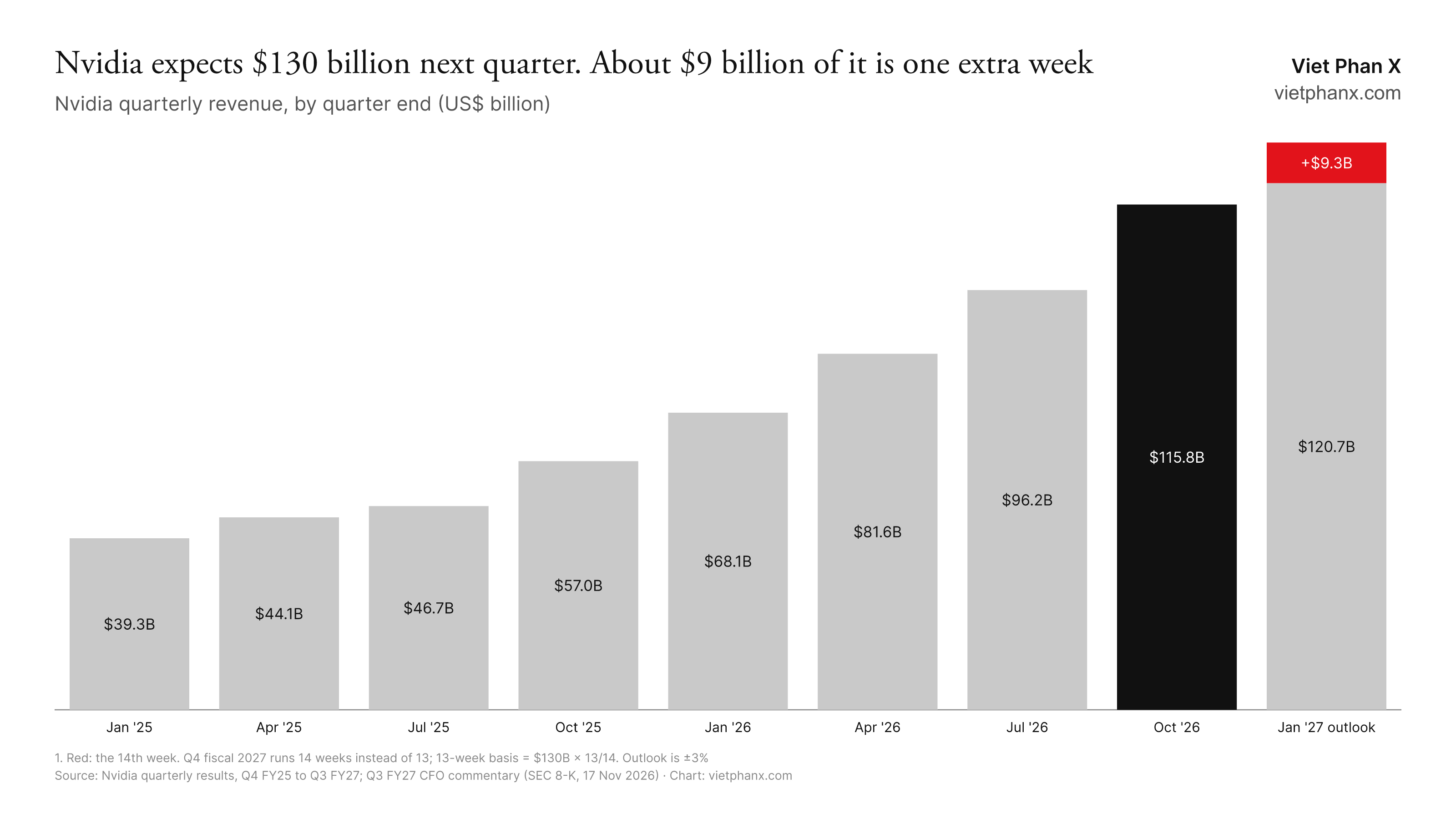
$115.8 billion.
That's what Nvidia sold in the three months to October 25. Twice as much as a year earlier.
Next quarter, it expects about $130 billion.
The stock closed at $155.46 on November 17, and rose almost 5% after hours.
Then, on page 3 of the finance chief's commentary, there's this sentence about the smaller cloud companies Nvidia has been backing:
"Our commitments take effect only if the neoclouds secure financing."
The neoclouds borrow to buy Nvidia's chips. Nvidia's promise was part of what made them easy to lend to.
Now the promise waits for the loan.
The Quarter
The numbers were big again.
Revenue was $115.8 billion, up 20% from the quarter before. Data centers brought in about $107.6 billion of it.
The gross margin held at 74.8%.
The $130 billion forecast has a catch: Nvidia's fourth quarter runs 14 weeks instead of 13. Its fiscal year has an extra week, and it lands in this quarter.
Take the extra week out, and the forecast is about $120.7 billion. That's 4% more than this quarter.
Each of the last four quarters grew 18–20%.
The Safety Net
Neoclouds are the smaller cloud companies that rent out Nvidia's chips: CoreWeave, Lambda, Crusoe, Nebius and others.
They buy the chips with borrowed money.
Nvidia helps in a few ways. It invests in them, sells them chips, and signs agreements to rent back capacity they can't sell to anyone else.
CoreWeave, for example, disclosed in September 2025 that Nvidia would buy its unsold capacity through April 2032, starting at $6.3 billion. That filing named no financing condition.
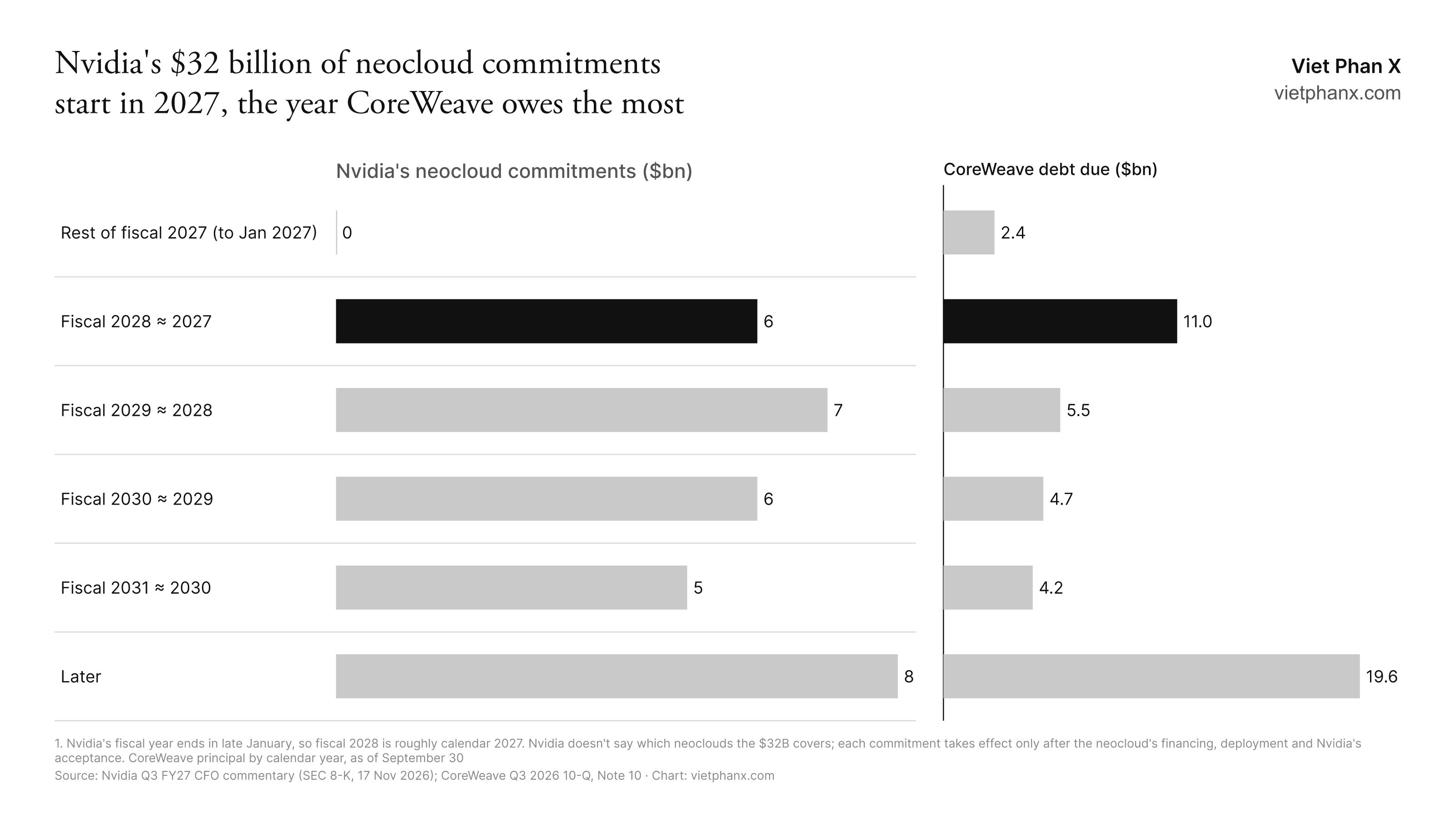
At the end of October, those agreements added up to $32 billion.
Think of a developer building an apartment block.
The bank lends more easily if a big company has signed to rent the empty floors. The signature is half the reason the loan happens.
Now Nvidia's commentary spells out when its signature counts.
It takes effect only once the neocloud has its financing, the capacity is "deployed, made operational, and accepted" by Nvidia, and "certain commitments could be reduced or eliminated" if that doesn't happen in time.
The tenant signs after the bank has already said yes.
The Question on the Call
Stacy Rasgon, Bernstein's chip analyst, read the same paragraph and asked about it:
"It reads like they have to secure their own financing in order to get the backstops and commitments from you."
He wanted to know if anything had changed.
Colette Kress, Nvidia's finance chief and, since last week, its interim CEO, said no. The guarantees start once the financing and the infrastructure are in place, she said, the way they always have.
The previous filing, from July, describes the same agreements without any of those conditions.
The exit it spells out belongs to the neoclouds: they can stop selling capacity to Nvidia and "sell to third-party customers at more advantageous rates".
In her prepared remarks, Kress also said this:
"As the market matures and additional sources of capital become available, we are rigorously evaluating future investments, commitments, and guarantees."
On November 12, I gave 3% that Kress formally cuts at least $1 billion of these promises for risk reasons by June 2027. That was in my last post.
The new sentence changes that.
Nvidia no longer has to announce a cut. A promise that waits for the loan can lapse on its own.
The total already fell from $36 billion to $32 billion in one quarter, with no reason given.
I now give 35%.
Kress says nothing has changed. If she's right, the next annual report shows the $32 billion intact.
The Year the Loans Come Due
Nothing of the $32 billion is scheduled before February. The first $6 billion falls in Nvidia's next fiscal year, which is roughly calendar 2027.
That's also the year CoreWeave, the biggest neocloud, has to pay back the most.
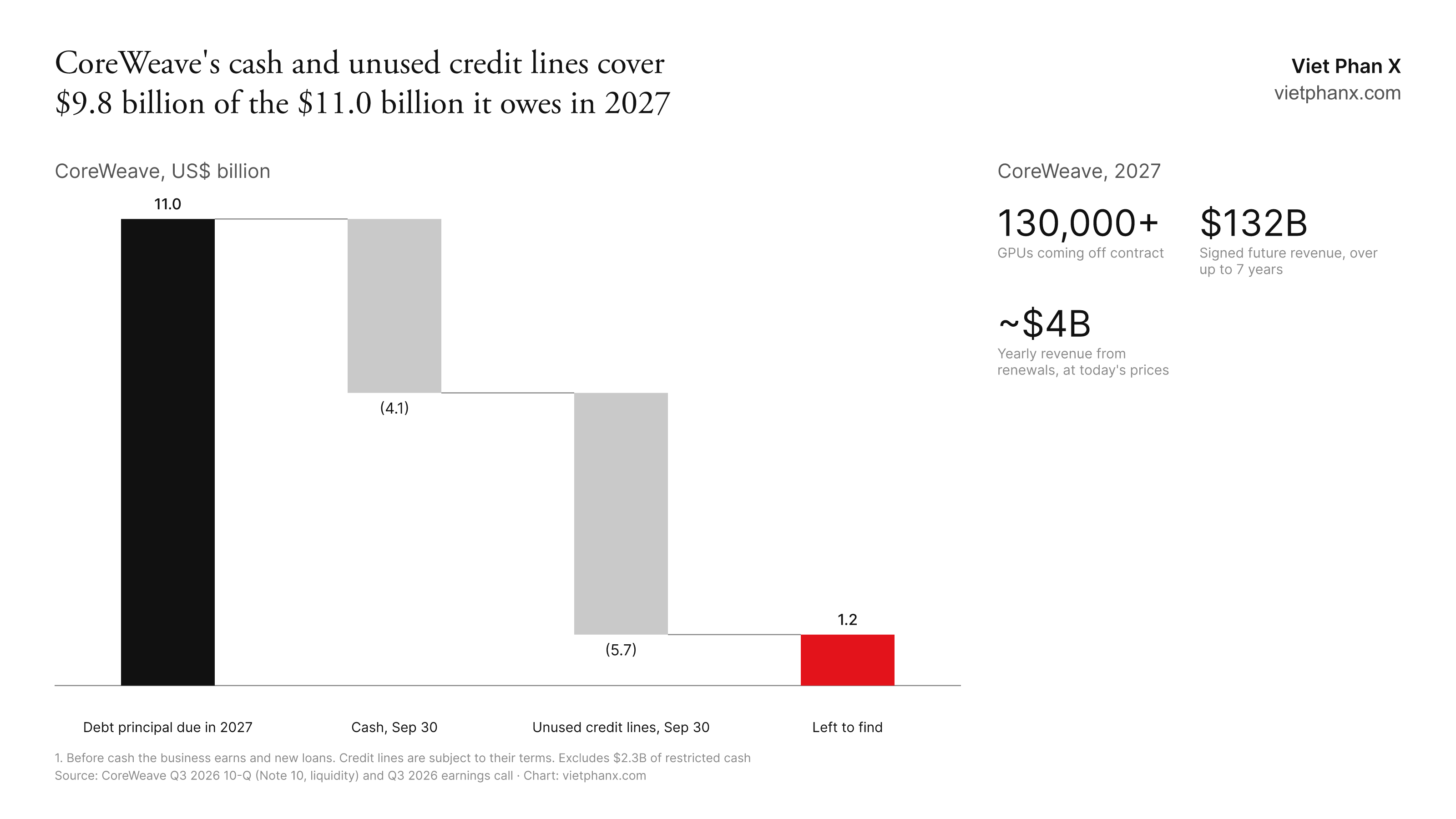
CoreWeave owes $11.0 billion of debt in 2027.
At the end of September, it had $4.1 billion in cash and $5.7 billion of credit lines it hadn't used yet. Together that's $9.8 billion.
The credit lines come with conditions of their own.
More than 130,000 of its GPUs also come off their customer contracts in 2027, and about 170,000 in 2028.
CoreWeave says renting them out again at today's prices could add nearly $4 billion a year. Older chips are renting for 30–50% more than a quarter ago.
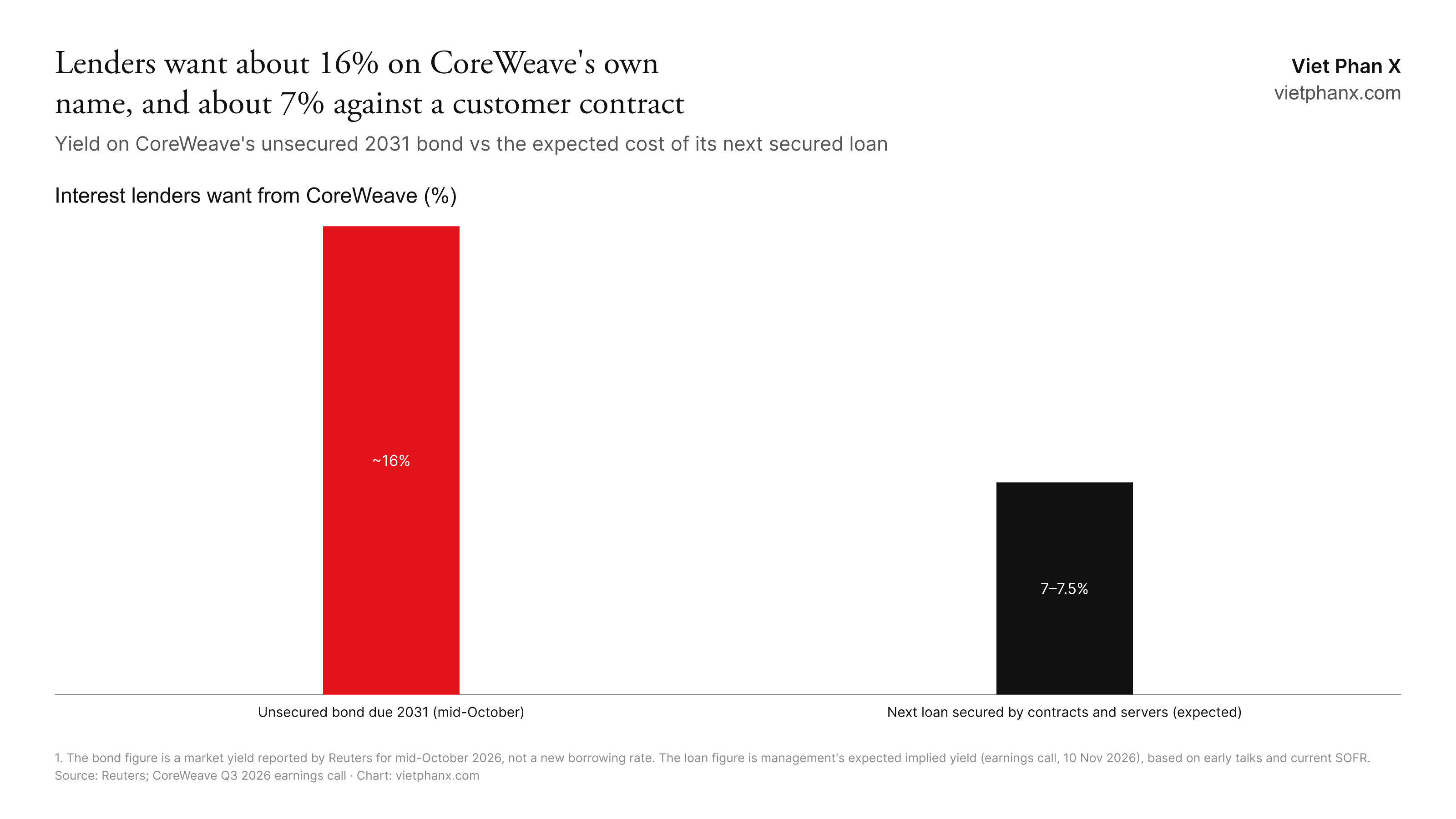
It has also said it won't borrow more on its own name through 2027 at current interest rates. Its new loans are backed by customer contracts instead.
If CoreWeave Can't Find the Money
So what happens if CoreWeave can't close the $1.2 billion gap, or can't get the next loan?
Two earlier busts show where the money, chips and contracts go: the fiber networks of 2001 to 2003 and the crypto miners of 2022 to 2023.
In both, the hardware kept running.
It changed owners.
For CoreWeave, the middle case over the two years after a failed refinancing looks like this.
About 205,000 GPUs are sold at a discount, roughly $3.1 billion of them, within a year.
The buyers are the big clouds, the AI labs and the neoclouds that can still borrow.
About $5.4 billion of customer contracts move to new operators within nine months.
Microsoft and OpenAI keep their capacity. Someone else runs it.
Lenders lose about $15 billion of what they're owed, and get back about $5.8 billion in cash.
Any Nvidia commitment to CoreWeave never takes effect. That money stays at Nvidia.
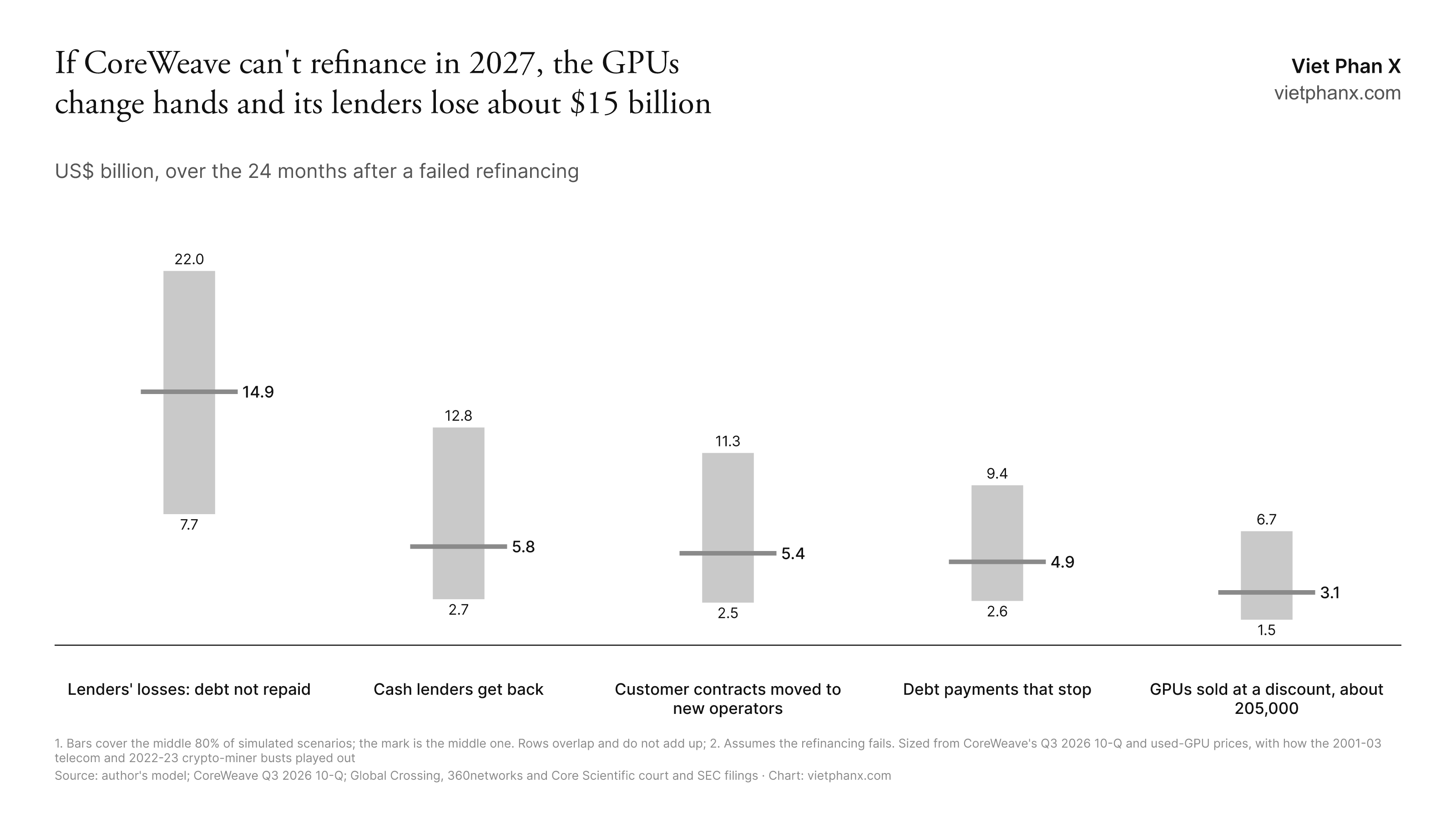
Each number sits inside a wide range. The lenders' loss runs from about $8 billion to $22 billion.
What Nvidia Has Signed
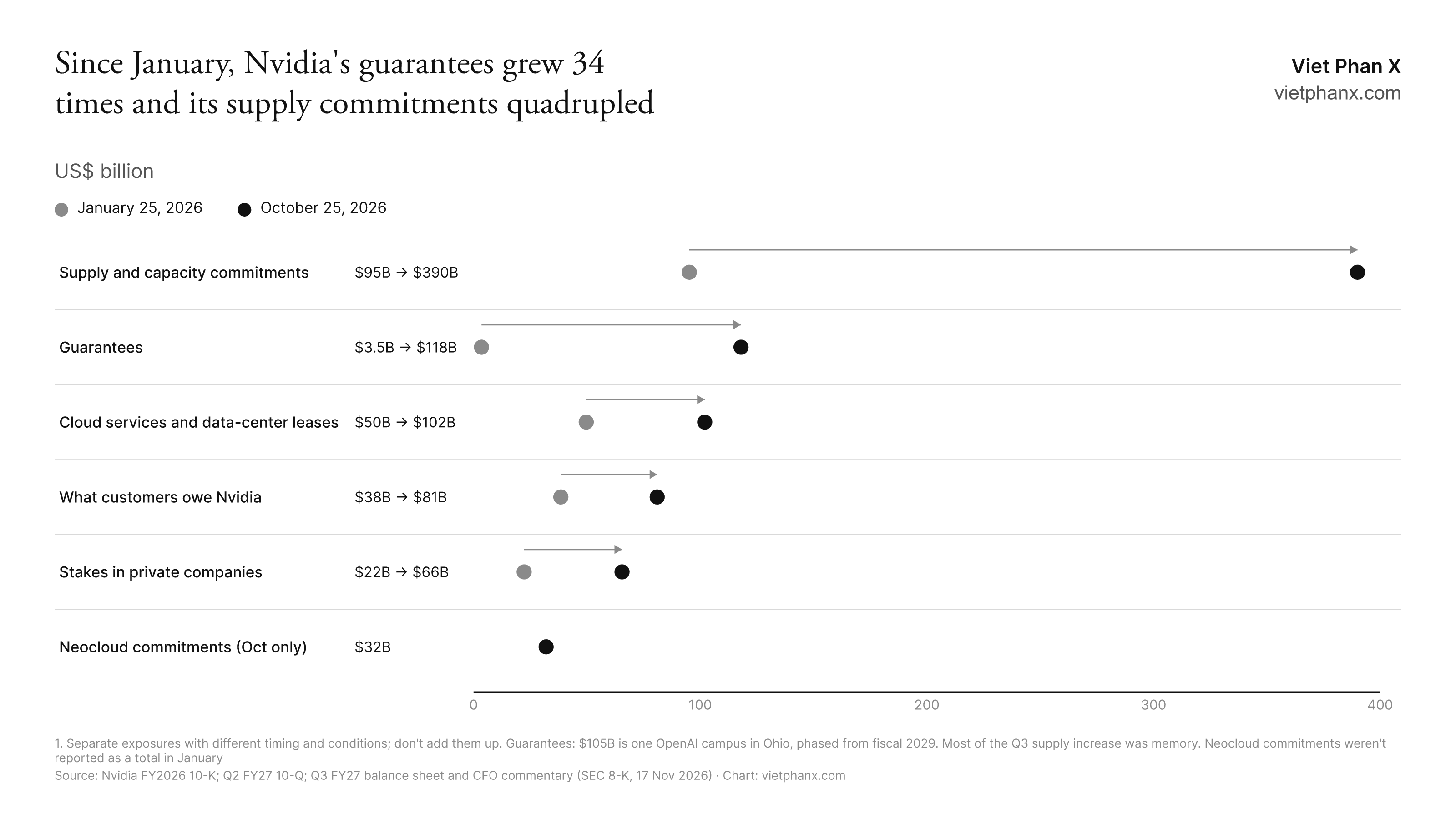
The neocloud agreements are the smallest of Nvidia's promises.
Since January, every one of them has grown.
- Supply and capacity it has agreed to buy: $95 billion in January, $390 billion now. Most of the latest jump was memory, bought years ahead.
- Guarantees: $3.5 billion, now $118 billion. $105 billion of it is for one OpenAI data-center campus in Ohio, built by SB Energy.
- Cloud services and data-center leases it has signed: $50 billion, now $102 billion.
- Stakes in private companies: $22 billion, now $66 billion.
- What customers owe it: $38 billion, now $81 billion.
Each has its own schedule, and some may never come due at all.
The Ohio guarantee starts building by building, the first in fiscal 2029. The July filing says it can end early if OpenAI earns a good enough credit rating.
The Forecast
I give 19% that CoreWeave, Crusoe or Lambda misses a debt payment by 30 days or more, or restructures its debt to avoid one, by December 31, 2027.
It settles on the company's own filings or statements, court records or a rating agency's default notice.
Wrong if none of the three does.
CoreWeave's $11.0 billion comes due over the same twelve months as the first $6 billion of Nvidia's neocloud commitments.

Copyright Viet Phan 2026. All rights reserved.Reuse this content
 Colette Kress, Nvidia's finance chief and, since last week, its interim CEO, said no.The CFO Behind Nvidia's Circular Financing Now Runs Nvidia7 min · 6 charts
 It has also said it won't borrow more on its own name through 2027 at current interest rates.CoreWeave's Two Prices for Money: 16% on Its Own Name, 7% on Its Customers'3 min · 3 charts